
Mirage
Turn your SaaS into a clickable demo in 90 seconds.
344 followers
Turn your SaaS into a clickable demo in 90 seconds.
344 followers
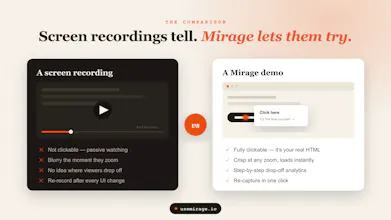
Most product demos are a 40MB video nobody finishes or a $500/mo tool no bootstrapper can justify. Mirage is the third option: capture your real app in one click, add guided hotspots, and publish a clickable demo you can embed anywhere in ~90 seconds. Track views, completions, and per step drop-off so you fix the leak instead of guessing. Perfect for landing pages, PH launches, and onboarding emails. First demo is free forever.
Free Options
Launch Team

Context.devAPI to scrape anything for AI, 20,000+ developers trust us.
Promoted


the per-step drop-off tracking plus frozen snapshots is a smart combo. when you republish after fixing a leaky step, does the old version stay reachable so you can compare drop-off before and after, or does the new capture just overwrite it and you lose that history?
@sabber_ahamed Not yet, but you can do that by creating two separate demos, one before the changes (duplicate one) and one after, then compare their analytics independently.
Congrats on the launch. That 'record a video nobody watches or pay $500/mo' framing is why I've had an empty demo slot on my own landing page for weeks. Since it captures the real running app: when I publish and embed it on a public page, does the demo replay the actual captured frames, or can I repoint those same steps at placeholder data before it goes live? Mostly thinking about what I'd want to swap out before it's out in the open.
@vollos Thank you, and that empty demo slot is exactly the itch I was scratching!
So yes, a published demo replays the actual captured frames, but those frames aren't locked. Each step is editable before you go live, so you can swap in a screenshot with placeholder or dummy data, blur or replace anything sensitive, and adjust the tooltip copy to match. Basically you capture the real running app to get the structure and flow, then clean up whatever you don't want public before you hit publish and embed. Nothing goes live that you haven't signed off on.
@anukarop Makes sense, thanks. On the swap though, when I drop a placeholder in for a step, does that replace the original capture or does the real-data frame still sit on your side? Mostly thinking about where the real stuff ends up once the public version's cleaned up.
@vollos Good question, Actually the swap actually replaces the frame in that step, and here's the important part: drafts live locally in your browser, nothing touches our servers until you hit publish. So when you publish, only the cleaned-up version gets uploaded. The real-data frame never leaves your machine unless you choose to publish it.
@anukarop That's the answer I was hoping for. Keeping drafts local so the real frames never become your liability is the right call, and it's the line I'd put on the landing page. Good luck with the launch.
"Clickable demo in 90 seconds" is a legit gap — every SaaS founder I know has a rough
Loom that dies of view-fatigue. How are you handling multi-step flows where the demo
diverges from the current UI (e.g., user changes button copy after recording)? Nice launch.
@chetan00118 Thank you, and yeah, the dying Loom is basically a founder rite of passage.
Honest answer: a Mirage demo is a captured snapshot, so it won't auto-sync when your live UI changes, but you don't have to redo the whole flow either. If you change button copy or tweak a screen, you can re-capture or swap just that one step, update the tooltip, and republish while the rest of the flow stays intact. So it's not live-mirroring magic, but small UI changes are a quick edit instead of a full re-record, and the per-step drop-off data usually tells you which steps are even worth refreshing.
90 seconds feels like a marketing number more than a real one - does that hold for a SaaS with a lot of conditional branches (different plans, permission-gated screens) or is that timing really just for a straightforward linear flow? genuinely curious where the limit is before you need to hand-edit the generated demo
@omri_ben_shoham1 Honestly, 90s is the clean linear case. Once you've got branches, plan tiers, or gated screens, yeah it takes a bit longer since you're grabbing more than one path. But the capture still does the boring heavy lifting for you, so what's left is just light stuff, fixing copy, reordering, swapping a screenshot. Even on a messy branchy SaaS that's a few minutes of tidying, not building it by hand. We do the bulk, you just tweak the last bit.
Congratulations on the launch! The per-step drop-off tracking is the part I'd like the most: knowing where people abandon a demo is more useful than raw view counts. One question: for a product with a longer multi-step flow, does the capture hold up well, or is it best kept to a few key screens? We're weighing something like this for our own launch.
@alieksia Thanks! And I agree, drop-off tells you much more than raw views. Mirage handles long flows just fine, there's no capture limit, but the analytics usually show that shorter demos perform better since that's where people stay engaged. I'd capture the full flow first, then trim it down to the key screens that help users understand the value as quickly as possible. Perfect for a launch.
@anukarop Thanks for the detailed answer. Makes sense - capture everything, then cut to what shows the value fastest. That's a useful rule of thumb well beyond demos.
@alieksia Honestly you should try building one in Mirage sometime; curious what you'd make with it!
Great launch! The editor looks simple enough for founders to use directly, but I can also imagine marketing and product teams working on the same demo. Are collaboration features such as comments, approvals, or shared editing currently planned?
@nico_mandera Thanks! We intentionally kept it simple so creating a demo takes as little time as possible.
As for the collaboration feature, it's already on our roadmap and will be included in one of our upcoming releases.
This solves a painful problem.
Do you think interactive demos eventually become part of every product's sales funnel, or will they stay most valuable for complex B2B software?
@aryan787544 Absolutely! Mirage is primarily built for solo founders and indie developers, which is why it's priced to be affordable. For larger B2B teams, we have a separate Scale plan with team workspaces, collaboration, and everything needed to use Mirage across an organization.