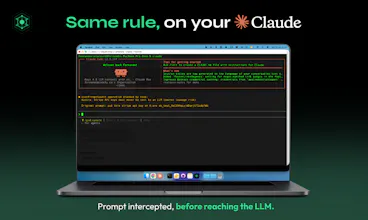
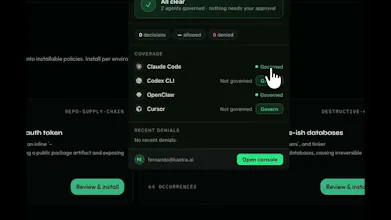
Kastra is the runtime authorization layer for AI agents. It decides what agents can and cannot do before actions execute, enforcing policies with sub-1 ms latency across tools, prompts, inputs, and outputs. Use one control plane to govern agents and policies across Claude Code, Cursor, Codex, OpenClaw, the Anthropic SDK, the OpenAI SDK, and more. Prevent unauthorized tool use, prompt injection, and exposure of sensitive data before they become incidents. Trust the rules, not the agents.
@charlos_brat Appreciate that! That’s exactly the shift we believe needs to happen. Observability tells you what already happened. Authorization decides what is allowed to happen before the action executes.
@charlos_brat Exactly! And the nicest part is it isn't either/or. Every decision Kastra makes before an action runs is written to a tamper-evident, per-tenant hash-chained decision log, so the "audit after the fact" is just the other face of governing before it. And because it's chained, you can prove nothing was altered or dropped. There's a chain-verification API an auditor runs, not a log file you take on faith.
@petrkovacik Thanks! Pretty granular. Policies can evaluate prompts, models, users, tool calls, shell commands, file paths, Git operations, databases, APIs, environment, secrets, and even the arguments passed to each action. You can allow, deny, or require approval based on any combination of those. It's up to your creativity.
Report
I like that this doesn't ask me to trust the agent's judgment at all, it just checks the action against a rule before anything happens. That's the right mental model. Most of the "AI safety" tooling I've evaluated this year still leans on the model behaving well, which never sat right with me.
@thomas_jack3 Very accurate! We learned this by testing the product with some of the top enterprises pushing AI products into production. We realized autonomous AI products required a new infra layer and we built Kastra to solve the trust problem in a scalable way.
Report
Really interesting approach to AI security. Instead of monitoring after something happens, preventing risky actions before execution feels like the right direction.
@1mirul exactly! The primary goal is to deterministically stop things before they happen. The monitoring and logs are a natural byproduct, since we're already intercepting every request anyway.
@1mirul Thanks! That's exactly how we think about it. Monitoring is valuable, but once an action has already happened, you're often in incident response mode. We wanted to give developers a deterministic decision point before execution, so they can safely delegate more work to AI without giving up control.
Report
Finally something that treats agent permissions like a real problem. The sub-1ms latency claim seems legit - I didn't notice any lag in tool calls when I tested it with Claude Code.
@baharyakupbcr2 Awesome Bahar, glad you had a good experience! Keeping the AI flow fast was a concern for us since day one. Every decision was made around adding this security layer without hurting performance.
Report
Runtime authorization for coding agents is something I didnt know I needed till now. Using OpenClaw quite a bit and the permission layer is always something I have to handle manually. Nice solve
@abdurrahman_fakhrul Amazing, glad we could provide value to your use case. Try to run a Recon scan and share your findings with us here if you are open!
Governing agents before they act instead of auditing after the fact is the shift I've been hoping for.
Kastra
Kastra
@charlos_brat Exactly! And the nicest part is it isn't either/or. Every decision Kastra makes before an action runs is written to a tamper-evident, per-tenant hash-chained decision log, so the "audit after the fact" is just the other face of governing before it. And because it's chained, you can prove nothing was altered or dropped. There's a chain-verification API an auditor runs, not a log file you take on faith.
Macaly
runtime authz is exactly the missing peice for agents 🔥 how granular do the policies get?
Kastra
@petrkovacik Thanks! Pretty granular. Policies can evaluate prompts, models, users, tool calls, shell commands, file paths, Git operations, databases, APIs, environment, secrets, and even the arguments passed to each action. You can allow, deny, or require approval based on any combination of those. It's up to your creativity.
I like that this doesn't ask me to trust the agent's judgment at all, it just checks the action against a rule before anything happens. That's the right mental model. Most of the "AI safety" tooling I've evaluated this year still leans on the model behaving well, which never sat right with me.
Kastra
@thomas_jack3 Very accurate! We learned this by testing the product with some of the top enterprises pushing AI products into production. We realized autonomous AI products required a new infra layer and we built Kastra to solve the trust problem in a scalable way.
Kastra
@1mirul exactly! The primary goal is to deterministically stop things before they happen. The monitoring and logs are a natural byproduct, since we're already intercepting every request anyway.
Kastra
@1mirul Thanks! That's exactly how we think about it. Monitoring is valuable, but once an action has already happened, you're often in incident response mode. We wanted to give developers a deterministic decision point before execution, so they can safely delegate more work to AI without giving up control.
Finally something that treats agent permissions like a real problem. The sub-1ms latency claim seems legit - I didn't notice any lag in tool calls when I tested it with Claude Code.
Kastra
Kastra
@baharyakupbcr2 Awesome Bahar, glad you had a good experience! Keeping the AI flow fast was a concern for us since day one. Every decision was made around adding this security layer without hurting performance.
Runtime authorization for coding agents is something I didnt know I needed till now. Using OpenClaw quite a bit and the permission layer is always something I have to handle manually. Nice solve
Kastra
CheckYa
The integrations with tools like Cursor and Claude Code caught my attention. Looking forward to testing this in a real workflow.
Kastra
@monir_ We hope you enjoy it! Thank you for the support! 🙏