
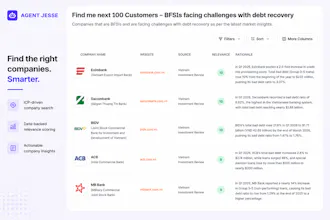
Sales teams have been stuck with stale databases for 15 years. Jesse changes everything.. the first internet-wide search engine built for sales & marketing. Ask in plain English: "Find newly opened soccer facilities in the Midwest needing turf solutions." Jesse scans the live web and finds the right buyers in the market today. We are an anti database company, we don’t scrape and store stale databases and sell them at premium. Every lead is found fresh from the live internet and delivered.



Free Options
Launch Team / Built With


Framer AI AgentsDesign and publish professional sites with AI
Promoted


@karthik_balaji1 Great question, and the wording is intentionally precise.
When we say "live internet without scraping," we mean:
We do not scrape the web once and store it in a database that goes stale.
We do not run batch crawls and then sell you that snapshot.
Instead, we run grounded web research at query time:
When you run a search, the agent goes out to public sources right then (LinkedIn posts, company sites, news, funding announcements, hiring pages, forums).
It reasons over what is currently there and returns results + the actual source link for each signal.
So "found fresh" = fresh at the moment you search, not fresh from a pre-built list. The caveat is the same as before: freshness is bounded by what has actually gone public. If a role change or funding round hasn't hit the web yet, we won't invent it.
@karthik_balaji1
Fair point, and you are right to poke at the wording. Let me be precise, because as an Apollo and Clay user you will see through anything fuzzy.
What we do not do is run our own crawler that bulk-collects contacts ahead of time and warehouses them in a database of our own. That stockpile is exactly what goes stale, and it is the Apollo and Clay model.
What we do, at the moment you search, is run live web searches and read the current pages and results that come back, and the model extracts and structures the leads from that. So the data is fetched and read at query time, not served from a pile we built weeks ago.
Honest nuance, since you asked: yes, this reads live web content, and yes it rides on web search infrastructure, an index that is itself continuously refreshed.
So "no scraping" means we do not pre-scrape into our own database, not that no page is ever read. The freshness ceiling is whatever live web search currently surfaces, which for active sources is close to now, with no snapshot of ours sitting in the middle going stale
How do you verify the data that is pulled is verified / correct?
@sandeepdinesh
A few layers, and I will be honest about where it ends.
Nothing is generated from thin air, every result is grounded in real public sources and ships with a rationale and the source link, so it is auditable, not a guess.
We weight trusted, verified portals like LinkedIn above weaker ones, so stronger signals win, and this confidence shows in the relevance score
A thin or single-source leads rank low rather than being passed off as solid.
Contact details like email get a separate verification pass with a status on each.
Honest boundary:
We do not fact-check the whole world. If a reputable source is itself wrong, that can carry through, which is why we attach the source to every result, so you can confirm in one click and additionally the relevance score tells you which results are even worth double-checking
@amitkumar0331
Thanks.
Yes, through MCP, with Claude Desktop, Claude Code, Cursor, and the API, connected via your Jesse API key.
The MCP access is in request-only beta right now, not open yet, and goes fully public in a couple of days.
DM me and I will get you in early.
One caveat: the claude.ai web connector panel needs OAuth rather than a pasted key, so that exact surface is not live yet. It shall be live in a couple of days as well.
This is such a cool product! Clay was super hard for me to use.
Is there a free trial to get started?
@kalpesh_bhalekar1 Thanks for the support. Yes, we have provided a free trial to all our customers to try out Jesse. Even then, after we start with base plans at just $5/month, they can go up to $100 according to your requirements and needs.
This is interesting. Do you cache results at all, or does every search query the live web fresh?
@dhiraj_patel5
Thanks Dhiraj.
Every search hits the live web fresh, no cache serves an old answer to a new query, so re-running a prompt researches again rather than replaying.
We do save a completed search's results so you can reopen, paginate, and export them, but that is storing a finished run, not caching the web.
Congrats on the launch Sudipta & team! Looks very cool. How do you determine that an email is "verified"? Also is there an API integration as well?
@rajoshi_ghosh
Thanks Rajoshi.
On verified emails: the email comes through our enrichment step, and each one carries a status from a deliverability check. So "verified" means it passed validation as a real, deliverable mailbox, not just a pattern-guessed address. We surface that status per contact, so you can see and filter verified versus inferred rather than trusting them all equally.
On API: yes. Everything runs on a Jesse API key, it is what powers our n8n integration (live in the n8n gallery now) and an MCP server for AI clients. Direct API and MCP access is in request-only beta right now and goes fully public in a couple of days. DM me and I will get you a key early.
@shimon_fogelson Good question, and yes - we do both discovery and verification from public sources, not a stale database.
For discovery, we look at company websites, LinkedIn posts, news, funding announcements, hiring pages, and niche directories/marketplaces when relevant.
For verification, we rank sources by reliability and recency, attach the actual source link so you can trace every lead, and for contact-level checks we apply multi-step validation (syntax/domain checks) plus real-time email verification where available.
An honest caveat: freshness is bounded by what has gone public. If a detail hasn't hit the web yet, we won't invent it. When sources conflict, the newer, more reliable signal wins—and you always see the source trail.