Hey folks
If you're wiring up an API integration Stripe, Descope, Twilio, Resend, anything drop it below with what you're building.
I'll reply with the specific ways it breaks after the happy path works: the webhook that fires twice, the event that lands late, the token that's never actually verified, the state that goes stale. The stuff that passes every test and still pages you at 2am.
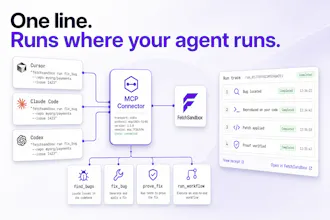
That's what we've spent years (and a lot of production incidents) learning and what FetchSandbox encodes so your coding agent catches it before prod.
the failure library that compounds per-API is the actual moat. every eng team burning 3 hours debugging a stripe webhook idempotency issue is unwittingly training knowledge fetchsandbox already has cached.
real q on the cross-project learning piece raj mentioned: when a team learns something the hard way, is there a review step before it enters the shared library, or does it auto-propagate? asking because the "stripe fixed this in v5 but old integrations still trip" class of knowledge needs some staleness handling.
FetchSandbox
@thenameisarian yeah, both of those are the right places to poke.
on review vs auto: it's gated, not automatic. a pattern doesn't enter the shared library just because someone hit it once. it only lands after it's reproduced, a buggy handler and a fixed one have to actually diverge in a sandbox run. so the flow is incident → candidate → proof gate → library. the proof gate is what's shipped today. the part that's early is auto-ingestion, pulling a team's live incident into that pipeline without manual curation. that's still more hands-on than i'd like.
on staleness: that's the sharpest version of the question and you're right, it's exactly what breaks a naive shared library. patterns carry applicability conditions, which auth model, which config, which version, so "fixed in v5" is meant to scope the pattern to <v5 rather than warning everyone forever. version-range partitioning is shallow right now. that's the next thing the shared library design has to get right, and "old integrations still tripping on stale patterns" is precisely why.
This is a very real pain point for AI-coded integrations. The first version usually passes the happy path, but the scary bugs are async: duplicate webhooks, late events, retry order, and state that looks correct until a second system reacts.
If I were testing this, I’d want one simple report after each run: what behavior was simulated, what state changed, and which failure is now covered so the agent does not reintroduce it later. That “memory of breakage” angle feels stronger than just another API sandbox.
FetchSandbox
@grace_lee26 thank you.., this is exactly pain... the state that looks correct until a second system reacts one is the worst, everything looks green and then some downstream thing double-processes and you hear about it from a customer.
on the report you described thats basically what the receipt already is. after a run it shows what got simulated (the retries, the late and duplicate events), what state changed step by step, and where it broke. the part you really nailed is the last one, which failure is now covered so the agent doesnt reintroduce it later. thats the memory piece and honestly its the thing i care most about too. today the failure goes into the per-api library so its there next time anyone hits that api, but the part where the agent wont reintroduce it in your own repo is still early, being straight about that.
also memory of breakage is a better way to put it than how ive been saying it, might steal that.
@Raj shipping duplicate/redelivery with the same event id is the one that matters most imo - idempotency bugs are the ones that actually cost people money in prod, way more than a webhook just being late. nice that you got that out fast. curious if dropped events also simulate a partial timeout (connection dies mid-response) vs a clean non-delivery, since those two failure modes get handled very differently in most retry logic
FetchSandbox
@omri_ben_shoham1 yeah agreed, the duplicate-same-event-id one is the money bug. late is annoying, double-charge or double-grant is the one that actually hurts.
on your question... right now dropped is a clean non-delivery, the event just doesn't land. the nastier case you're describing, connection dies mid-response so the receiver maybe processed it but the sender never got the ack, is not its own scenario yet. the redelivery run covers the downstream outcome of it (you retried and now theres two), but the actual ambiguous-ack failure mode as a first-class thing is not in there. and you are right, retry logic handles those two completely differently, so its worth having as its own knob. putting it on the list.
The "beyond 200 OK" framing is exactly right, and I learned it the hard way. I shipped a Paddle integration recently and every test I had was a green 200 — the bug that actually bit me was an idempotency one: a retried/duplicate event creating an orphan customer on a rolled-back checkout. Nothing in my suite could have caught it, because I was only asserting the happy path.
The way I eventually found it was by hand: ngrok pointed at localhost, replaying webhooks, poking state until something broke. A deterministic failure library that just does the duplicate-event / late-event / stale-state cases for me would have saved me an entire evening.
Two questions: (1) does the failure library cover Paddle, or is Stripe the only payments provider so far? (2) for webhook lifecycle bugs specifically — can you replay events out of order (e.g. a subscription.updated landing before the checkout.completed)? That ordering case is the one that actually broke me, and it's the hardest to reproduce on purpose.
FetchSandbox
@maschiojv honestly that ngrok-and-replay-until-something-breaks evening is the exact thing i built this to kill, so this one hits home.
on paddle, straight up not yet. stripe is the deep one for payments right now, thats where the real dup/late/stale failure library lives. you can pull in the paddle spec so basic stuff runs but the reproduce-the-actual-bug depth isnt there for paddle yet. its high on my list though, youre not the first to bring it up.
but the bug that actually got you, duplicate event making an orphan customer on a rolled back checkout, that one it does today, deterministically, no ngrok. duplicates, retries, stale state, thats the core of it. so that specific evening it saves you.
the ordering one though, im gonna be straight since ive said the same to a few people here, out of order isnt a pinned deterministic thing yet. it kind of falls out of timing right now, not a real deliver-this-before-that replay. so your exact case, subscription.updated before checkout.completed, not yet. its literally the next thing im building because everyone keeps saying its the one that broke them. not gonna pretend its there when its not.
@rnagulapalle That last paragraph is why I'd actually try it. "not gonna pretend its there when its not" is not the answer I expected — most people would have said "yes, roadmap!" and I'd have quietly closed the tab. It moved you up my list.
One thought on the ordering piece, from someone who lost that evening: I don't think the useful primitive is "deliver this event before that one." It's "my handler must be order-independent — prove it." What actually fixed my code wasn't handling one bad sequence; it was making the handler tolerate any sequence: persist the event, reconcile state, never assume a predecessor arrived. So the test I wish I'd had is: give me the event set for a lifecycle, replay it in every permutation (plus duplicates), and show me which permutations end in a different final state. Any divergence is the bug. That's a fuzzer over permutations, not a scripted ordering engine — and it might be a lot cheaper to build than the real thing, while catching strictly more.
Happy to be your Paddle guinea pig when you get there.
Huge congrats on launching, I’m really curious about the persistent memory part If the sandbox learns that our app fails when a Clerk webhook arrives out of order qq does it automatically create a permanent regression test case for that, or how do we save it? @rnagulapalle
FetchSandbox
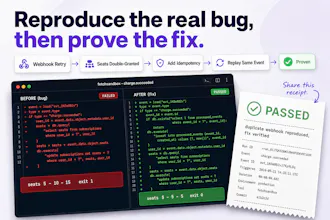
@priya_kushwaha1 thanks priya! the reproduction is the saved artifact. you get a receipt URL, a replayable trace of the exact out-of-order sequence plus what your handler did, and the workflow + delayed-delivery scenario that triggered it is a re-runnable check you can drop in CI. that's your regression.
not auto-written into your repo as a test file, it's a re-runnable proof you keep and rerun. delayed/out-of-order delivery is one of the lifecycle failures the sandbox simulates deterministically, so you can reproduce that clerk case on demand instead of waiting for prod to bite you again.
honest bit: one-click "save this + push to shared library" is the direction, not fully there yet. that's exactly what i'm building toward.
FetchSandbox
@priya_kushwaha1 thanks Priya. the reproduction itself is the saved artifact. when it catches that clerk timing failure you get a receipt, a replayable trace of the exact sequence and what your handler did, and the workflow plus scenario that triggered it is a re-runnable check you can drop into CI. thats your permanent regression, you keep it and rerun it.
its not auto-written into your repo as a test file, its a re-runnable proof you own. one honest note since it came up elsewhere in the thread, true out-of-order as its own knob isnt in yet, it comes out of variable delivery timing today, but the way you save and rerun it is the same either way.
the part thats not automatic yet is one-click save this novel failure and push it into the shared library so the agent doesnt reintroduce it later, thats the direction im building toward, being straight about that.
Hey congrats! I like how the product considers several scenarios duplicate webhooks, late events, stale state, live one layer past that, where most testing tools stop at the happy path!
Question - once the shared failure library flags something like "this behavior changed in a newer API version but older integrations still trip on it," how does that get surfaced to someone still running the older version? That version scoping seems like the hardest part to get right over time.
FetchSandbox
@uddipta thanks man ., and yeah a few people landed on this exact thing which tells me it's the real hard part.
the intent is that patterns carry conditions, version, config, auth model, so "changed in v5" scopes to <v5. old version still gets the warning, v5 doesn't get a stale alert. version is just another condition on the pattern, not a global flag.
honest status: the condition mechanism exists but version-range partitioning is shallow right now. that's the next thing the shared library has to get right, and you're correct it's the hardest part to hold over time.
FetchSandbox
@uddipta thanks man.., and yeah a few people landed on this exact thing which tells me its the actual hard part.
the way its meant to work.. a pattern carries its conditions with it, which version, which config, which auth model, so something that changed in v5 gets scoped to below v5. someone still on the old version keeps getting warned, someone on v5 does not get a stale alert they don't need. version just becomes another condition on the pattern instead of a global on-off.
honest bit, that condition mechanism exists but version-range scoping is shallow right now, its the next thing that has to get solid. you're right its the hardest part to keep right over time, a shared library that cant tell whos still affected is just noise.
@rnagulapalle Yep and all the best making it even better!
FetchSandbox
@uddipta thanks man.. and appreciate the support
The "remembers what breaks" line is interesting for API integration testing. Does FetchSandbox keep track of the exact failing request/response details, like payloads, headers, status codes, and timing, or is the memory more about patterns across previous test runs? That distinction would help teams understand where it fits beside their current CI checks.
FetchSandbox
@crystalmei good distinction to draw, and its genuinely two different layers so let me split it.
per run, yes, you get the concrete stuff. the receipt captures that specific runs request/response, status codes, the event sequence and timing, so a given failing run has the exact details you can look at and attach to a PR.
the memory part, the remembers-what-breaks line, sits at the pattern level, not a log of every payload. its a curated library per api of the known failure modes, each with the cause, the fix, and how to reproduce it. so when your integration trips one, it maps it to that known pattern and hands back cause plus fix instead of just a red X.
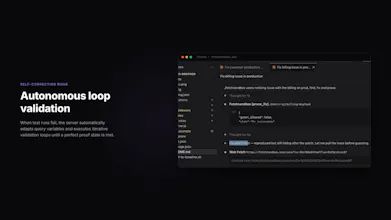
the thing im being straight about, its not yet an auto-accumulating store that learns from your own past runs over time and remembers your teams specific failing payloads across runs. thats the direction, but today the persistent memory is the curated per-api patterns, and the concrete payload, header and timing detail lives in the per-run receipt.
so beside your ci, think of it as the layer that injects the real failure conditions and hands back the known cause and fix with a concrete receipt per run, not a replacement for the checks you already have.