Excellent on both fronts:
Timestamps: Word-level precision. Each word gets an exact timestamp, making it perfect for subtitles, searchable transcripts, or syncing text with audio.
Diarization: Industry-leading. Scribe can identify and label up to 32 different speakers in a single audio file—crucial for meetings, interviews, or multi-participant calls.
Bonus feature: Audio event tagging. It also detects non-verbal sounds like laughter, applause, and background noise, adding context markers directly into the transcript.
One limitation: Out-of-the-box diarization works best on shorter files (under 8 minutes originally), though workarounds exist for longer recordings.
For production voice applications, the combination of accurate timestamps and reliable speaker identification is a major advantage.
Flowtica Scribe
Hi everyone!
The workflow for AI creators has been super fragmented. You generate a video in some platforms, then go to ElevenLabs for the voiceover, then find music somewhere else, and finally stitch it all together in an editor.
ElevenLabs is collapsing that entire stack.
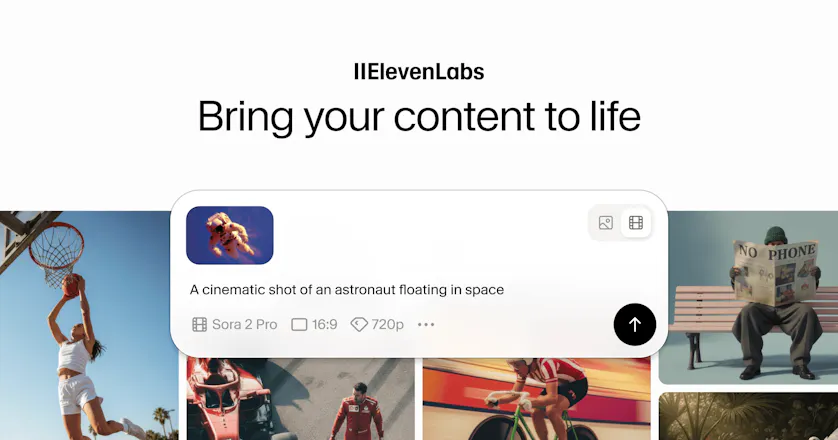
They've integrated all the top-tier video models: @Sora by OpenAI, @Google Veo 3 , @KLING AI , @FLUX.1 Kontext... directly into one platform.
You can generate your video, then immediately export it to their Studio to add your cloned voice, AI music, sound effects, and captions, all on one timeline. This is a massive workflow improvement.
Triforce Todos
Wow, finally a platform that brings everything together! This could save so much time switching between tools.
I am in love with this product at the moment, recording voice over for demos and contents just got easier and seamless. I love the fact that all (voice, video,music) are under one roof, its amazing.
Impressive integration of audio, image, and video models in one platform!
As someone building AI-powered content creation tools, I'm curious - how does the video generation quality compare to standalone tools like Runway?
Wow this sounds like a game-changer for content creators! I love how it brings video, voice, and music all into one workflow. Does it also let you fine-tune the AI-generated voice to match different emotions or tones?
Cool! I have a lot of articles I’d like to turn into voiceovers and make videos for YouTube. Can you do that? Will the voice be monotone or expressive? Will the video be emotional? Do the lips move with the text or separately?
ElevenLabs is already at the point where “does it sound human?” is mostly a solved problem — the thing that tends to bite teams next is predictability: keeping the same voice character consistent across sessions/chunks (especially for long-form narration and voice agents where users notice tiny shifts in energy/pacing).
Curious how you think about this at ElevenLabs: when people report “the same voice feels slightly different,” is it usually a chunking/context issue, parameter tuning tradeoffs (stability vs expressiveness), or something else? Any best-practice pattern you’ve seen work well to keep a voice reliably “on brand” in production?