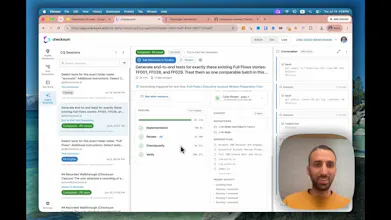
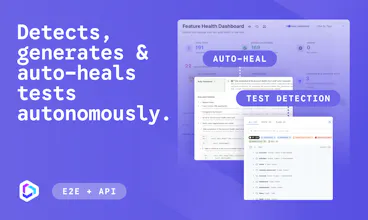
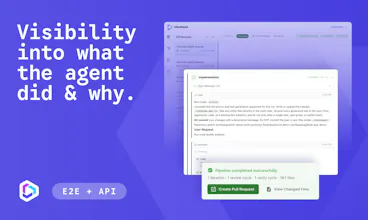
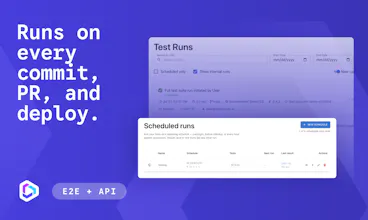
Checksum is an AI-native continuous testing platform for engineering teams shipping faster than manual QA can keep up. It generates, runs, and auto-heals end-to-end and API tests on every pull request, all as standard Playwright code in your own repo. When a test fails, Checksum tells you whether it found a real bug or a stale test, then fixes the false failures so your suite keeps pace with your coding agents.


Bababot
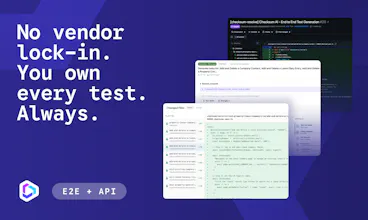
I like the idea of keeping everything as normal Playwright tests. makes adopation much easier for an existing engineering team.
Checksum AI
@adams_parker Exactly! Your test is yours whether you stay with Checksum or not.
As a marketer, I'm just here to say that I love your tagline ☺️ it makes a pretty intimidating category feel approachable. Congrats on the launch!
Checksum AI
@ryanwrites Thank you, that means a lot coming from another marketer! We wanted to convey that this is a solvable problem, and you've got real backup, not another intimidating tool to manage on your own. Really glad it's landing that way. 🙌
@michelle_dailey You nailed it. Well done!!
Checksum AI
I work at checksum so grain of salt, but my take:
What surprised me: I came in assuming the hard problem was generating tests. It isn't — models will write plausible-looking tests all day. The hard problem is that "plausible" and "green" are both terrible proxies for "actually proves the feature works." A big part of my job turned out to be making the system distrust its own passing tests.
The moment that sold me: a test broke after a routine frontend change, and the obvious move — the one every human on every team makes ten times a week — was to update the assertion to match the new behavior and get back to green. The agent refused. It walked the diff, decided the new behavior wasn't an intentional change but a regression, and filed it as a product bug instead of "fixing" the test. It was right. A human reviewer would have rubber-stamped the assertion update, the suite would have gone green, and the bug would have shipped with a passing test standing guard over it.
Why verification is the unglamorous problem: when it works, nothing visible happens. There's no demo moment for "this green check is real." So everyone builds the flashy generation demo and quietly ships suites that decay into checkmarks nobody trusts. But an untrusted suite is worse than no suite — you keep paying the maintenance cost and get none of the confidence. Solving that is the actual product, and it's the part nobody wants to put on stage.
Checksum AI
@daniel_harkin Thanks for sharing!
Lancepilot
Checksum AI
@odeth_negapatan1 Good question! We've seen teams measure a few different things depending on their priorities. First, cost per outcome: automated triage runs at roughly $10 per failing test resolved vs. around $78 for fully manual handling. Next is time reclaimed: Söderberg & Partners get back about 90 hours of manual testing a month once their suite was fully automated. And finally speed: Postilize saw engineering cycles get 30% faster alongside a 70% drop in bugs, since less time goes to figuring out whether a red test is a real problem or noise.
I'd say that most teams end up tracking a mix of "hours not spent on maintenance" and "time-to-ship," since the ROI shows up in both places at once, not just one.
Checksum AI
@odeth_negapatan1 And thank you for the congrats and questions!
Wion - Audio Dating
This is one of those problems that becomes more important as AI-assisted development becomes the norm. More generated code means more surface area to validate. Excited to see how Checksum AI evolves!
Checksum AI
@tanjum Thanks, Tanjum! That's a clean way of putting it, more generated code really does mean more surface area to validate. Congrats on Wion, going to check it out.
Shape
This is a really interesting take on keeping AI-generated code testable. Auto-healing stale tests sounds especially useful as coding agents get faster.
Watch Something
@natcale Exactly!
The interesting part of AI coding isn't just generating more code—it's being confident that the code actually works. Anything that closes that verification gap has huge potential for modern engineering teams.
Watch Something
@1mirul Appreciate the comments!