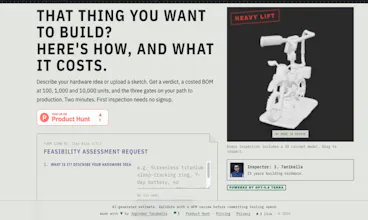
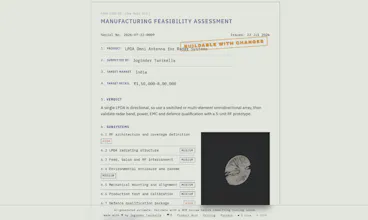
Have a hardware idea? Describe it in a sentence. You get back a verdict (Buildable / Buildable with changes / Heavy lift / Not viable), a bill of materials costed at 100, 1,000 and 10,000 units, subsystem risk ratings, certification gates for your market, and a 3D concept model. Two minutes, no signup. Criteria come from 23 years of hardware building. Running on GPT-5.6 Terra.
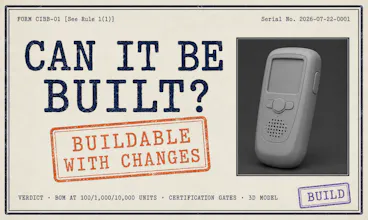
As an experienced hardware builder, 23 years commercialising products, I've started using AI models throughout my workflow. Frontier models can produce feasibility analysis if you push them, but not in a way you can easily take a call on building a product: getting a verdict, a BOM consistent across 100/1,000/10,000 units, subsystem risks, and market-specific certification gates took multiple passes, heavy prompting, and cost and latency that made a free public tool impractical. GPT-5.6 Terra changes the economics: it holds a strict verdict schema (Buildable / Buildable with changes / Heavy lift / Not viable) in a single fast pass, at a cost per report low enough to offer instant inspections to anyone, paired with a 3D concept model. canitbebuilt wraps that in verdict criteria encoding what I'd tell a founder across the table, and issues it as a certificate in about two minutes. Same intelligence, but fast and cheap enough to become a product. That's what wasn't practical before.
Hi Product Hunt, maker here.
After 23 years of building and commercialising hardware, there's one question, I get asked a lot: 'Can this be built?'
The honest answer is almost always yes. Ask me for a nuclear reactor and the answer is still yes. The real questions are how, in what form, at what cost, and whether the version that can be built is still the product you wanted. That gap between 'yes' and 'yes, but here's what it actually takes' is where most hardware ideas quietly get shelved.
Presenting canitbebuilt: describe your idea in a sentence, and in about two minutes you get a verdict (Buildable / Buildable with changes / Heavy lift / Not viable), a BOM costed at 100, 1,000 and 10,000 units, subsystem risk ratings, certification gates for your market, and a 3D concept model.
I built it solo and it runs on GPT-5.6 Terra, launching today, with the verdict criteria encoding what I'd tell you across the table.
First inspection requires no signup. Try your wildest idea, nuclear reactors welcome. I'll be in the comments all day, and I'd genuinely like to see what verdicts you get, especially the ones you disagree with.
The part I'd poke at is the 23 years of hardware experience baked into the criteria. That's one person's judgment calls turned into rules, and any two veteran hardware engineers will disagree on plenty of edge cases. What counts as buildable with changes versus heavy lift isn't really a formula, it's a judgment call, so I'm curious how much variance you've seen when real engineers push back on a verdict.
Also curious about the BOM costing itself. Component pricing and lead times shift all the time, especially for anything with connectivity or a battery in it. Does the 100, 1000, 10000 unit estimate refresh regularly, or is it more of a snapshot that could already be a bit stale by the time someone acts on it.
@thys_beesman Thank you for your comment. I wanted the reports to feel less like they came from a spreadsheet and more like they came from an experienced hardware engineer. So I used my 23 years of experience to shape the prompting and the evaluation rubric. The judgment isn't arbitrary, it's grounded in practical engineering gates. As more engineers challenge the reports, I'll keep refining that rubric.
@thys_beesman On the verdicts: you're right, there's judgment involved. My 23 years isn't deciding the answer, it's defining the engineering rubric. The tool checks concrete gates like custom silicon vs integration, manufacturing complexity, and certification requirements. Most engineers agree on those. Where opinions differ is usually because someone has already built that category before. The verdict is calibrated for a first-time team, and I should make that clearer. If an engineer disagrees, I'd genuinely like the report serial number because that's valuable calibration data.
On BOM costing: it's a directional estimate, not live pricing. The goal isn't to predict the exact BOM, but to show the right cost range and what's driving it. Prices for modules and batteries change, so these numbers are for go/no-go decisions, not procurement. Think of it as an experienced hardware engineer's first-pass estimate, with the reasoning shown.
the framing of 23 years of judgment encoded into a verdict is the interesting part to me. when it says Buildable, is there any confidence signal for ideas that fall outside your own experience base, or is every verdict presented with the same certainty regardless of how novel the idea is
@galdayan Thank you for your comment. If you say a Nuclear Power Reactor, it's going to show as Not Viable. :) So all are not having the same certainty.
a BOM generated from a text description is only as useful as how close it is to sourceable reality - part costs and availability swing wildly by region and by whether you're ordering 10 units vs 10,000. is the BOM pulling from live supplier/distributor pricing or is it more of a ballpark estimate based on typical component costs?
@omri_ben_shoham1 Thank you for your comment. Linking live supplier/distributor pricing would be a natural progression once there's some traction. Right now, it's a rough estimate and will vary based on quantity.
makes sense, rough-but-directional is still way more useful than nothing at the idea stage. quantity-based variance is probably the harder problem to solve for anyway since a single-unit BOM and a 500-unit BOM can point to completely different suppliers
@omri_ben_shoham1 Thank you. It's just to give a rough idea right now for people to get started. Plan to integrate supplier quotes in the next phase.
Report
Getting instant visibility on certification gates and subsystem risks before burning months on R&D is huge for hardware teams. How does it handle regional compliance differences when picking target markets?
canitbebuilt
canitbebuilt
@jogindertanikella Congratulations on the launch!!
canitbebuilt
@austinbuhl Thank you! :)
canitbebuilt
@thys_beesman Thank you for your comment. I wanted the reports to feel less like they came from a spreadsheet and more like they came from an experienced hardware engineer. So I used my 23 years of experience to shape the prompting and the evaluation rubric. The judgment isn't arbitrary, it's grounded in practical engineering gates. As more engineers challenge the reports, I'll keep refining that rubric.
canitbebuilt
@thys_beesman On the verdicts: you're right, there's judgment involved. My 23 years isn't deciding the answer, it's defining the engineering rubric. The tool checks concrete gates like custom silicon vs integration, manufacturing complexity, and certification requirements. Most engineers agree on those. Where opinions differ is usually because someone has already built that category before. The verdict is calibrated for a first-time team, and I should make that clearer. If an engineer disagrees, I'd genuinely like the report serial number because that's valuable calibration data.
On BOM costing: it's a directional estimate, not live pricing. The goal isn't to predict the exact BOM, but to show the right cost range and what's driving it. Prices for modules and batteries change, so these numbers are for go/no-go decisions, not procurement. Think of it as an experienced hardware engineer's first-pass estimate, with the reasoning shown.
Dial
the framing of 23 years of judgment encoded into a verdict is the interesting part to me. when it says Buildable, is there any confidence signal for ideas that fall outside your own experience base, or is every verdict presented with the same certainty regardless of how novel the idea is
canitbebuilt
@galdayan Thank you for your comment. If you say a Nuclear Power Reactor, it's going to show as Not Viable. :) So all are not having the same certainty.
Dial
a BOM generated from a text description is only as useful as how close it is to sourceable reality - part costs and availability swing wildly by region and by whether you're ordering 10 units vs 10,000. is the BOM pulling from live supplier/distributor pricing or is it more of a ballpark estimate based on typical component costs?
canitbebuilt
@omri_ben_shoham1 Thank you for your comment. Linking live supplier/distributor pricing would be a natural progression once there's some traction. Right now, it's a rough estimate and will vary based on quantity.
Dial
makes sense, rough-but-directional is still way more useful than nothing at the idea stage. quantity-based variance is probably the harder problem to solve for anyway since a single-unit BOM and a 500-unit BOM can point to completely different suppliers
canitbebuilt
@omri_ben_shoham1 Thank you. It's just to give a rough idea right now for people to get started. Plan to integrate supplier quotes in the next phase.