
akta.pro
Private company data and signals API for the agent economy
747 followers
Private company data and signals API for the agent economy
747 followers
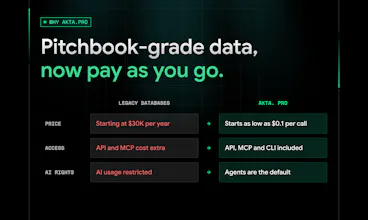
Private company data with 4x the depth and 2x the coverage of PitchBook, plus 100+ event signals and news across companies, industries, and topics. Source and diligence deals or make outreach lists and trigger outbound. Built for financial services and GTM teams, pay-as-you-go.




Launch Team / Built With


Viktor.comAn AI coworker that actually does the work
Promoted
@istiakahmad Thanks, and that was the reasoning. Resolving at capture rather than at query time is what lets every endpoint stay sync.
That matters if you're reasoning inside an agent loop or building a platform where someone is waiting. A data call that returns a job ID and asks you to poll compounds across every step of a run. So every API is sync, no job submission, no polling. The resolution work is already done by the time you ask.
@imtiaj_ahmad that's true. For so long high quality datasets were tied to large enterprise contracts, but that doesn't work for the agent economy. Our endeavor is to provide institutional grade data with consumption based business model to lower the barrier for entry for agent developers all over the world.
Congrats on shipping! Reliable private company data through a clean API is essential for autonomous AI agents to make real decisions. Simple, high-utility infrastructure for dev teams.
@thisiskp_ Thanks! Reliable is the word that matters most there, and in practice it comes down to schema and data consistency. Same shape every call, stable field names, nulls where data genuinely doesn't exist. That means you write the parsing logic once and it keeps working, instead of defensive handling around every field that might or might not show up.
Congratulations on the launch! Private-market data definitely needed something more developer-friendly for a while. Akta seems like a great solution.
@syed_shayanur_rahman Thanks. In most legacy private markets tools the API is an afterthought. Responses come back bulky, the structuring is off, and you end up writing a normalization layer before the data is usable.
MCP usually repeats the problem. What gets exposed is a subset of the API wrapped once and shipped, so you inherit every constraint of the original surface plus a few new ones.
We built the other way round. Structured JSON with deterministic schemas, full access across every offering rather than a curated slice, and rate limits set for how agents actually query. The MCP server and CLI are designed around real workflows, not mechanical wrappers over endpoints.
Would love to hear feedback on what is working and what is not