
akta.pro
Private company data and signals API for the agent economy
747 followers
Private company data and signals API for the agent economy
747 followers
Private company data with 4x the depth and 2x the coverage of PitchBook, plus 100+ event signals and news across companies, industries, and topics. Source and diligence deals or make outreach lists and trigger outbound. Built for financial services and GTM teams, pay-as-you-go.




Hey Product Hunt,
Sid here, co-founder at akta.pro. Private company data and signals API for agents, priced by consumption.
We were building AI agents for private markets and kept hitting the same two dead ends.
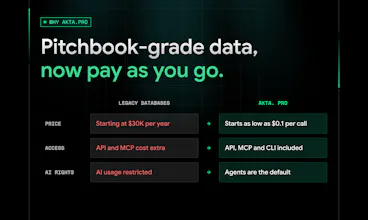
Legacy databases have company data, but they gate it behind a UI, charge by seat, carry no signal layer.
Search APIs return what ranks on SEO. Your agent burns tokens reading 100s of pages to find one event.
akta.pro gives an agent both sides, already structured.
Company data: 20M+ companies with 70+ fields, i.e., 2x coverage of PitchBook, 4x depth of ZoomInfo/Apollo.
Fundamentals: firmographics, management, funding history, investors, revenue and financial estimates.
The fields most databases skip: competitive moat, gtm motion, business model, tech stack, AI maturity.
News and signals: monitor a company, a sector, or a topic in plain language.
Feeds are de-duplicated, matched to the right company, and scored for impact and sentiment.
Tagged across 100+ event types like funding round, exec change, expansion etc., that work as triggers.
Alternative signals tied to the same company ID: headcount trends, web traffic, jobs, social posts, reviews.
On cost, company data runs 5x cheaper than legacy databases like PitchBook. News runs 10x cheaper than putting the same work through Claude or Parallel search APIs, where retrieval comes out of your token spend.
Used today by AI builders shipping agents, GTM teams triggering outbound, and investors screening startups.
Works as an API, over MCP, or CLI.
Try for free. Code PH50 gets you 50 credits: playground.akta.pro/signup/?coupon_code=PH50
If you have evaluated legacy databases, news or search API providers, or GTM intent data, I am happy to do a specific comparison in the comments.
Here all day, and the critical feedback is the useful kind.
@siddhant_masson you mentioned dropping 80% of noise before a response. how are you handling entity resolution upstream to match messy news feeds to the right 20M+ company IDs without blowing up latency?
@mohsinproduct Resolution isn't in the query path at all; tagging happens at capture.
At ingestion, we first use fast candidate-generation and filtering layers—names, aliases, domains, locations, industry/context signals, and our company graph to reduce 20M+ entities to a very small candidate set. Only then do semantic NLP and our in-house resolution models score and disambiguate those candidates. Confidence thresholds determine whether we accept the match or run additional resolution passes. The core algorithm is built in-house and patent pending.
This keeps resolution latency manageable even at feed scale. More importantly, resolution happens at capture, not in the query path. By request time, each article is already mapped to a company ID, so serving is essentially a lookup against a pre-resolved index.
That upstream resolution is also what lets us confidently remove ~80% of irrelevant feed noise. Our recent benchmarks show 93%+ entity-mapping accuracy, ahead of frontier reasoning models on the same task: akta.pro/benchmarks
@mohsinproduct Building on Sid's answer from the implementation side — the latency story comes down to what scales with corpus size and what doesn't. Candidate generation is an index lookup (roughly log-time / sublinear against 20M+), so growing the corpus barely moves that step. The expensive part — semantic disambiguation — only ever runs on the small fixed-size candidate set that lookup returns, never against the full index. So end-to-end resolution time stays effectively flat as we add companies: you're adding rows to the index, not adding work per query.
@siddhant_masson Many congratulations Siddhant, Shiv, Neeraj and team! 😊
When I first met Neeraj discussing the challenges of building AI agents for private-market research. What stood out immediately was how clearly they understood the gap: traditional databases lock valuable company data behind expensive interfaces, while search APIs often return too much noise and consume excessive tokens.
Akta pro brings both sides together through a structured API: deep private-company data across 20M+ companies, enriched with 100+ real-time signals covering funding, hiring, leadership changes, partnerships, expansion, and more.
I’m endorsing it because the team has focused on the details that matter: clean entity resolution, deduplicated data, relevant signals, and consumption-based pricing. It makes private-company research faster, more intelligent, and far more useful for building automated workflows.
It’s built for AI agents, investors, and GTM teams that need actionable intelligence. Definitely worth checking out if you’re working in AI, financial research, or B2B growth. :)
@rohanrecommends thanks Rohan. Its the entity resolution for private company that took us almost 1.5 years to crack (now patent pending). Getting that right changes the game.
@siddhant_masson congrats on the launch🙌 one question where do you pull the headcount trend data from? linkedin/github or aggregated payroll data?
@priya_kushwaha1 We get this from LinkedIn and few aggregated data sources
How often are company profiles updated? Private company data can change pretty quickly.
@yahya_rogers Good question - our refresh is field-aware and varies across 70+ fields.
Event-driven fields are updated real-time across thousands of publishers. Funding rounds, transactions and leadership changes get picked up by the real-time news pipeline as the event breaks, then reconciled onto the company profile
Alternative signals run closest to live. Job posts and web traffic are near real time. Headcount updates monthly, since it's only meaningful read as a trend rather than a point-in-time number
Stable firmographics like legal name, company type, founded year and industry codes run on verification cycles that are dynamically scheduled rather than fixed. How often a company gets re-checked depends on its size, news volume, website updates and overall activity, so the ones actually moving get looked at more often than the ones sitting still.
Happy to go deeper on any specific field if there's one you care about.
I enjoy seeing tools that improve private market research. I would ask how akta.pro manages global coverage since company information varies widely across regions and markets.
@darly_selby Fair question, and the short answer is that coverage varies by layer rather than by region. The 20M+ is genuinely global, not a US core with a thin tail attached. Fundamentals like firmographics, location and industry classification hold up across the board. And that's one of the advantages of having a purely agentic data extraction and synthesis
Transaction detail is where variation shows up. Funding and M&A depend on how actively a market reports, so it's really a long-tail effect rather than a regional one. A quiet company in the US looks much like a quiet company anywhere else.
The qualitative layer is the most consistent globally. Business model, moat, positioning and GTM motion come from how a company operates rather than what it chooses to disclose, so they don't depend on local reporting norms.
In fact, we also have a company addition endpoint, through which in the off chance that you don't find a company, you can add it live
@rukhsar_amjad Thanks! Pay-as-you-go is the default.
You top up a balance and spend credits per call, no monthly commitment, no seats, so cost scales purely with consumption. MCP and CLI access are included from this tier rather than gated behind an enterprise plan, so you can wire it into Claude, Cursor or your own agent from day one.
We also have Subscription and Enterprise tiers depending on usage and rate limit requirements, custom schemas, bulk export, etc.
Full comparison at akta.pro/pricing
Can users define their own triggers or signals based on the type of companies they’re tracking?
@dustin_warren Yes, that's the intended way to use it. Filtering happens at the query, so you define what counts as a signal rather than picking from preset alert types.
You can filter across a 70+ category news taxonomy, plus IAB and IPTC codes, and scope it to whatever set of companies you're tracking. So a fintech watchlist filtered to funding and leadership changes, and a separate one for competitors filtered to product launches, are just two different queries against the same endpoint rather than two different products.
Polling frequency is yours to set, and credits are only charged on news actually returned. Empty polls cost nothing, so you can run a tight loop on the things that matter without paying for quiet periods.
Webhooks for signal alerts are on the roadmap, which will remove the polling step entirely.
How do you handle companies with very limited public information?
@nuseir_yassin1 for such instances we rely on alternative data such as social media, blogs, podcasts etc. if there is limited information the company itself. We leverage a smart validation logic - if company has very limited public data, not all parameters are populated - only the one's which can be backed by sufficient data are populated while others are left out. Prioritizing accuracy and fidelity yet retaining good fill rates.
How granular are the sentiment and impact scores? Can developers access the underlying scoring fields through the API??
@zerotox yes, numeric scores on a scale of 0 to 1. Raw scores are available in the api response for developers to use.
@zerotox Adding to Sid's point, Both come back as continuous 0–1 floats in the raw response, not bucketed labels, so you set your own thresholds instead of inheriting ours. Impact and sentiment are scored separately — a layoff is high-impact and negative, a small partnership low-impact and positive — so they're pulled apart rather than collapsed into one good/bad number. Story centrality is a third field: whether the company is the subject or just mentioned, which is usually what you actually want to filter triggers on. All exposed, all filterable at query.