
Agently
Your whole stack, running itself!
601 followers
Your whole stack, running itself!
601 followers
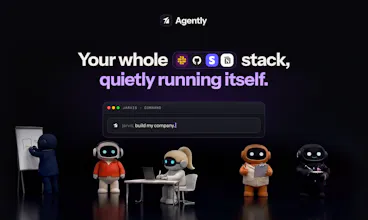
Every other tool answers, retrieves, or runs brittle rules. Agently holds your whole company in context and does the work. 100+ connectors flow into one brain that never forgets. It links a Stripe event to a Slack thread to a Linear ticket on its own. When something needs doing, Jarvis routes it to an agent that runs it end to end: triggered, running, shipped. The work lands without you, nothing falls through the cracks. Connecting takes minutes. The layer between today's AI and tomorrow's AGI.



Free
Launch Team / Built With


ShipifyAIAI agent that ships code for you or your dev team
Promoted


Congrats on the launch, Ahmad and Omar! The temporal-graph approach to memory is the right call. most "AI chief of staff" tools quietly break the moment two systems disagree. How do you handle the case where two integrations report conflicting facts at the exact same timestamp, does provenance alone decide, or is there a manual tie-breaker?
@renchu_songThank you 🙏 and you've found the exact edge most tools fake their way through. Our answer: a true tie is precisely when we refuse to auto-decide. Provenance is a signal, not a verdict, so when two sources genuinely collide at the same moment and neither is clearly authoritative, we don't silently pick a winner, we hold both as competing facts, flag the conflict and wait for more information to decide the winner.
It is worth noting that your interactions on the app get also logged into the brain, if the conflict comes up in a prompt and you happen to choose the right path for this specific issue, it also gets resolved in real time
I loved the video, does it work with BYOK or your own models ?
@bengeekly I hope someone would say that. This was a placeholder video, more of an Add, the actual video didn't end up done in time.
Honest answer: today it's managed. We run on a mix of models and keep the whole system tuned around them so it just works. That's on purpose and ties straight to the "agent is the commodity" idea, the model is the layer we think you shouldn't have to babysit, so we manage it and keep it current for you. The brain, the part that's actually your moat, is 100% yours.
We have had 290 teams use it in private betas, some of which also requested opening it up to both BYOK and self hosting. Mainly enterprise for the obvious reasons, happy to have a conversation around it. DM me
@bengeekly On the eng side: today it's managed, not BYOK. The reason is reliability, we tune the agent loop, prompt caching, and tool-use behavior around specific frontier models, and swapping in an arbitrary one changes how all of that behaves. We do have per-agent model selection internally (different jobs get different models), so the plumbing for choice already exists. BYOK and self-hosted are architecturally doable and a legit enterprise/on-prem ask, we just haven't exposed them yet, because we'd rather ship one stack that's rock-solid than a dozen that mostly work. If you've got a specific model or a data-residency constraint, happy to scope it with you.
This is clever. What does Jarvis do when it can't confidently route a task to any agent?
@dhiraj_patel5 The architecture does not allow for it. The subagents are spun up based of the task that needs to be done. Jarvis injects the context into them and details the role and desired objective.
@dhiraj_patel5 Routing always resolves, because Jarvis dynamically spins up a subagent for the task instead of matching against a static set, so "no agent fits" isn't a failure state. Confidence gating lives at the subagent's actions, not the routing, high-confidence reversible work runs, anything ambiguous or consequential routes back to you.
Congrats on shipping @omarships! How do you handle messy and keep growing context?
@nicklaunches Thanks 🙏
On messy: when signals are weak or conflicting, it degrades to asking, not guessing, so bad input never becomes a confident action.
On growing: connecting sources is table stakes, but every correction and decision you make gets encoded, so it keeps getting sharper long after your stack is wired up.
@nicklaunches Messy: we link on hard signals (shared IDs/domains), and when a match is weak we flag instead of forcing it.
Growing: as more episodes land, the graph's relationship density climbs and every human correction becomes a durable signal, so the curve bends up past "everything connected." It's not just more data, it's more resolved connections.
Hey Product Hunt 👋,
I'm Omar, founder of Agently.dev.
Here's the bet I'd stake the company on: one person should be able to run a whole company without being its memory, and a small team should ship like a big one. That only happens if the agent stops being the product. The agent is the commodity. The brain is the product.
Most agents are stateless: grab data, do a task, forget. Fancy macros. Ours runs on a persistent, entity-resolved model of your whole company, what each thing is, why it matters, when it's relevant, how it connects, across every tool, never forgetting. A living graph, not a chat history, so work lands instead of waiting on you.
Jarvis reads that brain, decides what needs doing, and dispatches event-triggered agents that act back through 100+ two-way connectors, so the work closes instead of piling on you: triggered, running, shipped. Real artifacts, not summaries. The hard part everyone stops at is keeping that model live, correct, and safe to write back through.
It compounds. Months in, your brain knows your company in a way even your co-founder cant, and you come off the critical path. That's the moat.
The teams already running on it go from solo founders to enterprises. This is where work is going. Become part of the future. 🧠
@omarships Looks super cool. Will give it a try!
@hrishio Looking forward to your feedback. In our vibe building era
@omarships Super excited for this launch. First company of its kind
Curious to know how it will manage all of our marketing KPIs and initiatives.
We are looking to build an AI VP of marketing for our team which sits in our team discussions
@sohraab_joshi1 love this, an AI VP of Marketing is exactly the shape Agently is built for. The way it comes together: your marketing context lives in the brain, goals, campaigns, analytics, what's worked and what hasn't, so the agent reasons from your actual numbers, not vibes. It tracks your KPIs across every conversation, tool and app against your own targets, flags what's slipping, proposes the next initiative, and drafts the work, then waits for your sign-off before anything ships. And because it lives where your team already talks, it's a participant, not one more dashboard to go check.
You can book a call with me and well get you set up
@omarships Yes let's chat, where can I find a book meeting link?
@sohraab_joshi1 on our website, booking button in the hero section
Hey Product Hunt 👋, I'm Ahmad,
Co-founder and CTO of Agently.dev
Here's what nobody warns you about when you build agents: entity resolution. The same customer shows up in Stripe, Slack, and Linear under three different names, and if your model of the company gets that wrong, everything downstream is wrong too. Agent demos are easy now. The hard part is what the agent knows.
We spent most of 8 months there: one living automated temporal knowledge graph of the whole company, kept correct enough that agents can safely write back through it. Our 100+ connectors are two-way, so agents don't just read your tools, they act back in them. Jarvis reads that graph, decides what needs doing, and dispatches agents on what it sees, not prompt by prompt.
"Do I trust the write-back" was the first question every beta cohort asked. Fair question, and parts of this are still early.
Happy to go deep on architecture, entity resolution, how Jarvis dispatches, or write-back safety. Ask away. 🛠
@ahmadhajj Building a the future for founders!