
Rebel is a desktop AI workspace for agentic work. It connects your memory, meetings, files, actions, automations, and tools so AI agents can help with real work — while keeping sensitive actions behind approval checks. Built Fair Source, with portable workflows and model choice.




What's great
memory management (1)
I lead Business Systems and AI Enablement at a software company, and I've watched plenty of AI tools get installed and quietly abandoned. Rebel is one that stuck.
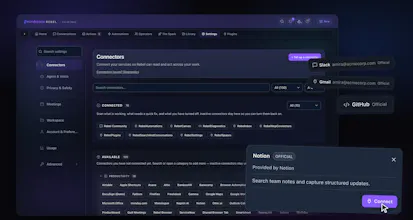
What sets it apart from a chat window is that it plugs into the actual work. It connects to all our SaaS apps with API or MCP access, then acts across them. One team has it pull from several systems every Monday and draft a leadership briefing, replacing an hour of manual system hopping. A product manager connected it to a live codebase and shipped a real UI change in under two hours. Our sales team is running roughly 30% more demos because Rebel handles most of the admin work in the CRM for them. None of this is staged. It's daily use.
Three things I rate:
Memory done right. It distinguishes what's private to me, what's for my team, and what's company wide, and stores things accordingly. That's the foundation of trust.
Automations and skills. You teach it a workflow once and it runs on a schedule, so the time savings compound.
Privacy by design with a real safety layer. It drafts rather than auto sends and asks before anything sensitive.
It's not flawless. Complex tasks take time, and it wants capable hardware. But the output quality makes the wait worth it.
If you want a chatbot, there are cheaper options. If you want an agent that lives inside your tools and does the work, this is the one I'd back.
What needs improvement
A few honest rough edges:
Speed. It's the most common gripe. For multi step agentic work the wait is justified, but for quick one shot questions it can feel slower than a plain chatbot. Snappier responses on simple tasks would close the gap.
Onboarding and discoverability. The capability surface is huge, and new users struggle to find what it can actually do. It rewards people who invest time learning it, but the first week is a climb. Better in product guidance would shorten that.
Cost control on simple tasks. It can spend a lot of model power on tasks that don't really need it, which drives the underlying AI cost up faster than you'd expect. Smarter matching of effort to task would keep spend in check.
vs Alternatives
 ChatGPT by OpenAI
 Gemini
 Claude by Anthropic
ChatGPT, Claude, and Gemini are excellent at responding, but you feed them context and copy the output back out. Rebel was the only one that lives inside the work rather than beside it. It routes to whatever model fits the task, so I'm not locked to one provider. It keeps memory with real privacy boundaries between what's mine, my team's, and the company's. And it gives me a governance and safety layer I can actually administer, which is what let me put it in front of the whole company. For quick one off drafting a raw chatbot is fine, but on cross tool, repeatable work nothing else came close.
Ratings
Ease of use
Reliability
Value for money
Customization
Report
26 views


Mindstone
Thanks for the thoughtful review. We’re working on the speed bit as we indeed built it for “real work” (as opposed to many others which did this the other way around).
Cost is also very high on the roadmap, with real movement already from next week