
Loomal
Monetize any MCP server in 5 minutes with no % skim.
430 followers
Monetize any MCP server in 5 minutes with no % skim.
430 followers
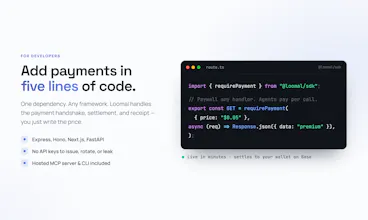
Loomal lets you charge for what you sell online — API calls, tools, digital products, or your whole store. One line of code (or a Shopify/WooCommerce plugin) adds an agent-ready paywall: AI agents pay you in USDC, settled in about 2 seconds, and you keep 100% of your revenue — no percentage cut, ever. Free to start, no card; flat monthly plans as you grow. Every paid listing appears on the Loomal Index, where agents discover and pay. Launch offer: first 500 sellers get 1,000 transactions free.
This is the 2nd launch from Loomal. View more
Loomal
Launching today
Loomal lets you charge for what you sell online — API calls, tools, digital products, or your whole store. One line of code (or a Shopify/WooCommerce plugin) adds an agent-ready paywall: AI agents pay you in USDC, settled in about 2 seconds, and you keep 100% of your revenue — no percentage cut, ever. Free to start, no card; flat monthly plans as you grow. Every paid listing appears on the Loomal Index, where agents discover and pay. Launch offer: first 500 sellers get 1,000 transactions free.



Free Options
Launch Team / Built With


Loomal
👋 Hey Product Hunt!
I'm Danny, maker of Loomal.
🤖 AI agents are starting to buy things. They research, compare, and complete purchases on their own.
⚠️ But here's the problem. Almost nothing online can sell to them.
Stores and APIs are built for humans. Browsers. Credit cards. Checkout forms.
Agents don't have those. They have wallets. 👛
So we have this strange moment:
millions of agents with spending power, and an internet that can't take their money. 💸
That's why I built Loomal. 🚀
Loomal makes anything you sell agent-ready. Agents discover it, pay for it, and use it — no human in the loop.
⚡ What makes Loomal different?
👉 One line of code for your API or MCP server. No re-architecture.
👉 Agents pay in USDC. Settlement lands in ~2 seconds.
👉 You keep 100% of your revenue. We never take a cut.
👉 Every paid listing goes on the Loomal Index, where agents discover and pay for services.
🛍️ For Sellers
List what you already sell.
An API.
A SaaS tool.
Digital goods.
✅ One-line integration
✅ Instant USDC settlement
✅ Zero revenue share
✅ Discoverable by agents on the Loomal Index
🤖 For Agent Builders
Give your agents services they can actually pay for.
❌ No scraping.
❌ No stolen credit cards.
❌ No human checkout.
🎯 Who is Loomal for?
🛠️ API and MCP server builders 🤖 Agent developers 💾 Anyone selling digital services who wants to be ready when agents come shopping
🎁 PH-only offer: first 500 sellers get 1,000 free transactions. Enough to validate real agent demand before you pay us anything. Free to start, no card. 💳❌
💬 Two questions: what do you sell that agents should buy? And what's missing before you'd list it?
🔗 Live demo at https://loomal.ai — here all day.
Thanks for checking us out! 🙌
@dannyheng What's the biggest blocker keeping you from listing on Loomal right now; technical, billing, compliance, or something else?
Loomal
@swati_paliwal Sorry, I may not have understood your question correctly. If you mean what’s stopping more people from listing on Loomal, it’s probably too early for us to say—we’re still fresh out of the oven and learning from our first users. So far, the biggest challenge seems to be helping people quickly understand what they can list and the value Loomal brings.
@dannyheng Congrats to the Loomal team! Happy to hunt it today. You're not just enabling payments, you’re helping create an entirely new commerce layer for AI agents. 💙
Loomal
@rohanrecommends Thanks so much, Rohan — really appreciate the support. That’s exactly how we see it too: payments are just the first layer. The bigger opportunity is enabling agents to discover, evaluate, and transact with services on their own. Excited to have you hunting with us today!
no % skim plus 2 second settlement is a real edge over the platform fee model. what stops a misconfigured agent from retrying a failed call and paying you multiple times for the same request, is idempotency on the caller side or yours?
Loomal
@sabber_ahamed Loomal verifies each signed payment authorization and returns a signed receipt after settlement. We’re also designing the retry flow so a failed request doesn’t accidentally result in duplicate charges, but we don’t want to overstate the current guarantees around idempotency yet. For now, callers should use sensible retry and request-deduplication logic.
Loomal
@sabber_ahamed Great question — the replay safety is protocol-level, so neither side has to be careful 😄
Every payment is a single-use signed authorization — once it settles, it's spent. A misconfigured agent retrying the same request just re-sends the same authorization, and it simply can't settle twice. And if the call fails before settlement, no money moved at all.
Where we go beyond vanilla x402: we verify before we ever settle (amount and recipient must match what was actually signed), and every settled call gets a signed receipt — so both sides have cryptographic proof of exactly what was paid, once. Stock x402 gives you the rail; we added the paper trail.
@oxrajesh single-use signed authorization answers it cleanly, that's the right place to put the guarantee. is the signature check happening on your server or is settlement itself the check, ie could a forged replay ever get far enough to hit your infra before failing?
stripe is clearly moving into agents payments too, curious what makes loomal a better bet than waiting for them to ship something similar.
Loomal
@holden_chase Honestly, Stripe moving in validates the space — but we're not really racing them on the same track.
Stripe's agent work is about agents buying from human commerce: checkouts, cards, merchants. Card rails are brilliant for a $40 cart and hopeless for a $0.01 tool call — the fixed fee alone eats the transaction. Our whole bet is machine-to-machine: agents paying APIs and other agents per call, settling in ~2 seconds, no % skim. That's economically impossible to retrofit onto card infrastructure — it needs different rails, which is why we built on x402 instead.
The other piece Stripe doesn't touch: agent identity. When a machine pays a machine, "who authorized this?" matters more than the payment itself. Every agent on Loomal has its own verifiable identity, scoped permissions, and signed receipts for every call — payments and accountability in one stack.
Loomal
@holden_chase Stripe don't do discovery for builders. Their agentic commerce stack points at retail checkout through the big assistants, not a neutral index where agents find indie API and MCP sellers. That index is our bet — plus flat plans, no cut of your revenue. Big merchant on Stripe? Use Stripe. Builder who wants agents to find and pay you? That's us.
Unabyss
good stuff! from the buyers' perspective: if my AI agent makes a mistake, how do I prove what it did and who authorized it? or there's no chance?
Loomal
@marcin_uchacz1 There's a chance — it's actually two layers.
On Loomal: every payment produces a signed receipt — which agent paid, which endpoint, amount, timestamp. So for transactions, the record exists by default.
"What did it do and who authorized it" beyond payments is an identity problem, and it's exactly why we built Mailgent (launched here last week): each agent gets its own cryptographic identity, actions are signed against it, and permissions are scoped — so you can show which agent did what, under whose authority, with proof.
Loomal
@marcin_uchacz1 There's very much a chance — this is honestly the whole reason we glued identity to payments.
Every agent on Loomal has its own verifiable identity with its own keys — it's never "someone with the company card," it's that specific agent. Every payment it makes settles on-chain (public tx) and comes with a signed receipt binding the agent, the recipient, the amount, and the exact resource it paid for.
So when your agent does something dumb, you can reconstruct the whole story: which agent, what it paid, to whom, for what, and when — and verify every signature independently, without trusting us. You scope what each agent is allowed to do up front, and the receipts prove what it actually did.
Blaming the intern has never been this cryptographically rigorous.
Love seeing infrastructure being built around the agent economy.
Curious....what kinds of MCP servers are seeing the most traction so far?
Loomal
@worksforme The categories getting the most interest so far: data/search APIs (agents pay per lookup), scraping and enrichment tools, and document processing — the pattern is bursty, mid-task consumption, which is where subscriptions never made sense. Anything an agent needs unpredictably, 40 calls at a time.
Too early to declare a winner from our volume alone — we launched the new model this month.
The MCP server monetization focus is neat. One thing I’m wondering: when you say “in 5 minutes,” is Loomal mostly handling payments/access control around an existing MCP server, or does it also help with packaging, hosted endpoints, or user management? The no % skim detail makes the business model feel builder-friendly, so I’d be curious what parts are included in the basic setup.
Loomal
@mia_qiao The 5 minutes is payments and access around your existing server: install the SDK, wrap the endpoints you want to charge with requirePayment(), set prices. No hosting, no packaging — your server stays where it is.
Basic setup includes: the paywall, your listing on the Loomal Index (machine-readable, so agents discover and pay you programmatically), a dashboard showing which endpoints earn, and USDC settlement in ~2 seconds. User management/auth for humans isn't us — pair with your existing stack.
So: payments, discovery, visibility. You build the server; we make it sellable.
Haha this framing of giving an agent its own identity instead of duct taping it onto a human's is a clean way to describe a problem that's been quietly obvious for a while (agents running on borrowed Gmail passwords and unscoped API keys with no audit trail).
Wondering if an agent's vault or inbox gets compromised, is there a way to revoke just that agent's identity without breaking every other agent sharing the same account?
Loomal
@uddipta You've actually wandered into our sister product 😄 Loomal handles the payments side; the identity/inbox/vault layer you're describing is Mailgent (mailgent.dev) — same team, built to work together.
To answer directly: yes, that's the whole point of giving each agent its own identity instead of a shared account. Every agent gets its own DID and its own Ed25519 keypair — nothing is shared. So if one agent's vault or inbox is compromised, you revoke that agent's identity and keys, and every other agent keeps running untouched. No blast radius, and the audit trail shows exactly what the compromised agent did before revocation.
That's exactly the failure mode of the "borrowed Gmail password" setup — one leak takes down everything and you can't even tell what happened.
Happy to go deeper on the Mailgent side if useful, but didn't want to hijack the Loomal thread 😅 On the Loomal side: agents pay under scoped spend mandates, so a compromised agent can't drain a wallet either — you revoke the mandate and it's done.
Loomal
@uddipta @oxrajesh Exactly this. Loomal’s role is to make the commercial side just as scoped as the identity side. Each agent gets its own spend mandate, limits, and revocable access, so a compromise stays contained instead of exposing the whole account or wallet.
The broader principle is simple: agents should have their own identity, permissions, and budget—not borrow a human’s credentials!