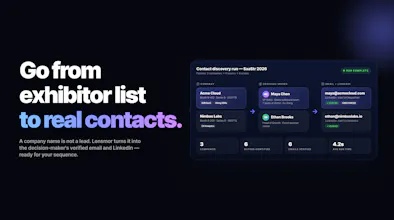
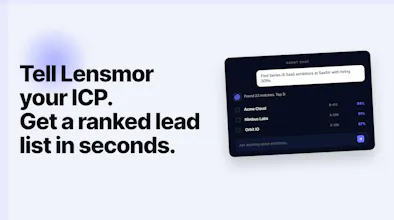
Unlike generic contact databases, Lensmor starts with exhibitor data, helping teams discover relevant events, find exhibiting companies, identify decision-makers, reveal verified emails, and book meetings before the show begins. Standout features include 160,000+ global events, exhibitor search, reverse company-to-event lookup, CSV export, and an AI agent for lead discovery and outreach planning.
Hey Product Hunt, Claire here, founder of Lensmor.
We built Lensmor because trade show prep is still weirdly manual.
A lot of B2B teams spend real money on booths, travel, sponsorships, and sales time, but still walk into the event with a messy spreadsheet, a generic exhibitor list, and no clear plan for who they should meet.
Lensmor starts with exhibitor data.
You can search 160,000+ global events, find exhibiting companies, identify decision-makers, reveal verified emails, export lists, and plan outreach before the show starts.
The goal is simple: help teams walk into trade shows with the right target list and more meetings already booked.
We’re also building an AI Agent that turns the workflow into a faster pre-show sprint: find target exhibitors → generate intelligence briefs → draft outreach → help plan meeting booking and follow-up.
We’re launching today as part of Vercel Day, and Lensmor is built on Vercel.
I’d love feedback from anyone who has used trade shows for pipeline:
Where does trade show prep usually break for your team? - finding the right exhibitors - figuring out who to contact - writing pre-show outreach - booking meetings before the event - proving ROI after the show
Report
@clairehuang This is the kind of tool I would want to test against one upcoming event first. If it can surface better target accounts quickly, the business case is pretty straightforward.
@haiping_fu1 Thanks Haiping, that’s exactly how we think teams should test it too.
One upcoming event is usually enough to see whether the workflow is useful:
pick the show, define the ICP, generate a target exhibitor list, then review whether the surfaced companies are actually worth outreach.
If you have an event in mind, I’d be happy to help you think through what a good target list should look like.
Report
💎 Pixel perfection
@clairehuang The "figuring out who to contact" part kills me every time. You find the right company exhibiting, then spend 30 minutes on LinkedIn trying to figure out if it's worth reaching out to the VP or if there's a more relevant director, and by then you've lost half your morning.
The reverse company-to-event lookup is genuinely useful for the other direction too, when you already have a target account list and want to see which shows they consistently attend. That's a workflow I'd actually pay for.
One question: does the AI agent handle enrichment for smaller regional shows, or mostly the big international ones? That's usually where the data gets thin.
Congrats on shipping, Claire! The pre-show prep window is way underserved.
@aigerim_nogaibayeva we’re not only focused on the biggest international shows. We also cover regional and more niche events where the data is often thinner, but the intent can be extremely valuable.
Improving data processing efficiency, freshness, and quality is one of our biggest ongoing priorities. For trade show intelligence, timing matters a lot — stale data quickly becomes useless.
Really appreciate the thoughtful comment!
Report
@clairehuang This is such a smart solution. Trade show prep has always been chaotic for sales teams. I'm curious, once the meetings are booked, how are you helping teams follow up and manage those conversations after the show?
Our current focus is helping teams win the pre-show window: identify the right exhibitors, find the right people, and book the most relevant meetings before the event starts.
After meetings are booked, teams can push those opportunities into their CRM, including HubSpot, and manage the follow-up there. But we also believe the post-show workflow should not be generic. The follow-up should carry the full event context: why this account mattered, what signal triggered the outreach, who was involved, and what next step makes sense.
That’s an area we’re actively thinking about.
Report
@_ivan1 That's really insightful Ivan, the context-aware follow-up angle makes total sense. A generic CRM push after a trade show loses all the warmth of the original conversation. Would love to see how you tackle that. Following your journey closely
How do you source and keep exhibitor rosters current across 160,000+ events—especially when organizers gate lists behind sponsor/exhibitor access—and what’s your approach when data is incomplete or changes right before the show?
@curiouskitty Great question — this is one of the hardest parts of building in this category.
We combine multiple public and permitted sources: organizer websites, exhibitor/sponsor pages, event directories, company websites, and other open signals. Then we run enrichment, deduplication, freshness checks, and confidence scoring on top of that data.
When data is incomplete or behind gated exhibitor access, we don’t want to pretend it’s perfect. We’d rather make the data quality and recency clear, then focus on surfacing the highest-confidence signals first.
Right before a show, things can change quickly — exhibitors drop, booths move, new sponsors appear — so improving refresh speed and data quality is a big ongoing priority for us.
Our view is that event intelligence is not just about collecting lists. It’s about continuously turning fragmented, messy event data into timely, usable sales signals.
Report
💎 Pixel perfection
Proving ROI after a show is always the hardest part because the follow-ups are usually generic and late. If Lensmor helps us book meetings before the event starts, that’s already a win. Is there a way to track which booked meetings actually came from Lensmor lists?
Congratulations, team, the trade show ROI piece you mentioned, how does Lensmor help prove that? Is there built-in tracking for which booths/meetings actually converted, or would that be on us to track separately in our CRM?
@abod_rehman Great question, Abdul. Today we support HubSpot integration, so teams can push selected exhibitors, contacts, and meeting opportunities into their CRM and track conversion/pipeline there.
Our core value right now is the pre-show intelligence layer: helping teams identify the right events for their ICP, the most relevant exhibitors, and the decision-makers worth reaching before the show starts.
We see that intent signal itself as a big missing piece in trade show ROI, and we’ll continue adding more event-specific data and attribution workflows over time.
@_ivan1 perfect, all the best with your launch mate
Report
Converting exhibitor data into meetings is a high-value niche. Does the tool use AI to personalize the outreach based on the specific company's recent news or launches?
@rivra_dev Great question — yes, we believe public news, launches, and product signals are key to making outreach truly relevant.
Today, Lensmor focuses on helping teams identify the right events, exhibitors, and decision-makers before the show. In our upcoming iterations, we’re adding more company-level signals like recent news and product updates to support more personalized, timely outreach.
The goal is context-driven outreach, not just AI-generated copy.
Congrats on the launch. Curious about the AI agent's autonomy - does it draft outreach sequences for human approval before sending, or do you let it send autonomously to verified emails? Asking as someone building agent harnesses on the other side of this category and always interested in where teams draw the trust line.
@mu_li Great question, Mu — and I really like the way you framed the “trust line.”
For us, the AI agent should first act as a research and drafting layer, not an autonomous sender. Lensmor helps identify the right exhibitors, contacts, and event context, then can support more relevant outreach drafts — but we believe the human should review and approve before anything goes out.
Especially in outbound, trust is not just about data accuracy. It’s also about brand voice, timing, and reputation. So our current philosophy is: let AI do the heavy research and personalization work, but keep humans in control of the final message and sending decision.
Report
Congrats! On booking meetings before the event does Lensmor integrate with scheduling tools like Calendly or Chili Piper to suggest time slots based on the event agenda or exhibitor availability?
@imogen_wallace Great question, Imogen — this is definitely part of the workflow we care about.
Today, Lensmor is more focused on the pre-show intelligence layer: helping teams identify the right exhibitors, decision-makers, and outreach opportunities before the event starts. Teams can then move those opportunities into their existing CRM/scheduling flow.
Native integrations with tools like Calendly or Chili Piper are on our roadmap. What we’re especially interested in is not just “add a booking link,” but making scheduling smarter around the event context — agenda, booth timing, travel windows, and priority accounts.
That’s where we think trade show scheduling can become much more intentional.



Lensmor
Hey Product Hunt, Claire here, founder of Lensmor.
We built Lensmor because trade show prep is still weirdly manual.
A lot of B2B teams spend real money on booths, travel, sponsorships, and sales time, but still walk into the event with a messy spreadsheet, a generic exhibitor list, and no clear plan for who they should meet.
Lensmor starts with exhibitor data.
You can search 160,000+ global events, find exhibiting companies, identify decision-makers, reveal verified emails, export lists, and plan outreach before the show starts.
The goal is simple: help teams walk into trade shows with the right target list and more meetings already booked.
We’re also building an AI Agent that turns the workflow into a faster pre-show sprint:
find target exhibitors → generate intelligence briefs → draft outreach → help plan meeting booking and follow-up.
We’re launching today as part of Vercel Day, and Lensmor is built on Vercel.
I’d love feedback from anyone who has used trade shows for pipeline:
Where does trade show prep usually break for your team?
- finding the right exhibitors
- figuring out who to contact
- writing pre-show outreach
- booking meetings before the event
- proving ROI after the show
@clairehuang This is the kind of tool I would want to test against one upcoming event first. If it can surface better target accounts quickly, the business case is pretty straightforward.
Lensmor
@haiping_fu1 Thanks Haiping, that’s exactly how we think teams should test it too.
One upcoming event is usually enough to see whether the workflow is useful:
pick the show, define the ICP, generate a target exhibitor list, then review whether the surfaced companies are actually worth outreach.
If you have an event in mind, I’d be happy to help you think through what a good target list should look like.
@clairehuang The "figuring out who to contact" part kills me every time. You find the right company exhibiting, then spend 30 minutes on LinkedIn trying to figure out if it's worth reaching out to the VP or if there's a more relevant director, and by then you've lost half your morning.
The reverse company-to-event lookup is genuinely useful for the other direction too, when you already have a target account list and want to see which shows they consistently attend. That's a workflow I'd actually pay for.
One question: does the AI agent handle enrichment for smaller regional shows, or mostly the big international ones? That's usually where the data gets thin.
Congrats on shipping, Claire! The pre-show prep window is way underserved.
Lensmor
@aigerim_nogaibayeva we’re not only focused on the biggest international shows. We also cover regional and more niche events where the data is often thinner, but the intent can be extremely valuable.
Improving data processing efficiency, freshness, and quality is one of our biggest ongoing priorities. For trade show intelligence, timing matters a lot — stale data quickly becomes useless.
Really appreciate the thoughtful comment!
@clairehuang This is such a smart solution. Trade show prep has always been chaotic for sales teams. I'm curious, once the meetings are booked, how are you helping teams follow up and manage those conversations after the show?
Lensmor
@chinaemerem_maxwell Thank you, Chinaemerem — great question.
Our current focus is helping teams win the pre-show window: identify the right exhibitors, find the right people, and book the most relevant meetings before the event starts.
After meetings are booked, teams can push those opportunities into their CRM, including HubSpot, and manage the follow-up there. But we also believe the post-show workflow should not be generic. The follow-up should carry the full event context: why this account mattered, what signal triggered the outreach, who was involved, and what next step makes sense.
That’s an area we’re actively thinking about.
@_ivan1 That's really insightful Ivan, the context-aware follow-up angle makes total sense. A generic CRM push after a trade show loses all the warmth of the original conversation. Would love to see how you tackle that. Following your journey closely
Product Hunt
Lensmor
@curiouskitty Great question — this is one of the hardest parts of building in this category.
We combine multiple public and permitted sources: organizer websites, exhibitor/sponsor pages, event directories, company websites, and other open signals. Then we run enrichment, deduplication, freshness checks, and confidence scoring on top of that data.
When data is incomplete or behind gated exhibitor access, we don’t want to pretend it’s perfect. We’d rather make the data quality and recency clear, then focus on surfacing the highest-confidence signals first.
Right before a show, things can change quickly — exhibitors drop, booths move, new sponsors appear — so improving refresh speed and data quality is a big ongoing priority for us.
Our view is that event intelligence is not just about collecting lists. It’s about continuously turning fragmented, messy event data into timely, usable sales signals.
Proving ROI after a show is always the hardest part because the follow-ups are usually generic and late. If Lensmor helps us book meetings before the event starts, that’s already a win. Is there a way to track which booked meetings actually came from Lensmor lists?
Triforce Todos
Congratulations, team, the trade show ROI piece you mentioned, how does Lensmor help prove that?
Is there built-in tracking for which booths/meetings actually converted, or would that be on us to track separately in our CRM?
Lensmor
@abod_rehman Great question, Abdul. Today we support HubSpot integration, so teams can push selected exhibitors, contacts, and meeting opportunities into their CRM and track conversion/pipeline there.
Our core value right now is the pre-show intelligence layer: helping teams identify the right events for their ICP, the most relevant exhibitors, and the decision-makers worth reaching before the show starts.
We see that intent signal itself as a big missing piece in trade show ROI, and we’ll continue adding more event-specific data and attribution workflows over time.
Triforce Todos
Converting exhibitor data into meetings is a high-value niche. Does the tool use AI to personalize the outreach based on the specific company's recent news or launches?
Lensmor
@rivra_dev Great question — yes, we believe public news, launches, and product signals are key to making outreach truly relevant.
Today, Lensmor focuses on helping teams identify the right events, exhibitors, and decision-makers before the show. In our upcoming iterations, we’re adding more company-level signals like recent news and product updates to support more personalized, timely outreach.
The goal is context-driven outreach, not just AI-generated copy.
Design Agent by Lokuma
Congrats on the launch. Curious about the AI agent's autonomy - does it draft outreach sequences for human approval before sending, or do you let it send autonomously to verified emails? Asking as someone building agent harnesses on the other side of this category and always interested in where teams draw the trust line.
Lensmor
@mu_li Great question, Mu — and I really like the way you framed the “trust line.”
For us, the AI agent should first act as a research and drafting layer, not an autonomous sender. Lensmor helps identify the right exhibitors, contacts, and event context, then can support more relevant outreach drafts — but we believe the human should review and approve before anything goes out.
Especially in outbound, trust is not just about data accuracy. It’s also about brand voice, timing, and reputation. So our current philosophy is: let AI do the heavy research and personalization work, but keep humans in control of the final message and sending decision.
Congrats! On booking meetings before the event does Lensmor integrate with scheduling tools like Calendly or Chili Piper to suggest time slots based on the event agenda or exhibitor availability?
Lensmor
@imogen_wallace Great question, Imogen — this is definitely part of the workflow we care about.
Today, Lensmor is more focused on the pre-show intelligence layer: helping teams identify the right exhibitors, decision-makers, and outreach opportunities before the event starts. Teams can then move those opportunities into their existing CRM/scheduling flow.
Native integrations with tools like Calendly or Chili Piper are on our roadmap. What we’re especially interested in is not just “add a booking link,” but making scheduling smarter around the event context — agenda, booth timing, travel windows, and priority accounts.
That’s where we think trade show scheduling can become much more intentional.