Launched this week
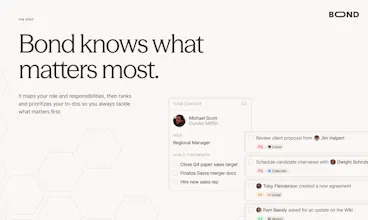
Bond is an AI Chief of Staff for executives. It connects to your tools, learns how your company works, and turns scattered tasks into a self-managing to-do list that always knows what you need to do next. You can ask Bond to prepare you for your next meeting, draft a follow-up, send an email, create action items, identify blockers, surface risks, or delegate tasks to team members.




Bond
Hey Product Hunt! 👋
I’m Chloe, co-founder and CEO of Bond.
Over the last few years, I’ve become obsessed with how exceptional leaders operate.
The best founders and CEOs aren’t smarter than everyone else.
They just have an obsession with how they spend their time.
The best leaders know exactly where their attention should go.
They know what matters, what doesn’t, and what’s at risk of slipping through the cracks.
The challenge is that as companies grow, keeping track of everything becomes a full-time job.
The information you need is scattered across email, Slack, meetings, docs, tasks, CRMs, and dozens of conversations happening simultaneously.
Before you can make a decision, you first have to gather the context.
What’s blocking the team?
Who owns this?
Did we follow up?
What’s changed since last week?
What am I forgetting?
Most leaders spend hours every day reconstructing the state of their business before they can actually get anything done.
That’s the problem we’re solving.
Bond is an AI Chief of Staff for high-performing founders and executives. It understands what’s happening across your company and proactively tells you:
• What matters most right now
• What’s falling behind
• What decisions need your attention
• What should happen next
A few things Bond has already done for early users:
✅ Flagged concerns about a candidate before a founder made a hiring decision
✅ Alerted a founder about a meeting with the CEO of a $10B company he’d almost missed with prep ready before it started
✅ Reminded a founder about a follow-up they’d forgotten for two weeks…the reply closed the deal
The goal is simple: you spend your attention on the work only you can do, and Bond handles the rest.
The entire team will be here all day answering questions and collecting feedback.
We’d love to hear what resonates, what doesn’t, and what you’d want Bond to do for you!
@chloesamaha definitely feeling this pain, is there a way for my more manual tasks to get done by bond?
Bond
@peterdambrosio yes! We have routines :)
Essentially any repetitive admin workflow you have: pre-meeting prep, follow ups, and investor newsletters are all things I've automated with Bond!
@chloesamaha thanks, signed up :)
@chloesamaha Congrats!! :)
Bond
@ipek_girgin thank you! Wouldn't have possible without the absolute legends on the team!
@chloesamaha Congrats on the launch team. How do you handle exec inaction (I know about it and just haven't done anything and so task age is increasing) and task priority?
Bond
@chloesamaha @zolani_matebese Great question, and honestly this is the failure mode of every todo app: stuff just ages and guilt-trips you forever.
Bond treats aging as a signal, not just a growing number. Urgency actually evolves over time, so a task climbs as it becomes genuinely more pressing, but Bond also re-evaluates whether it still matters at all. A few things can happen to an aging item:
It escalates if it's genuinely getting more important (deadline approaching, someone now blocked on you).
It offers to handle or delegate it rather than just nag, because half the time inaction means "this isn't really mine" or "I keep deprioritizing this for a reason."
It goes to cleanup if it's quietly gone stale, so dead weight doesn't pile up and drown the list.
The insight is that a task sitting untouched is information. Sometimes it means "do this now," sometimes "this was never actually a priority," and Bond tries to tell the difference instead of treating every old item as equally urgent.
Does that make sense?
@chloesamaha @tibo_wiels Brilliant
@chloesamaha The reconstruction of the state of the business pain point is so real. As a founder myself, I spend too much time context-switching between Slack, email, and docs just to figure out what’s actually blocking progress. Now, how does Bond handle 'noise'? For example, if there’s a heated debate in Slack that doesn’t actually require my attention, does it know to filter that out, or does it flag everything?
Bond
@chloesamaha @diana_nadim2 I Felt this in my soul. The "wait, what's actually blocking us" archaeology dig is exactly what we built Bond to kill.
On noise: flagging everything is the same as flagging nothing, so Bond is precision-biased on purpose. A heated Slack debate that doesn't need you is the textbook case it filters out. It distinguishes "this is a discussion happening near you" from "this is actually waiting on a decision or action from you," and only the latter reaches your list.
So FYI chatter, threads where you're cc'd but not the owner, debates that resolve themselves, all of that stays out of your face. If that same thread suddenly does need you (someone asks you directly, or it's blocking something you own), then it surfaces. The bar to interrupt you is deliberately high, because the moment the list fills with noise you stop trusting it.
@chloesamaha @tibo_wiels That precision-biased approach is exactly what’s missing in most tools. Trust is everything...if the list is noisy, I ignore it. Thanks for clarifying the logic, Tibo! Looking forward to seeing how it handles the 'archaeology dig' in practice. :)
@chloesamaha How do you balance Bond’s proactive nudges with avoiding notification overload or undermining a leader’s judgment; and what controls will founders have to tune the signal so Bond feels like a trusted teammate rather than a second-guessing assistant?
Bond
@sanreds Thank you, sanreds ! Great questions.
1. We don't see Bond as replacing one specific tool. It sits above the tools you already use and helps turn all that scattered context into a self-managing todo layer. So less "another app to maintain," more "an orchestration layer across the stack."
2. The ROI is mostly time and follow-through: fewer missed follow-ups, less context reconstruction, faster delegation, and less chief-of-staff/EA busywork. For execs, even saving a few hours a week can justify the cost, but the bigger value is often avoiding the one thing that would have slipped through the cracks and ofc staying focused on the right company goals is gold.
3. Today we're most focused on founders, executives, chiefs of staff, and lean leadership teams where the coordination load is already painful. That tends to be scaling startups and SMBs more than huge enterprises right now, though the product naturally becomes more valuable as the org gets more complex.
Hope this helps 😊
Bond
@moh_codokiai Both, but the second one is where it gets interesting. Bond does pull from your tools (calendar, email, Slack, Linear) but what it's really doing is building a model of you: your relationships, your commitments, what you own, what you've said you'd do. Over time it knows who matters, what's stuck, and what you're avoiding.
Users open it first thing because it's a reliable list of what actually needs to get done today. It removes the anxiety of "did I forget something?", the overwhelm of "I have 100 things, where do I start?", and the 2+ hours wasted bouncing between tools trying to build a list.
Your morning looks completely different with Bond. Instead of waking up and spending two hours just getting oriented, you open Bond and start getting things done.
Triforce Todos
Congrats on the launch team 🎉
For a founder managing multiple companies or workstreams, can Bond handle separate contexts without mixing them up, or is it one unified view across everything?
Bond
@abod_rehman Thanks!
Totally fine btw. Many founders run multiple companies or workstreams, and Bond is designed for exactly that.
Hook up as many workspaces as you want. Each gets its own scoped context layer (isolated pipelines, permission-aware access, strict tenant boundaries). Bond won't mix them up.
But it will connect the dots within and across each: signals from Slack, Gmail, calendar, and your PM tools get linked to the right people and initiatives, always with source citations so you can trust (and verify) what you're seeing.
Unified intelligence, clean separation. That's the idea!
Most AI assistants struggle with context retention across tools how does Bond maintain a coherent understanding of ongoing projects when executives are juggling 10+ active workstreams simultaneously?
@alexander_gray3 also curious how it priortizes stuff accordingly
Bond
@alexander_gray3 This is exactly the problem we built Bond around.
Most AI assistants only know what's in the current chat window, which falls apart when you're running 10+ things at once. Bond doesn't rely on the conversation to remember your company. It continuously builds a living company brain of it from your connected tools.
So instead of indexing raw text, Bond structures it: who said what, what are everyone's responsibilities, which project a ticket belongs to, what actually moved, and what's waiting on you vs. just noise. It learns what you own vs. what you're watching, carries context across conversations, and cross-references updates across tools against your to-dos, so it knows when something changed even if you never opened that app today.
It's not magic, and it gets sharper the more it syncs. But the bet is simple: you don't need a better chatbot, you need something that holds the whole picture together while you're busy running things, and that's the billion dollar problem we decided to destroy 😎
This seems built for rather big company CEOs with large teams. Does it work for early-stage founders like myself who are wearing 10 hats and have a very small team?
Bond
@jan_willem_denys early-stage is honestly where it shines at the moment. When you're wearing 10 hats nobody's catching the dropped balls but you...Bond does that part. Keeps the few things that matter today up top and handles the chasing/follow-ups in the background. Works whether your team is 2 or 200.
Bond
@jan_willem_denys Thankss Jan-Willem, lovely question.
While larger teams get a lot of value from Bond, we actually built it with the belief that early stage founders need a chief of staff even more!!
Many of our earliest users are founders with very small teams, who use Bond as an AI chief of staff before they can justify hiring one.
Bond
@martijn_bonte yess!
Bond
@martijn_bonte In the era of AI agents, aren't we all becoming executives? 🤔
Bond
@martijn_bonte Definitely. Right now we're focussed on founders and executives just because they have the pain-point more than anyone else. But we're definitely rolling this out enterprise very soon :)