I'm rethinking the weekly uptime report. Most monitoring tools send pages of metrics. We're experimenting with something different: A weekly email with one simple action: Generate AI Weekly Summary Instead of scanning charts and percentages, you'll get an AI-generated explanation of what actually happened across your monitored services that week powered by your own monitoring data. The goal is simple: Less time reading metrics.
More time understanding your infrastructure. Would an AI-generated weekly reliability summary be something you'd actually use?
Grocyy helps you turn everyday receipts into powerful insights. Website: https://grocyy.com/ The pain point of we throw away receipts or forget what we bought. That means we have no idea:
how much we re really spending on groceries
what we buy most often
or when we ll need to restock
Grocyy fixes that.
Just upload a receipt and Grocyy will automatically:
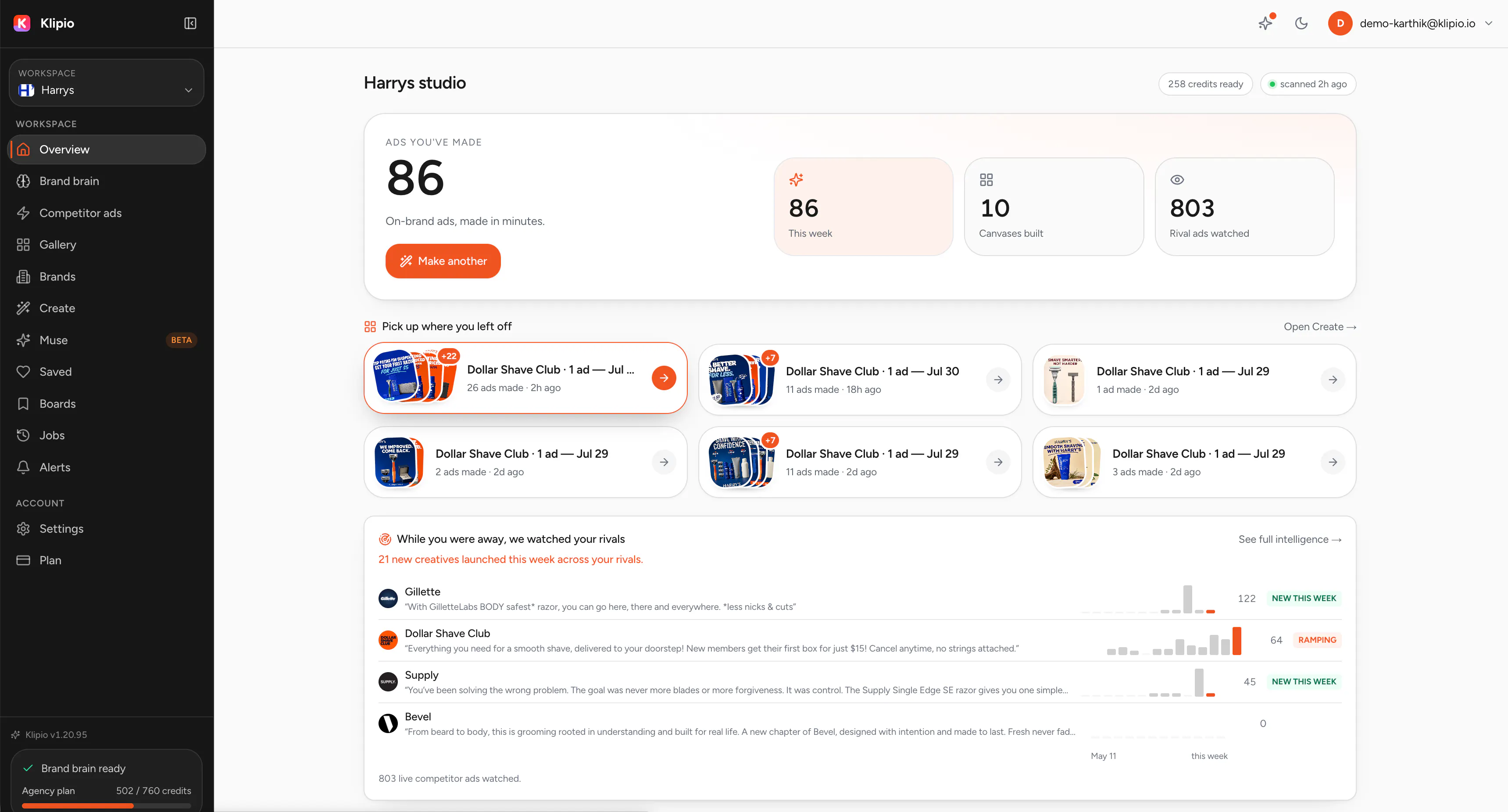
Hi all sharing what I've been building. I'm Karthik, and I ran a performance-marketing agency for years. The most-repeated task was always the same: study competitors' winning ads, then rebuild what's working into on-brand creative for my own brand. It was slow and scattered across ad-spy tools, spreadsheets, designers and AI image tools that don't know your brand.
So I built Klipio to do the whole loop in one place: it learns your brand from your website (products, prices, voice and positioning, with facts cited and guesses flagged), watches your competitors' live Meta ads to surface what's actually winning right now with daily alerts, and then generates a finished, on-brand ad you can download or push straight to your Meta ad account.
After months of building, testing, and improving, I finally launched UluP Spaces , a visual collaborative workspace where projects become interactive maps.
Can your organization currently produce a complete, audit-ready record showing every AI system in use is mapped against EU AI Act requirements? In my research, most cannot and under NIS2 and the AI Act, that gap now carries personal liability implications for named executives, not just the organization.
I'm developing Compliant to address this: a structured inventory of AI systems and vendors, a clear view of what documentation is missing, and an audit trail to support compliance efforts.
Last year, our data pipeline kept failing in ways that made no sense. Requests would work perfectly for hours, then suddenly start returning 403s and CAPTCHAs. We blamed everything our code, our infrastructure, even the time of day. Six months of debugging later, here's what we actually learned.
1. IP freshness matters more than pool size
We assumed a large IP pool meant we were safe. Wrong. We discovered that many providers recycle IPs aggressively the same IPs get reused across customers, and once an IP gets flagged, it stays flagged. A smaller pool of freshly validated IPs consistently outperformed a massive pool of stale ones.
OrienFrame is an AI portrait studio inspired by classical East Asian visual aesthetics. Upload a portrait, choose a curated style, and create an artwork with a quieter and more intentional visual direction than a typical collection of AI filters. I built OrienFrame because I felt that many AI portrait products offer a huge number of filters, but very little consistent art direction.
OrienFrame takes the opposite approach. It focuses on a curated visual identity inspired by East Asian aesthetics and presents the experience as a digital portrait studio rather than a general-purpose image generator.
The product currently includes one free generation per day after Google sign-in.
I d especially appreciate feedback on three things:
Most productivity apps focus on adding features, reminders, and to-do lists. I built one that focuses on removing distractions instead. Do you think eliminating distractions is more effective than adding more productivity tools?
try it out here - https://lockindotcom.vercel.app/