

c8doc a decentralised document verification that i made to help the society to prove what is real
www.c8doc.xyz
A few months ago, something happened that completely changed the way I think about digital trust.
A policeman stopped me around 10:00 AM and asked for my name and phone number. When I asked why, he said it was just for a routine verification and wrote it in a notebook. I went home thinking nothing of it.
Later that day, I received a ₹1,000 fine for not wearing a helmet.
The problem? I was wearing my helmet.
What made it even stranger was the evidence photo. It was blurry, almost like a reflection. After looking at it closely, I realized the officer had likely taken a photo of my bike with his phone and later photographed that phone screen using the ticketing device. The timestamp on the receipt even showed 11:45 PM, even though I had been stopped around 10:00 AM.
I was frustrated.
I had selfies from home that could have helped prove where I was, but then another thought hit me.
Would anyone believe those photos today?
We're living in a time where AI can generate realistic photos, videos, documents, invoices, and even voices. If I showed someone a selfie, they could simply say, "That could be AI-generated." The same applies to PDFs, Word documents, contracts, invoices, certificates, or almost any digital file.
That made me realize something.
The problem isn't just fake images.
The problem is that almost every digital document can now be questioned.
I started looking into blockchain because it provides an immutable timeline. My first idea was to store the actual files on-chain.
Then I realized why almost nobody wants that.
Imagine storing your passport, family photos, legal contracts, invoices, medical records, or private videos on a public blockchain. Even if it were technically possible, most people simply wouldn't be comfortable with their personal documents becoming part of a permanent public ledger. Blockchains are transparent and designed to last forever. Privacy matters.
There was another problem too.
Images and videos are large. Uploading tens or hundreds of megabytes for every document would be expensive and impractical.
So I asked myself:
What if we didn't store the file at all?
That's how C8DOC was born.
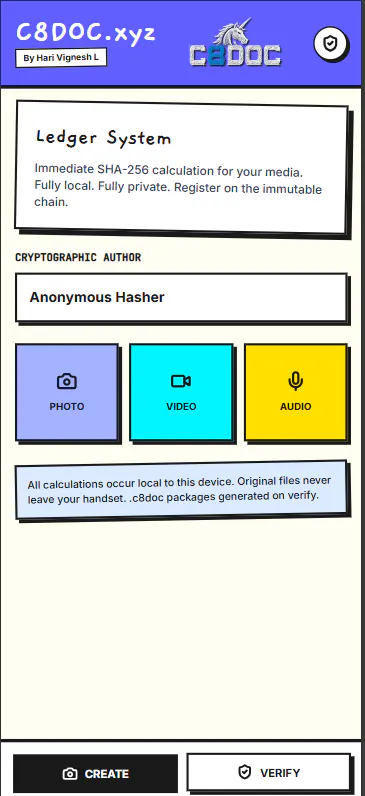
Instead of storing your actual file, C8DOC generates a unique cryptographic fingerprint (SHA-256 hash) of the file. Whether it's a photo, video, PDF, Word document, Canva design, invoice, audio recording, or almost any other digital file, it becomes a unique fingerprint that represents that exact content.
Only that fingerprint is recorded on the decentralized ledger.
Your original document remains with you.
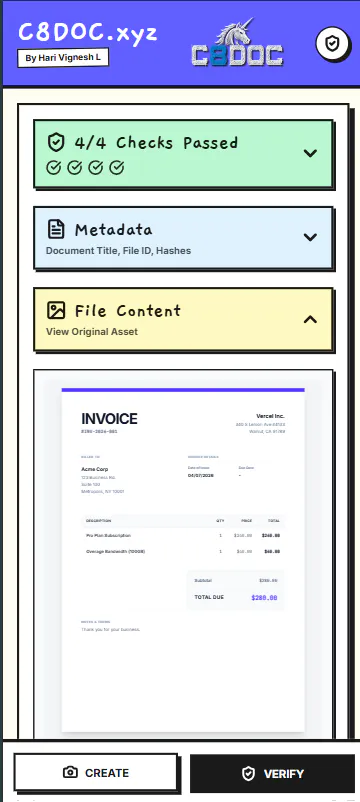
When someone wants to verify the file later, they simply upload it to C8DOC. The system calculates its fingerprint again and compares it with the fingerprint recorded on the blockchain.
If they're identical, the document is verified.
If even one pixel changes in an image, one frame changes in a video, or one character changes in a document, the fingerprint becomes completely different, and verification fails.
People often ask me:
"What if someone uploads an AI-generated image to the blockchain first?"
That's a fair question.
C8DOC isn't designed to determine whether a file was created by AI or by a camera.
Instead, it proves when a specific version of that file already existed.
For example, imagine someone accuses me of creating fake evidence after receiving a traffic fine. If my photo had already been registered on the blockchain before the disputed event, I couldn't have created that exact file afterward to support a false claim. The timestamp and the file's fingerprint become part of the evidence.
C8DOC doesn't replace courts or investigators.
It simply gives people a way to prove that a digital file has remained unchanged since the moment it was registered.
My goal isn't to fight AI.
My goal is to restore trust in digital documents.
Whether it's a photograph, invoice, legal agreement, educational certificate, video, audio recording, or business document, I want people to have a simple way to prove its integrity without giving up their privacy.
That's why I built C8DOC.
Replies
Really interesting idea. I like that you're focusing on proving a file's integrity over time rather than trying to detect whether it's AI-generated. That feels like a much more practical approach, especially as generative AI keeps improving.
One question I had: have you thought about how you'll handle versioning? For example, if a contract or document is legitimately updated multiple times, can users verify the entire history while preserving the trust chain?