

Google just gave you the one AI visibility report you have been waiting for.
Google just released what SEOs have been asking for: dedicated reports for Generative AI performance in Search Console.
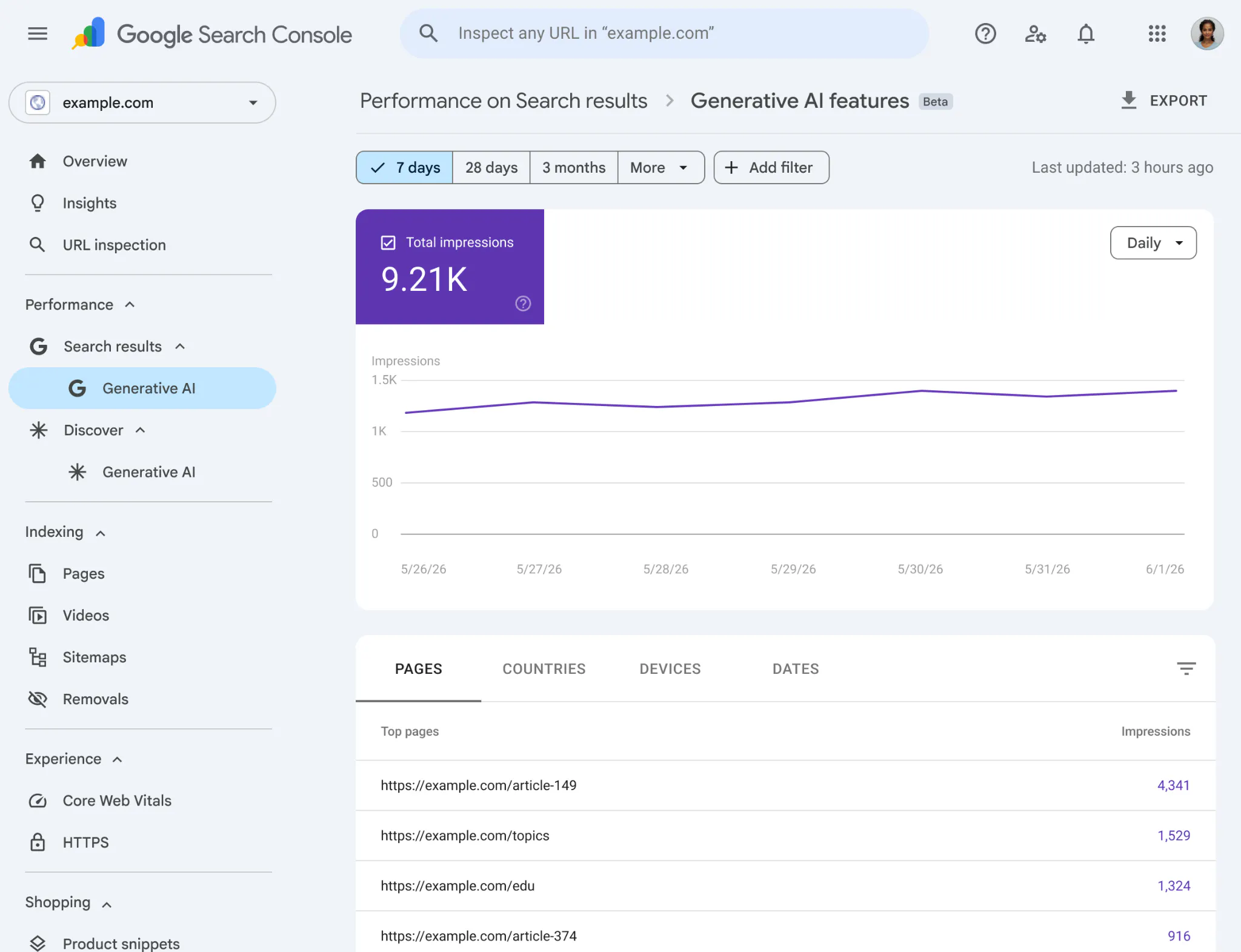
On June 3, 2026, Google announced new Search Console reports specifically for Generative AI features . It's the first time Google has given publishers direct data on how their content performs in AI Overviews, AI Mode, and Generative AI-powered Discover .
What You Get in the New AI Reports
The reports show you data that has never been available before. You will see your website's URL, the country where impressions came from, the device used, and the date — all with the same granularity as standard Search Console performance data . You can filter and slice the data by hour, day, week, or month to track exactly how your AI visibility changes over time .
How to Use This Data
Track your AI visibility. You can now see exactly how often your content appears in Google's AI Overviews and AI Mode. This is the baseline for any AI visibility strategy.
Identify which pages perform best in AI answers. The reports show you which URLs are surfaced most often. You can see what content actually works and double down on it.
Monitor your AI performance across different countries. The reports include geographic data. You can see if your content is more visible in one region and less visible in another.
Understand device-specific performance. The reports include device data, so you can see if your AI visibility is consistent across mobile and desktop.
Why This Matters
Before this report, SEOs were flying blind when it came to AI visibility. You knew if your traffic was dropping. You did not know why. Now you have the data.
You can see if your content is being surfaced in AI Overviews. You can see if it is being ignored. You can experiment and measure the impact.
What This Means for Your Strategy
This is not optional. The shift to AI answers is structural, not temporary. If you are not tracking your AI performance, you are not tracking search.
The data is now available. There is no excuse for guessing. The report is rolling out now to a subset of sites before full availability . Start checking your account.
The bar has been set. If you have data and your competitors do not, you have an advantage. The window to act is open.
How Rankfender Connects to This
Rankfender already monitors your brand's citations across ChatGPT, Perplexity, and Gemini. The new Google reports give you the Google side of the equation. Together, you get complete visibility across all major AI platforms.
The Google report tells you how your site performs in AI Overviews and AI Mode. Rankfender tells you how your brand performs in ChatGPT, Perplexity, and Gemini. You get the full picture.
What I am curious about. Have you seen the new Generative AI report in Search Console yet? What data surprised you most?
Full article on Linkedin: https://www.linkedin.com/pulse/google-finally-opened-black-box-what-new-search-console-ai-cwjde
Imed Radhouani
Founder & CTO – Rankfender
Replies
This is a big shift for SEO and GEO.
For years, search visibility was mostly about rankings, clicks, and impressions. Now the question is also: “Is my brand or content being used inside AI answers at all?”
I like the combination of Google’s AI visibility data with tools like Rankfender for ChatGPT, Perplexity, and Gemini. The real value will be comparing where a brand is visible, where competitors are cited instead, and which content changes actually improve that over time.
@prashant_patil14 Exactly. The shift is structural, not tactical. The old question was "where do I rank?" The new question is "am I cited at all?"
Google's new report gives you the Google side of the equation. Tools like Rankfender give you the rest of the ecosystem. The real value is in the comparison: where are you visible, where are competitors cited instead, and which content changes move the needle.
The brands that win will be the ones that treat AI citations as a primary metric, not a secondary one. And the ones that combine first-party Google data with third-party tracking across all major AI platforms will have a complete picture of their visibility.
What is your current setup for tracking AI citations across platforms?
@imed_radhouani Right now my setup is still very manual.
For DataCrawlPro and VideoDataPro, I’m checking a few core prompts across ChatGPT, Perplexity, Gemini, and Google results, then comparing whether the brand appears, how it is described, and which competitors or sources are cited instead.
It’s not scalable yet, but it already shows how different AI platforms describe the same brand differently. That’s why I think tools like Rankfender will become important manual checks are useful for learning, but proper tracking is needed once AI visibility becomes part of growth strategy.