

The hidden gap in AI audit trails: reasoning changes, but records stay flat.
One thing I've noticed with AI audit trails is that they tend to do a good job of recording events but not always the reasoning behind them.
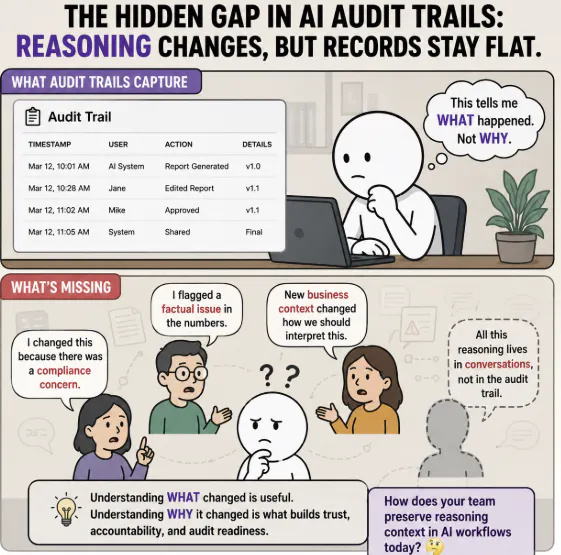
Take a simple example: An AI-generated report goes through an internal review before being shared with customers or stakeholders. Someone makes edits, approves the final version, and the workflow moves forward. Months later, if you look back, the audit trail will usually tell you when the changes happened, who made them, and which version was approved.
What it may not tell you is why those changes were made in the first place. Maybe there was a compliance concern. Maybe someone spotted a factual issue. Maybe additional business context changed how the output was interpreted. The record captures the action, but not necessarily the thinking behind it.
The more I look at AI governance, AI accountability, and audit readiness, the more this feels like an important gap. Understanding what changed is useful. Understanding why it changed is often what helps teams make sense of a decision months later.
Curious how teams are preserving reasoning context across AI workflows today, especially when outputs move through review, edits, and approvals.
Lets chat👇🏼
Replies
We've found that requiring reviewers to add a short rationale for significant edits creates much more useful records than version history alone.
@adrian_scott2 That makes a lot of sense. I like the “significant edits” threshold too, otherwise rationale capture can quickly turn into paperwork.
Do you define what counts as significant through policy/risk level, or do reviewers decide when a rationale is needed?
Honestly this is where AI fgovernance still feels very early days. WE've inherited software style audit trails for something that behaves more like human decision making.
@hassan_ismail_rebe Exactly. Traditional audit logs assume the important part is the event. With AI, the important part is often the judgment around the event.
It feels less like system logging and more like decision documentation. The challenge is capturing that context without slowing teams down too much.
Great point. I think a lot of audit trails are still designed around “what happened” rather than “why the decision made sense at that moment.”
For AI workflows, the reasoning context can be just as important as the final action: what concern triggered the edit, what evidence was reviewed, who agreed with the interpretation, and what trade-off was accepted.
I’ve seen this problem in smaller product workflows too. A change may look obvious months later in the log, but without the reasoning behind it, it’s hard to know whether the team was fixing an error, adapting to new context, or just making a preference-based edit.
Do you think this context should be captured manually by reviewers, or partially generated by the system as part of the approval workflow?
WebCurate.co
An audit trail that only shows what changed is often incomplete. In many cases, the reason behind the change is actually more valuable than the change itself. I think we're still very early in solving that part of AI workflows.
This is exactly where many audit system feel incomplete to me. We spend a lot of effort tracking actions and approvals, but the rationale behind those decisions often disappears. Months later, teams can reconstruct the timeline but not the judgment that shaped it.