

Building a BI layer for Product Hunt launches — what metrics would you like to see?
One recurring piece of feedback after launching PH Radar was that makers want more context, not just rankings.
I'm currently experimenting with a BI layer that analyzes Product Hunt activity beyond the daily leaderboard.
Current prototype dashboards include::
• Launches by category
• Votes by category
• Hunter activity
• Comment-to-vote ratios
• Historical launch trends
My goal is to help makers answer questions like:
• Which categories are becoming more competitive?
• Which hunters are consistently active?
• When is the best time to launch?
• What engagement patterns correlate with successful launches?
If you could see any Product Hunt metric or visualization, What Product Hunt metrics, comparisons, or historical trends would help you make better launch decisions?
Replies
@m_m_carvalho Interesting idea. I'd personally love to see repeat launch performance , how second , third, or fourth launches compare to a maker's first one. That could reveal a lot about what experience and community building actually contribute over time.
@alexander_carter1 Love this — and the upvotes agree. Comparing a maker's 2nd/3rd/4th launch to their first would separate the product from the audience + experience compounding over time, which the leaderboard completely hides. Maker-history-over-time is core to where PH Radar is going — adding this. Thanks!
As a data analyst who just launched: the metric I wanted and could not get from the leaderboard was a proxy for conversion, not rank. Final position told me almost nothing about whether the launch actually sent people who signed up. I only learned that by tagging my own links.
PH cannot see off platform conversion, but it can compute proxies that correlate with it. Three I would build:
Maker responsiveness: time to first reply and reply rate in the first 6 hours. Responsive makers convert and retain better, and it is invisible on the leaderboard.
Engagement depth, not volume: unique commenters per 100 upvotes, and how comment-to-vote moves over time rather than one final figure. Thirty real conversations beat three hundred drive-by upvotes.
Velocity shape: points in the first 3 hours versus final rank. The curve shows whether a launch had genuine pull or just front-loaded a network.
Comment to vote ratio is already on your list, which is the right instinct. I would just split it by depth and timing rather than a single number.
@oshylabs This is the most useful comment I've gotten — thank you. You named something I half-felt but hadn't: rank is a vanity proxy; the signal is pull. All three are buildable from PH data, and they're going on the roadmap:
• Velocity shape (first 3h vs final) — started capturing intraday this week, exactly for this.
• Engagement depth (unique commenters per 100 upvotes; comment-to-vote over time, not one figure) — the "split by depth and timing" point is a real upgrade over the single ratio I had.
• Maker responsiveness (time-to-first-reply, reply rate in first 6h) — hadn't considered it, and it's brilliant: invisible on the leaderboard and genuinely predictive.
If you're open to it, I'd love to run a few of these by you as I build them.
@m_m_carvalho Saw the prototype update below. Maker responsiveness is the one worth prioritising first: least obvious to makers and hardest to game retroactively. Happy to look at what you build on that metric. Let me know when ready.
@oshylabs Thanks for nudging me toward this one — you were right, so I built maker responsiveness first.
For any launch, it pulls the comment threads and measures three things, all from the maker/hunter's own replies:
Reply rate — % of commenters the maker actually answered
Median time-to-first-reply — how fast they typically responded
Presence window — the span they stayed engaged that day
Your point about it being hard to game retroactively is exactly why I like it: the reply timestamps are fixed, so you can't go back and fake being responsive after the fact. Unlike upvotes, there's no rallying it.
As a sanity check I ran it on my own launch: 100% reply rate (7/7), median first reply ~49 min, engaged across the day. It runs per launch on demand, so it also works on other launches — useful as a benchmark when you're planning your own ("how responsive were the launches that actually did well?").
Still early and I'd value your eye on it:
Does median first-reply time feel like the right headline, or would you weight coverage (reply rate) higher?
Worth distinguishing top-level questions from generic "congrats" comments?
Happy to share a screenshot / walk through it whenever.
@m_m_carvalho Reply rate is the headline. Coverage is the binary check: did the maker engage at all, or not? Median time-to-first-reply is secondary context that only matters once coverage passes a meaningful threshold. A maker who answers 90% of commenters in 4 hours and one who answers 20% in 20 minutes are not comparable by time alone. Show coverage first; timing adds nuance for high-coverage launches.
On comment types: yes, worth distinguishing, and it changes the signal significantly. A congratulatory comment that goes unanswered does not indicate disengagement. An unanswered question does. If you weight them equally, a maker who replies to every easy congratulations and ignores every genuine question will score well on your metric while doing exactly the wrong thing. Even a crude intent flag, question versus non-question, lifts the metric considerably. The classification does not need to be perfect; the cost of ignoring the distinction is higher than the cost of occasional misclassification.
Presence window as the third dimension looks right. The three together give a cleaner picture than any one alone.
@etiennegarcia Good call — lumping first launches, relaunches and major updates together would skew every benchmark. Separating new vs. relaunch/update is a distinction I'll build in from the start rather than retrofit. Thanks Etienne!
I really like the shift from rankings to context. For launch planning, the most useful metrics for me would be category-specific benchmarks, not just global ones.
I’d want to see things like:
• Median votes/comments by category, not only top launches
• How competitive each category is over time
• Comment-to-vote ratio by category
• Early traction curves: first 1h, 3h, 6h vs final position
• Best launch days/times by category
• Hunters with consistent activity in specific niches
• Similar past launches and how they performed
The biggest value would be helping makers answer: “What does a strong launch look like for a product like mine?” Not just “who won today?”
@vlasoffchess This is exactly the framing PH Radar is built around — "what does a strong launch look like for a product like mine" over "who won today." A few of these are already in the dashboard I'm building: median votes/comments by category and comment-to-vote by category are done, and I just started capturing early-traction curves (first hours vs final) this week. Best-day-by-category and niche-hunter consistency are next. The category-specific angle is the right call — global medians hide the real bar. Great list, thank you.
WebCurate.co
I'd be very interested in seeing the relationship between comments and rankings. For example, do products with higher comment-to-vote ratios tend to perform better? And how early in the launch day do those comments need to happen to make a difference?
I'd also love to see launch difficulty over time. It feels like the number of launches is increasing rapidly, but having actual data showing how many votes/comments were needed to reach Top 5 or #1 each month would be really useful for planning a launch.
@hosseinyazdi Both are on my list. "How early do the comments need to happen" is exactly why I started capturing intraday traction this week instead of just final totals. And launch difficulty over time (votes/comments needed for Top 5/#1 each month) is fully computable from the historical data I'm already collecting — it's probably the first public stat I'll ship, because it answers "is PH getting harder?" with real numbers. Thanks Hossein.
I would love to see comparisons between similar products launched in the same category. That would help set realistic expectations.
@sadam_ansari2 Yes — comparing against similar products in the same category is what sets realistic expectations; the global top is misleading for niche tools. That category-cohort comparison is one of the core views I'm building. Thanks Sadam!
Upvote velocity by hour (not just total count), conversion from tool page to signup, and where traffic is coming from - organic PH vs. maker's own network. Those three together tell you if a launch is actually working or just getting a popularity boost from the maker's existing audience.
@antwon_randolph2 Upvote velocity by hour is exactly what I started capturing this week — agreed it tells a totally different story than the total. On conversion-to-signup and traffic source, I'll be straight: PH Radar can't see off-platform data — that lives in your own analytics. What it can do is build PH-side proxies that correlate with "real pull vs. network boost" (velocity shape, engagement depth). Sharp framing — appreciate it.
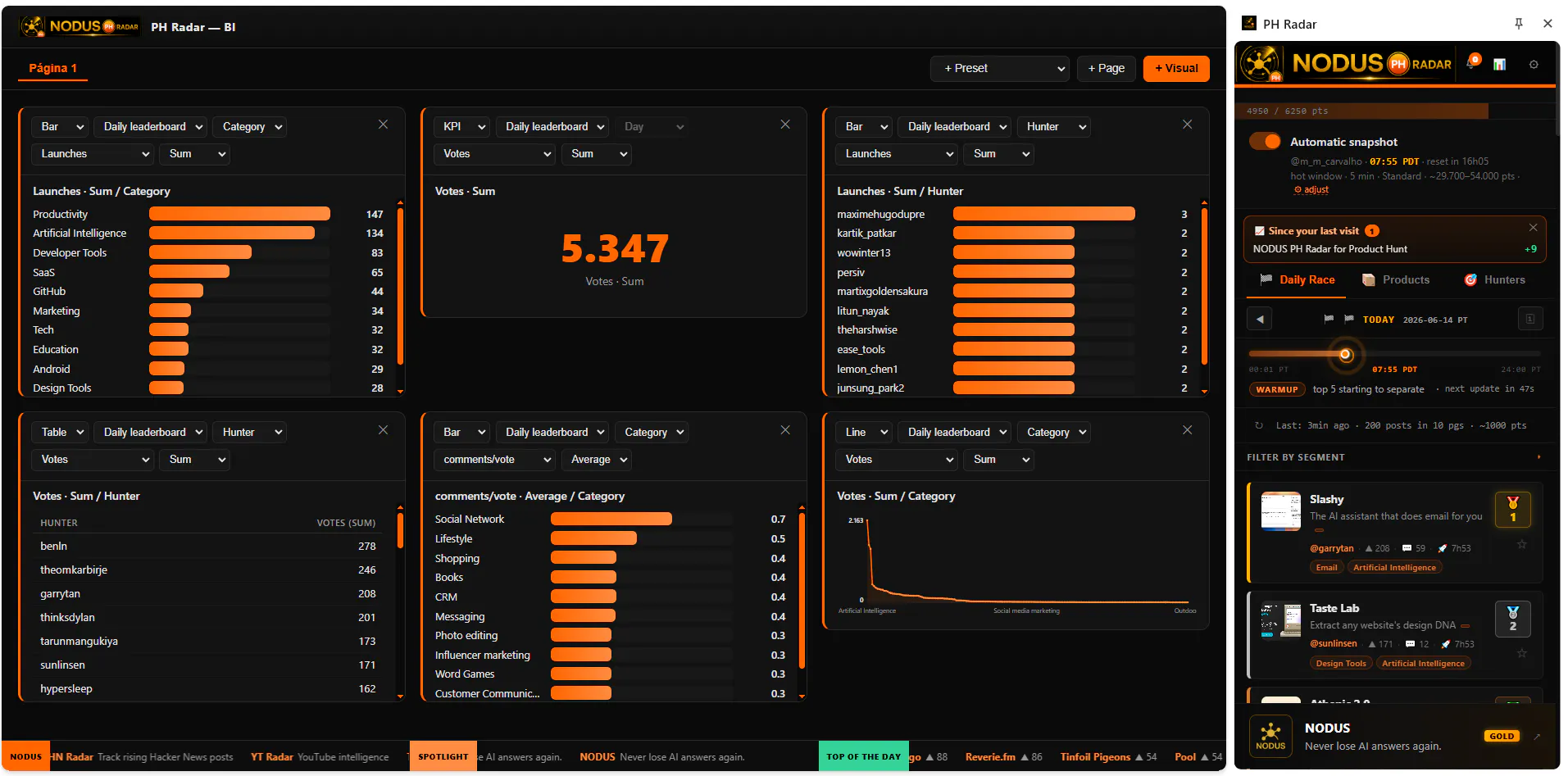
Update: prototyped the BI layer based on this thread's feedback. Here's a first pass — every card maps to what you all requested:
• Launches by category · Votes by category · Comment-to-vote ratios · Hunter activity · Historical trends
Plus auto-insights (movers vs previous period) and a watchlist with metric alerts. Still early — data fills in daily. What would you add?