I built a benchmark that runs nine WordPress backup plugins head to head on identical sites. One of the nine is mine, and it currently sits second. That is an obviously compromised position, so I have spent more time on what makes a vendor-run benchmark believable than on the measuring.
Three things I landed on, and I am not sure any of them are enough.
Publish the runs you threw away. 581 completed runs, 180 scored, 401 excluded, and every excluded one is browsable with its reason attached. Most are boring reruns rather than embarrassing failures, and saying so is part of the point: 360 superseded, 41 excluded for cause. The honest number includes the boring ones.
Say when a lead is not a lead. Mine sits five points above third place with plus or minus 113 error bars. That is a tie, and the page says tie rather than letting me quote the higher number.
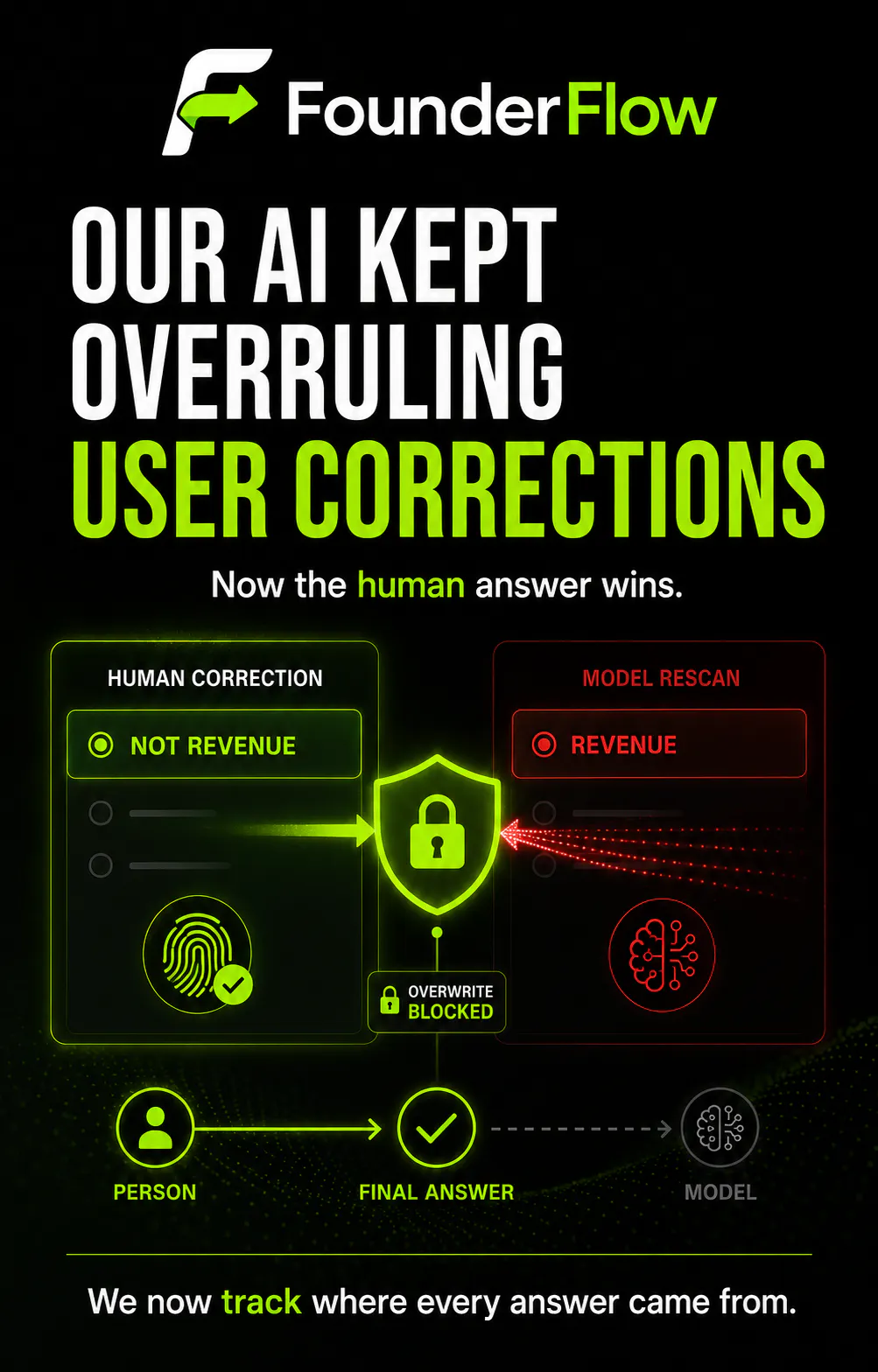
e let people correct us. Mark a sender as important. Fix a classification we got wrong. Tell us something we flagged as revenue isn't actually revenue.
Scroll through half the launches here and it's obvious. Cool tech, clever execution, no real problem underneath. Built because building is fun, not because someone was stuck without it.
Nothing wrong with that honestly, building for fun is a legitimate reason to build. But calling it a "startup" or acting confused when it doesn't get traction is where it falls apart. A bored person solving their own boredom isn't the same as a founder solving someone else's pain.
Be honest about which one you're doing. They need completely different strategies to actually work.
Most people building here are doing the first one and marketing like it's the second.
Every credit system I've used bills on the API call, not the outcome. So when a model returns something plausible and wrong, the user pays, then pays again for the version they actually wanted. You've priced your own failure rate and handed the bill to the person who noticed it.
The counter I keep hearing is that inference costs money either way. True, and beside the point. If a generation is unusable because we routed it to the wrong model, that's our decision, not their prompt.
Two things fall out of eating it yourself, both good. You have to define unusable narrowly enough that it can't be gamed, ours is a same-prompt regenerate inside a short window and nothing else. And you start caring a lot about routing, because a bad route now costs you directly instead of quietly costing someone else.
Curious who's actually doing this and where it broke for you. Most pricing pages I read still bill per attempt and call it usage.
Hey everyone! As I'm gearing up for my first-ever product launch here, and I was wondering, are there any experienced launchers out here, that could give their personal experience on their first launch. What worked for you, what didn't? What mistake turned out to become a pleasant surprise? Which expectations did not materialize, and which did?
The initial spark of an idea usually starts with a grand purpose and a wave of high motivation. However, over time, this process can turn into a cycle of professional and psychological exhaustion. As the project progresses, the idea hits walls relative to its purpose and fails to align with the real world. Sometimes, you have to give up right in the middle of building it; other times, as time passes and the idea keeps coming back to you, you begin to think it was just a nonsense idea in your mind all along. Watching a concept you once cherished slowly disintegrate like this is a process that pushes you to your psychological limits. As a founder or product leader, how do you prevent your mind from manipulating you with these ideas? When and how do you realize that an idea will actually work and that it isn't just a mental trap?
Our team is hitting a classic scaling bottleneck, and we need some technical advice and tool recommendations from fellow makers who have taken their apps global.
Right now, our core team only has English and Chinese language talent. Our product is English-only, but we re starting to see strong organic interest from non-English speaking markets like Japan and Russia.
We want to prioritize using AI or platform automation for localization, but we are terrified of translation accuracy and the heavy engineering required to proofread everything. For our marketing videos on YouTube and Facebook, the experience is incredibly seamless we just provide our English subtitle files, and the platforms handle the multi-language translations automatically. What we love most about this is that users trust platform-level translations more, which naturally shields us from user complaints if a translation error slips through.
Hello PH Community I'm running a digital credential business and trying to understand how people make use of their achievements to further develop my product. I'd be more than happy to hear your experiences!