

I stopped asking AI for more ideas and started asking it which assumption to test first
I've noticed something while using AI for startup research:
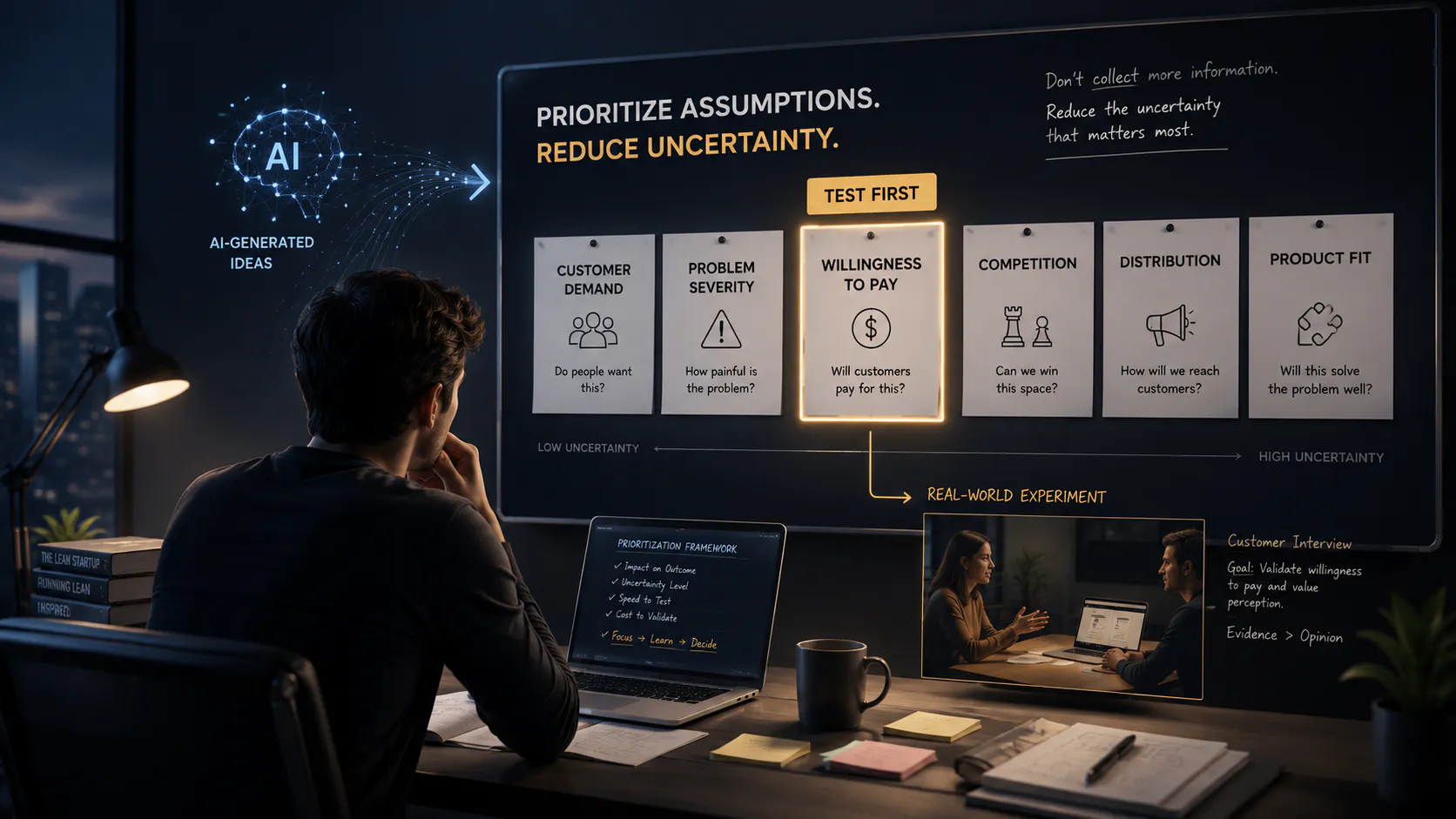
It's very good at giving me more things to think about.
More features.
More customer segments.
More competitors.
More business models.
More growth ideas.
At some point, more ideas stop being useful.
So I've been experimenting with a different prompt:
"Which assumption should I test first?"
That changes the output.
Instead of getting a longer list, I get something closer to a priority:
Assumption
Customers have this problem often enough to care.
Why it matters
If the problem isn't painful, everything built on top of it becomes less important.
What I'd need to learn
How often the problem occurs, what people do today, and whether they have already paid for an alternative.
Smallest useful test
Talk to a few people who currently experience the problem and ask about their existing workaround.
I like this workflow because it creates a stopping point.
You don't keep generating research.
You identify the uncertainty that matters most, then go and learn something about it.
I've been testing this approach while building AI products, and it has made me think differently about AI research:
**The goal isn't to collect the most information.
It's to reduce the most important uncertainty.**
Curious how other founders handle this:
When you have several unknowns around a product idea, how do you decide which assumption deserves to be tested first?
Replies
Be the first to reply
Have a question or a thought to share? Add a comment above to start the conversation.