

Shopify Is Shutting Down Stocky. Here's What That Means for Merchants
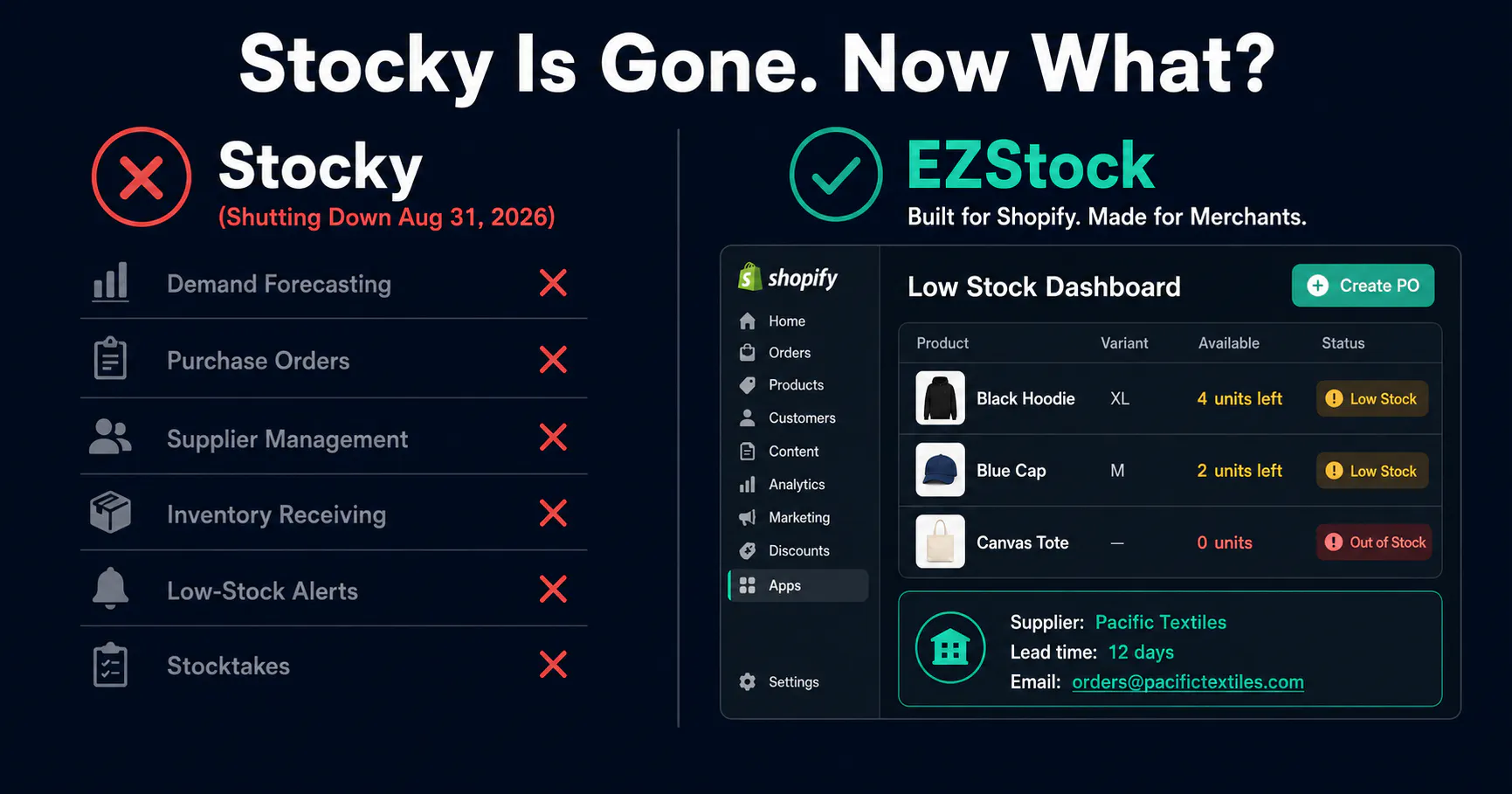
For years, Shopify merchants running physical inventory had something most SaaS companies charge hundreds of dollars a month for: a free, native inventory management tool baked directly into their admin. It was called Stocky. It handled suppliers, purchase orders, demand forecasting, low-stock alerts, and stocktakes — all without a third-party integration.
On August 31, 2026, it shuts down permanently.
The timeline is worth understanding in full, because it didn't happen overnight. In July 2025, Shopify quietly removed support for inventory transfers between locations and min/max forecasting — two of Stocky's most-used features. Then on February 2, 2026, Shopify removed Stocky from the App Store entirely: no new installs, no reinstalls for merchants who had uninstalled and wanted it back. August 31 is the final date — APIs go dark, and all historical data (purchase orders, supplier records, stocktake history) becomes inaccessible.
No migration tool. No export for supplier data. Merchants who have years of vendor contacts, lead times, and PO history inside Stocky have to manually recreate all of it somewhere else.
One merchant put it plainly in a Shopify Community thread: "The PO feature in Shopify is brutally inadequate. Using it takes more than triple the time to place an order."
That gap — between what Stocky did and what Shopify's native tools offer today — is the problem I built EZStock to solve. But before I get to that, it's worth explaining exactly what the market is missing and why the obvious alternatives don't fully cover it.
What Stocky Actually Did
The reason the Stocky shutdown is causing real disruption is that merchants underestimated how much operational infrastructure was running through it until it started disappearing.
Stocky had six core functions that Shopify's native inventory tools do not replace:
Demand forecasting. Stocky analyzed historical sales velocity to suggest reorder quantities — how many units to buy, based on how fast each SKU was selling. This alone saved hours of manual spreadsheet work every time a merchant needed to place a restock order.
Purchase order generation. Merchants could create structured POs inside Shopify, attach them to specific suppliers, and track each order through a full lifecycle: draft, sent, partially received, and fully received. When marked received, Stocky automatically updated inventory counts.
Supplier management. Each supplier had a dedicated profile: contact email, phone number, lead time in days, preferred currency, and order notes. This was the operational database behind every reorder decision.
Inventory receiving. When stock arrived, merchants could reconcile the PO against actual units received, flag discrepancies, and have Shopify's inventory updated automatically — no manual adjustments needed.
Low-stock alerts. Stocky tracked minimum stock thresholds and surfaced at-risk products before they hit zero.
Stocktakes and cycle counts. Merchants could run physical inventory counts inside Shopify and reconcile discrepancies without exporting to a spreadsheet.
These weren't premium features. They were free. Tightly integrated with Shopify's native product and inventory data. No API keys, no third-party connections to manage. For a small or mid-size Shopify merchant running 50–500 SKUs, this was the entire operational layer of their business.
Shopify's announcement acknowledged the shutdown but offered no direct replacement and no path to export supplier data. Everything in Stocky stays in Stocky until the lights go out.
What Shopify Left in Its Place
Shopify's native inventory tools after Stocky are exactly what they were before Stocky existed: quantity tracking. You can see how many units you have. You can manually adjust levels. You can export a CSV.
There is no reorder suggestion system. No purchase order workflow. No supplier contact database. No automatic inventory update when stock arrives. No low-stock dashboard across all your SKUs at once.
The Shopify Community thread titled "Replacement to Stocky?" has accumulated 2,886 views. Read through the replies and a clear pattern emerges. Merchants aren't confused about why this is a problem — they're frustrated that the answer from Shopify essentially amounts to "find something else." One merchant wrote: "We need basic inventory history reporting... not AI-driven demand planning." Another noted: "The logistics of performing basic stock takes is suddenly way more manual."
The common thread is scale. These aren't enterprise operators with warehouse management systems and dedicated procurement teams. They're Shopify merchants running real businesses — often solo founders or small teams — who relied on Stocky precisely because it handled the operational basics without requiring a $300/month ERP subscription.
That population of merchants — call it the missing middle — is where the problem lives.
What the Market Offers
When I researched what merchants are actually switching to, I went through the Shopify Community threads, read the recommendations, and tried to understand the real tradeoffs. Here's an honest picture:
Inventory Planner by Sage is the most frequently recommended alternative for forecasting. It's genuinely good software — sophisticated demand modeling, multi-channel support, strong integrations. It also starts at around $99/month and is primarily built for high-volume stores where forecasting accuracy on thousands of SKUs drives meaningful revenue impact. For a merchant managing 80 SKUs, it's overbuilt.
Cin7 Core is a full ERP. It starts at $349/month. It handles multi-warehouse logistics, manufacturing workflows, B2B order management, and more. It's excellent for the businesses that need all of that. For a merchant who just wants to email a supplier a purchase order and update their stock when it arrives, it's a completely different product category.
Prediko and Fabrikator are AI-driven forecasting tools. Both have merit for merchants where demand prediction is genuinely complex. They also come with a learning curve and a price point that doesn't make sense for straightforward restock operations.
Spreadsheets remain the most common fallback. This is understandable — Google Sheets is free, flexible, and familiar. It also doesn't send emails, doesn't alert you when stock drops below a threshold, doesn't auto-update when a shipment arrives, and doesn't scale past a certain point of SKU complexity without becoming its own management burden.
The gap isn't that no software exists. The gap is that the software available either serves a much larger business than a typical Shopify merchant, or it requires rebuilding operational workflows from scratch in a spreadsheet every month.
What EZStock Is
I built EZStock specifically to fill this gap. It's a Shopify embedded app — meaning it lives inside your Shopify admin, not in a separate dashboard — and it covers the same operational layer that Stocky did.
Supplier management. Add suppliers with their name, email, phone, lead time in days, preferred currency, and notes. Every supplier has a profile. When you create a purchase order, their contact details are already there.
Purchase order lifecycle. Create a PO in draft, add products and quantities, then send it — EZStock auto-emails the supplier a professionally formatted PDF. The PO moves through Partial/Received states, and when you mark it received, inventory counts update automatically.
Sales velocity tracking. EZStock calculates 30-day rolling sales averages per product variant, giving you a real basis for reorder quantity decisions instead of guessing or pulling manually from analytics.
Reorder points. Set minimum stock thresholds per product or variant. When quantities drop below your threshold, EZStock surfaces it.
Low-stock dashboard. One view showing every at-risk SKU across your store, with current stock, reorder point, and average daily velocity — so you can see what needs a PO immediately.
Pricing is straightforward, and there's a free tier to start:
— Free ($0/month): Unlimited suppliers and products, up to 5 purchase orders per month, low-stock dashboard with reorder points, email support. No credit card required.
— Starter ($19/month): Unlimited suppliers, products, and purchase orders, low-stock dashboard with reorder points. 14-day free trial.
— Growth ($49/month, most popular): Everything in Starter, plus demand forecasting, PDF purchase orders, automatic inventory update on receipt, and multi-vendor inventory report. 14-day free trial.
— Pro ($99/month): Everything in Growth, plus multi-location support, priority support, and early access to new features. 14-day free trial.
Why This Matters Beyond the Tool
Shopify's decision to discontinue Stocky reflects a strategic direction: the platform is moving upmarket. The investments are in enterprise features — B2B, Markets, fulfillment infrastructure. That's a legitimate business decision.
But the merchants who built their operational workflows around Stocky aren't enterprise operators. They're independent businesses — apparel brands, supplement stores, hardware shops, specialty retailers — running $200K to $2M a year on Shopify. They don't need AI-driven demand forecasting or a warehouse management system. They need to know when to reorder, how many to order, and to be able to email a supplier a professional PO in under two minutes.
Without a direct replacement, those merchants face three options: absorb the operational overhead of manual spreadsheet work, pay $300+/month for enterprise software that's 90% features they'll never use, or risk stockouts because they have no system for catching low inventory before it hits zero.
None of those options are good. The August 31 deadline makes it urgent.
EZStock exists to be option four.
EZStock Launches on Product Hunt June 9
If you're a Shopify merchant who used Stocky — or who's been managing inventory in spreadsheets and has been looking for a reason to fix that — I'd genuinely appreciate you checking it out.
Replies
Be the first to reply
Have a question or a thought to share? Add a comment above to start the conversation.