

How to calculate your reorder point for a Shopify store (the math most merchants skip)
Most Shopify merchants reorder on instinct. They glance at inventory, it looks low, they send a message to their supplier. Sometimes it works. Sometimes they're already in a stockout by the time the order arrives.
The problem isn't negligence — it's that the correct reorder point requires three numbers most merchants don't have readily available, and calculating it manually every week for every product isn't realistic.
Here's the actual formula:
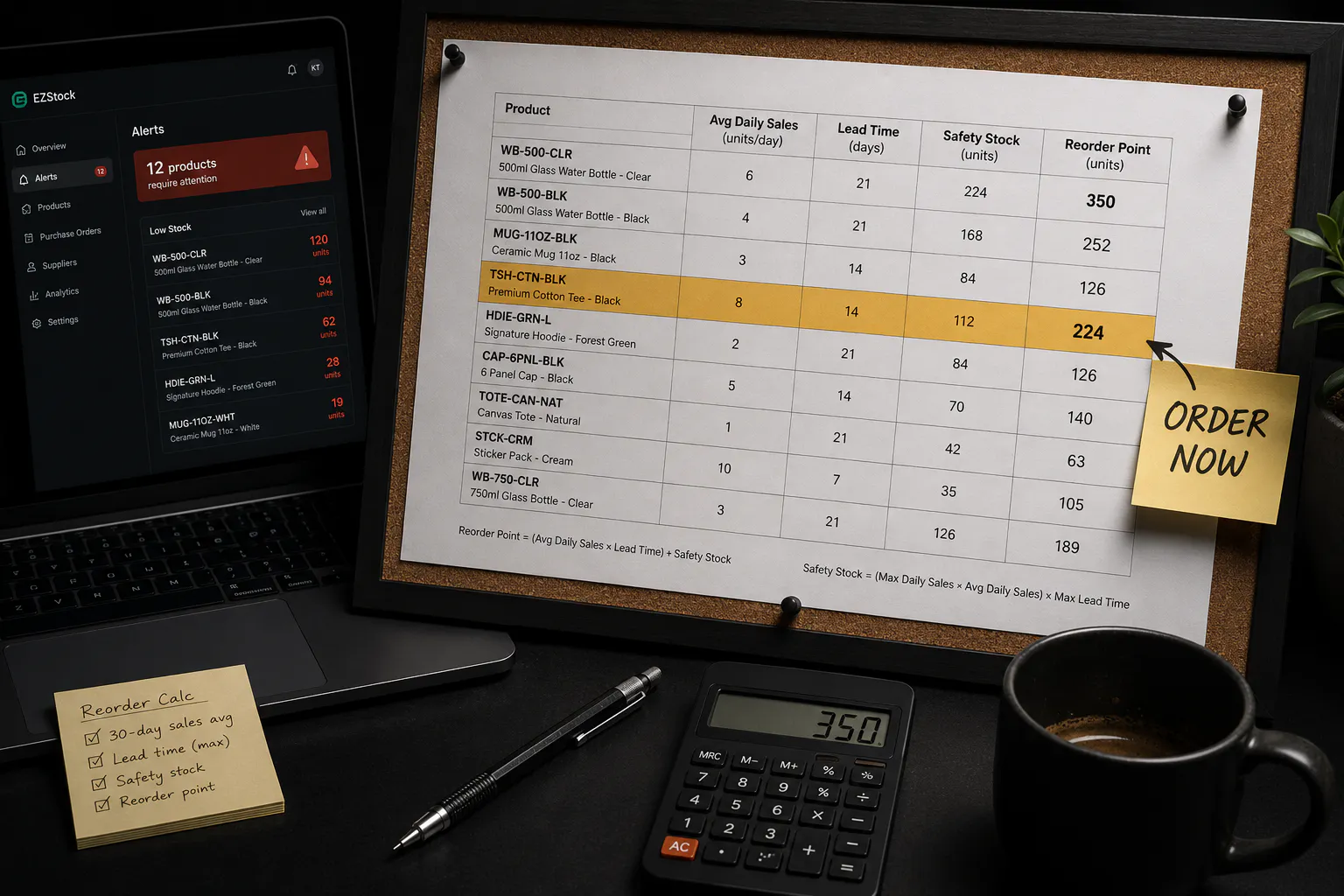
Reorder Point = (Average Daily Sales × Supplier Lead Time) + Safety Stock
Breaking that down:
Average Daily Sales — not your gut feel, but your actual 30-day average. If you sold 90 units of a product in the last 30 days, your average daily sales is 3 units/day. This changes seasonally, so recalculating monthly matters.
Supplier Lead Time — the number of days from when you send a PO to when stock arrives at your warehouse. This isn't just shipping time — it's order processing + production (if made to order) + shipping + your receiving time. For domestic suppliers this might be 7–14 days. For overseas manufacturers, 45–90 days is common.
Safety Stock — the buffer you keep to absorb demand spikes and supplier delays. A simple formula: (Maximum Daily Sales − Average Daily Sales) × Maximum Lead Time. If you occasionally spike to 8 units/day and your supplier has been as slow as 20 days, your safety stock should be (8 − 3) × 20 = 100 units.
A worked example:
Product: a 500ml glass water bottle
30-day sales: 180 units → 6 units/day average
Supplier lead time: 21 days (overseas manufacturer)
Max daily sales (peak): 14 units/day
Max lead time ever experienced: 28 days
Reorder Point = (6 × 21) + ((14 − 6) × 28) = 126 + 224 = 350 units
That means the moment your stock drops to 350 units, you should already be creating a purchase order. Not when you hit 100. Not when you notice it "looks low." At 350.
Most merchants doing this manually check stock once a week at best — by which time they may have already passed their reorder point without realizing it.
Where merchants go wrong:
Using total monthly sales instead of daily average (misses velocity trends)
Ignoring lead time variance — using "usually 14 days" when it's occasionally been 30
No safety stock at all, treating lead time as the only buffer
Recalculating manually so infrequently that seasonal demand shifts aren't reflected
How EZStock handles this:
EZStock calculates 30-day sales velocity per product automatically using Shopify order data. It flags products when current stock ÷ daily sell rate approaches your configured lead time buffer — so the reorder alert fires before you're in trouble, not after. You set your lead time and coverage days target; EZStock does the math in the background and surfaces the products that need attention on your dashboard.
The goal isn't to add complexity — it's to replace a mental model merchants are currently doing poorly (or not at all) with a system that runs automatically.
Curious what approaches people are using here. Are you calculating reorder points formally, or working from feel? And for those who've had a stockout — what did it actually cost you in lost sales or customer churn?
Replies
Be the first to reply
Have a question or a thought to share? Add a comment above to start the conversation.