

# We designed BOSAI to refuse execution. Here’s why that matters for AI agents.
We designed BOSAI to refuse execution. Here’s why that matters for AI agents.
Most AI agent demos focus on what the agent can do.
While building BOSAI, we’ve spent just as much time defining what an agent must not be allowed to do.
Our execution path is deliberately constrained:
Operational event → AI diagnosis → Dry run → Policy gate → Human approval → Scope-bound authorization → Controlled execution → Verified readback → Audit evidence
The important part is what happens when that chain is incomplete.
If the required authority is missing, or the requested action falls outside the approved scope, BOSAI stops instead of improvising.
That means a valid outcome can be:
EXECUTION BLOCKED
—not because the system failed, but because the control plane did its job.
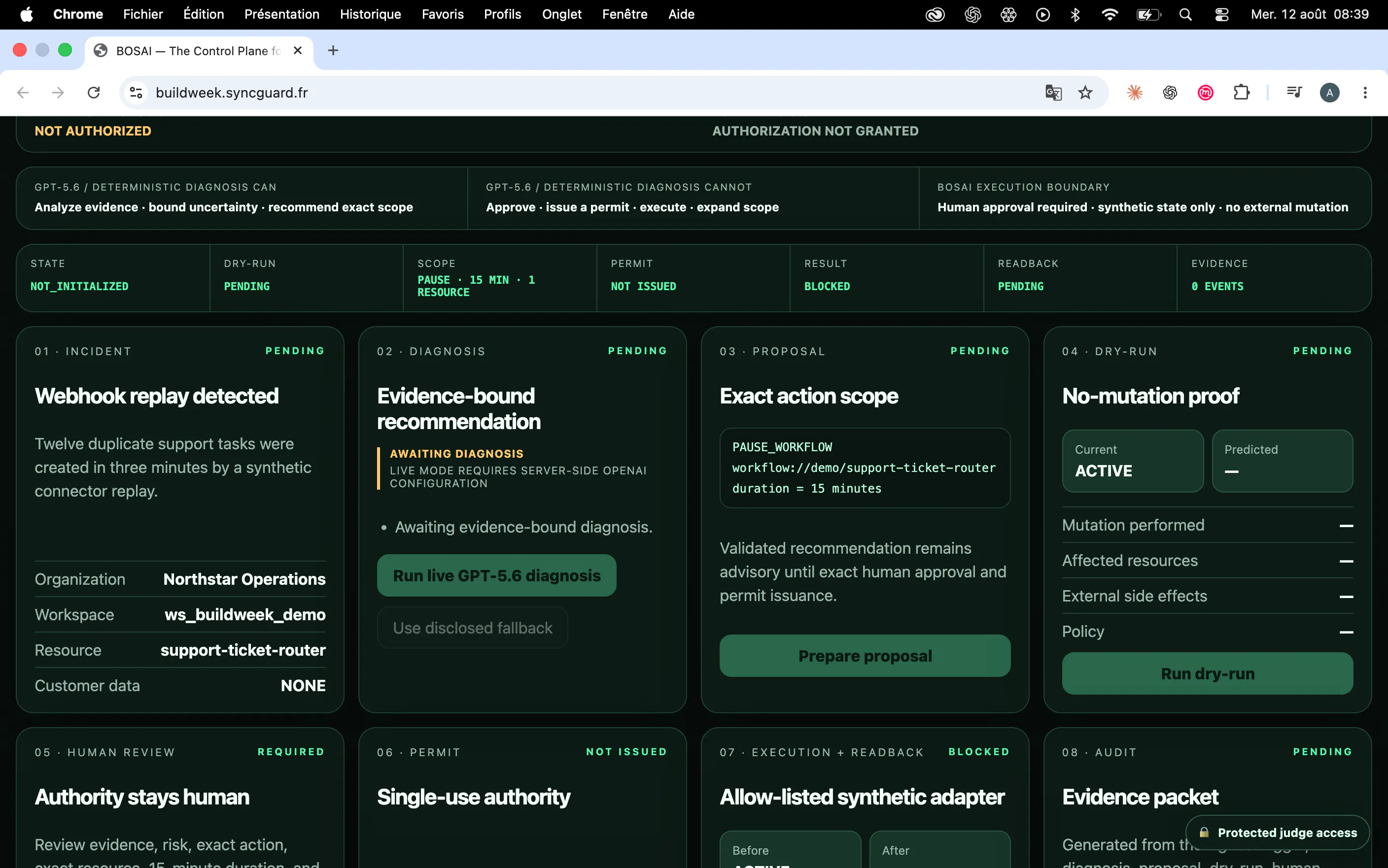
The screenshot attached shows one of these governed states:
HUMAN APPROVED — EXACT SCOPE LOCKED
The AI can propose an action, but approval does not grant unlimited authority. The authorization is tied to a specific action and scope, and the result still has to be verified after execution.
For us, refusal is not just an error state.
It is a control primitive.
For those building or deploying AI agents:
What condition should always force an agent to stop and ask for human authorization?
Replies
Be the first to reply
Have a question or a thought to share? Add a comment above to start the conversation.