Curious how builders here think about this: Would you trust an AI developer to work on a real production codebase today? Not just autocomplete or code suggestions, I mean actually taking a scoped task and shipping code updates. What would make you comfortable trying that, and what would be the biggest red flag for you?
I'm Sonny, a freelancer turned founder based in Cairns, Australia.
I built Pact because I kept watching talented freelancers including myself say yes to extra work they weren't paid for, because they were scared to say no.
Not because they didn't know their worth. Because they had no system to back them up.
In a discussion forum with @monatruong_murror , we talked about how AI can help us learn things that aren t naturally familiar to us, like programming.
The biggest challenge was/is: Getting AI to guide you toward a solution, instead of just giving you the answer.
Last week Garry Tan (CEO of Y Combinator) shared his entire Claude Code setup on GitHub and called it "god mode."
He's sleeping 4 hours a night. Running 10 AI workers across 3 projects simultaneously. And openly saying he rebuilt a startup that once took $10M and 10 people. Alone, with agents.
I've talked to 50+ founders about why they don't post on LinkedIn.
Almost all of them say "I don't have time" at first. But when I dig deeper, that's not really it. They'll spend 30 minutes scrolling Twitter, or an hour in a useless meeting, but they say they can't write one LinkedIn post?
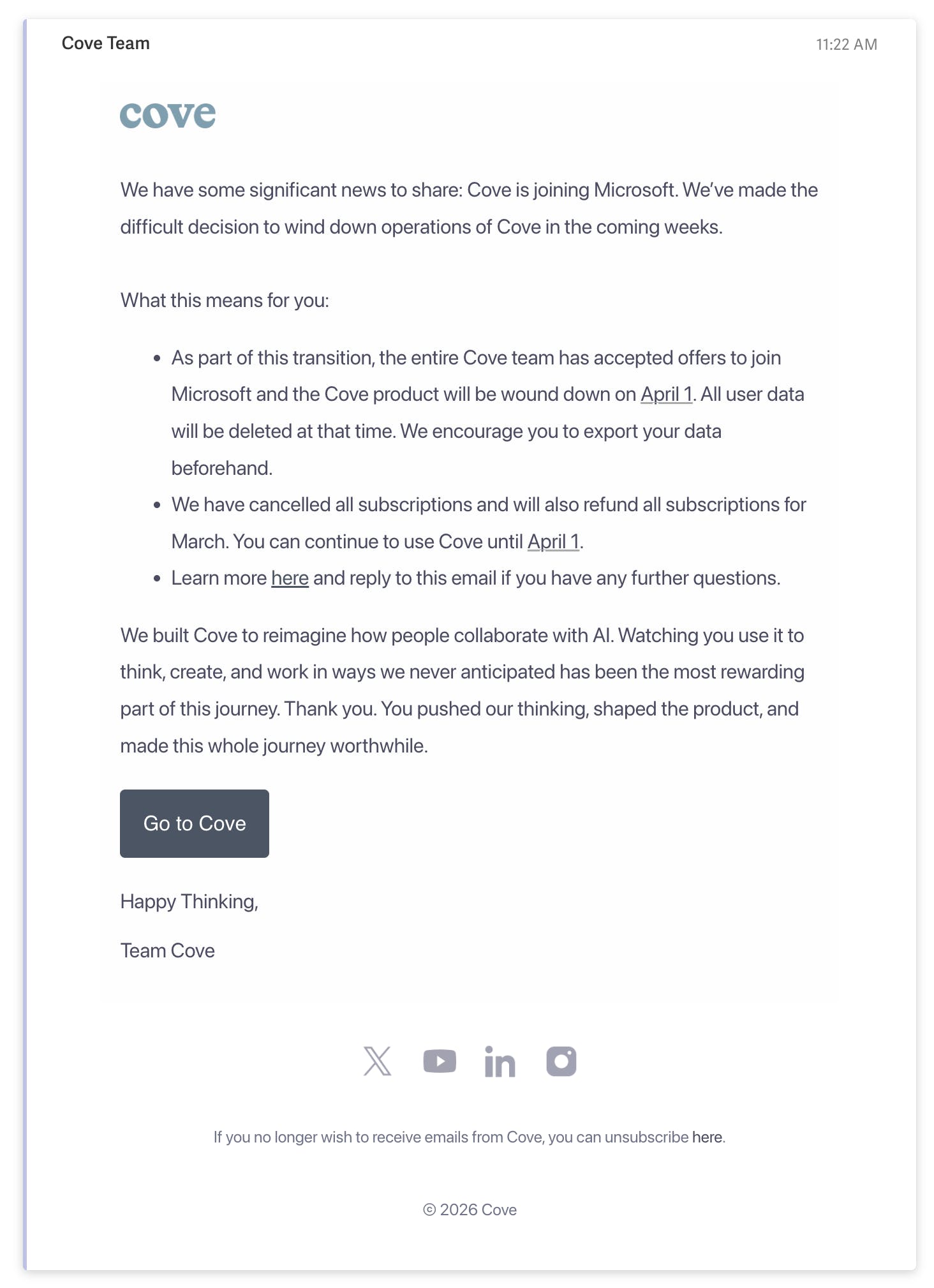
Cove has announced that they've been acquihired by Microsoft:
If you were a Cove user:
What this means for Cove
As part of this transition, the entire Cove team has accepted offers to join Microsoft, and the Cove product will be wound down on April 1. Existing users can continue using Cove until then, but we are no longer accepting new sign-ups.
We've built a data export feature so you can take your work with you. We recommend exporting as soon as possible all user data will be permanently deleted on April 1.
To export your data:
Sign in to your Cove account and go to your Account page.
Click the Export button.
You'll receive an email with a download link when your export is ready. The export will be a ZIP of HTML files containing all spaces you've created.
To export spaces created by others and shared with you, export each of those spaces individually.
Most CRMs weren't built for small businesses. They were built for enterprises and then "simplified" into cheaper tiers with half the features stripped out. And that's the core problem.
When a 5-person sales team signs up for a CRM, they don't need:
6-month implementation timelines
Mandatory training certifications
200-page admin guides
A dedicated "CRM manager" role just to keep things running
They need to know: Who talked to which customer? What was said? What's the next step?
Hey PH community. Yesterday we launched ClawSecure and landed #2 Product of the Day
ClawSecure is the free security scanner for OpenClaw AI agent skills. But I'm not here to pitch. I just want to share real traffic numbers and what I actually learned from our Product Hunt launch, so it's useful for other makers planning theirs
Here's the painful truth: Your site is translated. Your AI visibility isn't.
When a German user asks ChatGPT in German about your category, you're invisible. When a French prospect searches Perplexity in French, your competitor shows up.
I wrote a forum post not long ago on marketing as one of the rising in importance hires for all startups. This is all the things we've done, with some results and free resources.
Hi everyone! I m Jacob. I ll be launching one of my personal projects called Nomad here soon and wanted to introduce it first.
Nomad started as something I built just for myself. I work remotely and move between coffee shops, public tables, my apartment, and the occasional coworking space. I kept forgetting places I liked or struggling to recommend them to friends, so I made a simple app to log where I worked, tag the spot, and add a photo or note.
I ve been building things on the internet since the late 90s. Started out the same way a lot of people probably did back then, tinkering with early websites, figuring out how things worked, breaking things, fixing them, and generally making software do things it wasn t originally designed to do.
I ve always been more of a problem solver than anything else. If something annoys me or feels inefficient, my instinct is usually to try and build a way around it.
For most of that time I was a developer, mainly web and backend, but over the last year AI has completely changed how I work.
The way products get made hasn't changed in decades. A designer, a maker or an enterpernuer creates something. It gets passed through technical writers, ops and production teams, and back-and-forth email chains before a factory can even read it. Somewhere in that handoff, ideas slow down, get distorted, or disappear entirely.
We think that pipeline is ready to be rebuilt from scratch - with Genpire's AI at the center of it.