

Forums
 •
•1d ago
Anyone else running Opus 4.7 yet? This one feels different (with CC harness)
Anthropic just shipped Opus 4.7 today and i had to write about it somewhere because the jump is weird.
I ran the same backlog task on 4.6 and 4.7 back to back. same repo, same prompt, same tools. 4.6 looped on a bug for 25 minutes and was not going to solve it. 4.7 closed it in eleven, and the part that freaked me out is that it paused in the middle to sanity-check an assumption i had not asked it to check. literally wrote "before i write this migration, let me verify the actual shape of the response object, because my assumption here might be wrong" and then went and verified it. unprompted.
That self-verification behavior is the thing. Vercel is reporting it does proofs on systems code before starting work. Hex says it flags missing data instead of making up plausible-but-wrong fallbacks. Genspark measured loop rates on hard queries and 4.7 basically stopped looping. different teams, different harnesses, same pattern.
the numbers are nuts too:


Room types, device density, and a smarter optimizer
Big update. The optimizer can now prioritize high-traffic rooms over hallways and closets. Shoutout to @yotam_dahan who suggested density-aware placement.
Room type assignment - Right-click any room to tag it with a type from 46 presets across 6 building categories (commercial, residential, education, healthcare, hospitality, industrial). Each type carries a device density sourced from Cisco, IBC, and industry planning guides. Densities are fully adjustable per room. Custom type lets you name rooms whatever you want.
 •
•4d ago
Agents Need Names
TL;DR: .agent is the most strategically important TLD still without an owner. ICANN's application window opens in weeks. A company is going to bid for it - unless a community claims it first. Here's the story, and two questions I'd actually like pushback on.
---
Agents already need real addresses. I've been working on this for over a year, and the pitch just keeps getting simpler. Right now agents mostly live at a subdomain of whoever built the framework platform.com/yourname-7. Borrowed identity, borrowed trust.
If you want the concrete version, look at OpenClaw. An autonomous agent running on your machine with its own email (real OTP codes, real password resets), OAuth credentials across hundreds of thousands of SaaS apps, sub-agents spawning and talking to each other, webhooks, the whole thing. A worker, not a demo.
And in its first three days live, OpenClaw had to rename itself twice. The name it launched under - gone. That's the whole argument in one news cycle: agents running real lives from borrowed names are one legal letter away from disappearing.
.agent is the most strategically important TLD still without an owner. ICANN's next gTLD round opens in weeks. And once .agent is claimed, it's claimed - the internet's naming system doesn't hand these out twice.
If one company wins it, .agent becomes their product. They'd set pricing. They'd set policies. They'd decide who gets yourname.agent and who gets blocked. One company choosing shareholder interests over an open internet - because that's literally what it would be.
The community bid is a formal ICANN community application its own specific path with its own process. The goal, if approved: keep .agent open infrastructure. Open standards for agent discovery. No gatekeeper. Governance by the people actually building agents, within ICANN's rules.
23,000+ members have joined. Esther Dyson, who used to chair ICANN, and Illia Polosukhin, who co-wrote "Attention Is All You Need," are advising.
It's not done. ICANN scores community applications on size, governance, nexus, and endorsement depth. You need 12/16 points to beat the corporate applicants who are absolutely going to file. Every signal matters.
Two questions I'd genuinely like pushback on:
1. Is the naming layer for AI agents something the community should own, or is it fine if it goes corporate? I have a strong view, but makers building agents every day see things I don't.
2. If you think it should stay open - what governance rules would you want locked in from day one? What would make you still trust the TLD in 5 years?
If this resonates, the non-binding endorsement is here (30 seconds). The one-pager has the deeper version.
Either way, would love to hear what you think. Especially the pushback.
 •
•4d ago
What are your must-have features in the peronal finance app of yours?!
Hey everybody,
Yigit here! I am developing a personal finance app mainly based on what features I wish an app to have and it is on google play closed test now. Here is a quick summary:
The app's main value proposition is being able to keep track of your expenses 'automatically'. The rationale behind is the fact that in my country banking laws restrict individual's access to open banking apis. That is, you cannot have an API access to your bank to exchange information and keep track of your expenses unless you are corporate. According to my research, this feature is available in US and EU but only with certain restrictions in the latter.
I thought it could be sutaible time to ask the community about their needs about such an app and can guide me a long way before I commit further. Would you be so kind enough to answer below questions? Any replies are appreciated and thanks in advance.
Do you use personal finance app?
Could you please share your the most essential must-have features of the personal finance app of your choise and tell me why?
Under which circumstances would you give another app a try?
What would be the ideal price point for such a service in your perspective?


v0.10.17 is Live — Boards, Terminal Split, and Dark Mode Improvements
Hey everyone! Just shipped v0.10.17 here's what's new:
- Boards New /boards slash command with node types, collapsible groups, and node notes
- Terminal Drag-to-Split Drag to split and unsplit terminal tabs
- Dark Mode & Themes Refined surface system and improved colors


We stopped tracking daily active users and our product got better
For the first year of building Murror, DAU was the number we checked every morning. It was the first thing on our dashboard, the first metric in every team meeting, and the number we used to judge whether a feature was working.
Then one day we noticed something strange: our DAU was climbing, but our NPS was dropping. People were opening the app more often, but they were less happy with it. Some of our most engaged users were showing signs of what we started calling "compulsive checking" opening Murror out of habit rather than intention.


We have a new home! Welcome to the PawseKeys community
Happy Friday, everyone!
It s been an incredible journey since we first launched PawseKeys just a few days ago. What started as a simple tool to solve a problem in my own home, keeping my "furry coworkers" from taking over my keyboard, has grown so much faster than I ever imagined thanks to your support.


I have two ideas, please tell me which one is good and can be sold.
1=> Are you interested in a product that lets you insert your own face into any TikTok or Instagram Reel by automatically replacing the original person s face with yours?
2=> Scrape any website without writing code.
 •
•9d ago
AI and "Human in the loop" - what does that actually mean in practice?
Every AI agent pitch I see includes this phrase somewhere. Human in the loop. Human oversight. Human supervision.
But when I look at how it actually works inside most companies, it breaks down into one of three things:
A person reviews the output after the action already happened. A person could intervene but the system makes it slow and inconvenient. One person monitors a dashboard tracking 40 agents running tasks they do not fully understand.


[Extended] Easter weekend deal: $10/mo locked in for life (normally $29)
Quick one. I've been building software for over 20 years, and I've never done a seasonal discount before. But we just passed 40 free users, and I wanted to give people a reason to jump in this weekend.
The offer:
- Monthly plan locked in at $10/month (normally $29/month)
- That's 66% off, and the rate stays for as long as your subscription is active
 •
•10d ago
Are we over-engineering AI memory? (Markdown vs. Vector DBs for small datasets)
Hey makers!
Lately, I ve been looking closely at how independent builders and small teams are managing AI knowledge bases. It feels like the default "industry standard" is to immediately reach for a complex RAG pipeline and a heavy, paid Vector Database.
But I'm starting to wonder if we are over-engineering this for 90% of standard use cases.
Vector DBs are incredibly powerful for massive scale, but for smaller or non-massive datasets, they can be expensive, complex to query, and act as complete black boxes. If a search returns a weird chunk, diagnosing it is often a nightmare.
 •
•14d ago
Do you click for the cool logo or the clever tagline?
We all spend hours obsessing over every pixel and word before a launch, but I m curious about what actually works on you as a user.
When you re scrolling through the top products of the day, what is the one thing that actually makes you stop and click?
The Icon/Logo: Does a sleek, high-quality aesthetic signal a better product to you?
The Tagline: Does a clever or "punchy" one-liner win you over?
The Upvote Count: Do you only click things that are already trending?
The Problem: Do you ignore the branding and only click if the name solves a pain point you have right now?
 •
•16d ago
We realized 12% of our "Active" MRR was actually ghosts 👻 Have you checked your silent churn?
Hey everyone! I had a massive reality check this month and wanted to see if other founders have experienced this.
We use Stripe for billing and HubSpot as our CRM. Our dashboard looked incredibly healthy, MRR was growing, and deals were marked as "Active." But out of curiosity, we cross-referenced our active paying users with our actual product analytics (Mixpanel/PostHog).
Turns out, almost 12% of our paying customers hadn't logged into the app in over 20 days. They were "ghosts." Because their Stripe subscription hadn't failed yet, our CRM was completely blind to the drop-off, and our CS team was doing nothing to save them.
We ended up having to build a native bridge to pipe usage data directly into HubSpot to fix this.
 •
•17d ago
Why AI companies are building ecosystems in 2026?
Something raised in the last couple of months. And it's worth paying attention to.
Runway launched a $10M venture fund + free API credits for startups yesterday. Perplexity launched a $50M fund for seed-stage companies. CoreWeave Ventures launched in September. OpenAI has been running its Startup Fund for a while now.
 •
•18d ago
AI Decision Logs
Dear makers, do you keep somewhere the AI decision logs and what do you do with them? Say I have a AI chat and I ask it - create me this and that and they I use the results for something that brings bad user experience. Do you keep a log for the decision tree or the process and why?
Apart from your own use, is there a Law somewhere in the world that requires you to do that?
 •
•18d ago
Right-to-repair + asset tracking: EU laws changing consumer apps?
EU's Right to Repair stuff (and 2026 updates) now says electronics need 7-10yr parts + tough e-waste rules. But us consumers? We gotta prove service history, serials, ownership at repair shops without digging thru email/paper mess.
Asset tracking apps might be the fix: one GDPR-safe vault for full timelines (bill warranty repairs resale).
Thoughts:
•18d ago
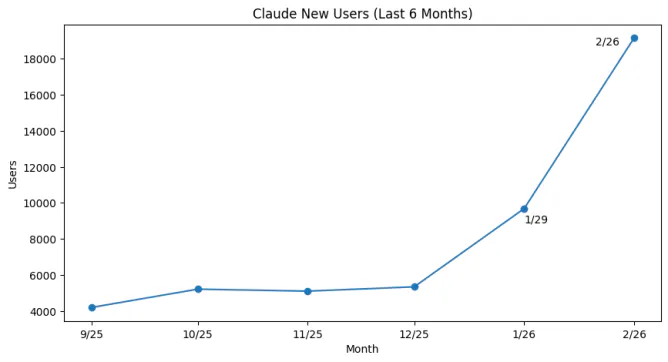
Why Claude is suddenly winning and what founders can learn?
Claude's paid subscriptions have more than doubled this year. New users hit record numbers between January and February. Previous users came back in record numbers too.
 •
•21d ago
We are obsessed with "daily streaks". But how do you track the irregular maintenance of life?
As builders, we love tracking daily metrics: MRR, GitHub commits, daily workouts, Inbox Zero. Standard habit trackers are incredibly optimized for this gamification.
But lately, I've realized my "mental RAM" gets completely eaten up by the irregular tasks. The stuff you only need to do every few weeks or months:
Changing the AC filter
Watering specific houseplants
Following up with that one dormant enterprise lead
Taking as-needed medication
Taking a full day away from the screen
 •
•21d ago
Please take responsibility for what you put out into the world
I can't believe the number of products posted here "anonymously."
Almost every product here is asking its users to provide some data. Even if it's just an email address. Which is obviously normal.
 •
•22d ago
The part about building nobody warns you about
When you're bootstrapping multiple products, there's this physical feeling that shows up and nobody ever talks about it. Your stomach is somehow empty and full at the same time. This knot that just sits there while you're trying to figure out which project needs you most.
I run Sparkum, Biteme, and LifeLines all under Onyx Labs. No investors. Every dollar is ours. Some days that's exciting. Other days it's just heavy.
A few things that actually help me:
Get specific. The "everything is overwhelming" feeling is almost never true. It's usually one or two things hiding behind everything else. Name them. The rest gets lighter.