
Webhound builds long-running AI research agents that scale quality with time and budget. Our agents can create either structured datasets or fully cited research reports.
This is the 3rd launch from Webhound. View more
Webhound
Launching today
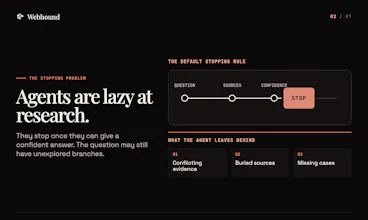
Research has no natural finish line. An agent can spend ten minutes or ten hours on the same question, and both answers can look finished. Webhound lets you choose how much work the question deserves. Give it a question and a dollar budget. It follows leads and checks weak claims until the budget is consumed, then returns a cited report or sourced dataset with the sources and working documents behind it. Run Webhound yourself or call it from your agent through MCP or the API.





Free Options
Launch Team / Built With


Webhound
@harithavijayakumar Thanks, and great question! On the agent side, you can inspect the chain of reasoning and every tool call.
In the report, you can open any claim to see the original source, exact supporting evidence, how Webhound found it, any potential caveats or biases, and its confidence score. You can also inspect the working documents from the run.
How does Webhound handle conflicting sources? If two credible references disagree on a fact does the report flag that discrepancy or try to weight one more heavily based on the research trail?
Webhound
@aiden_pearce7 Webhound does both, depending on the evidence. It looks at where each claim originated, how current the information is, and whether primary records support it. If that gives Webhound a clear reason to trust one source more, the report uses that source and explains the choice. It will also flag the existence of the conflicting source in the report, with reasoning on why it chose not to use it.
If the evidence remains split, Webhound flags the discrepancy instead of forcing a conclusion. You can open the claim to see both sources, the evidence from each, and Webhound’s confidence in its assessment.
More budget gives it more time to look at as many possible conflicting sources as possible, and as a result more transparent coverage of the topic.
If a $5 run hits a dead end early, does the user get to adjust the budget mid-stream or is it strictly set at the start?
Webhound
@freya_jensen_d Yes, you can increase the budget while Webhound is researching. You can also stop the run early if you no longer think the question deserves more work.
Having said that, we’ve seen many examples of runs where the fourth or fifth lead got past what first looked like a dead end.
Congrats on the launch! qq When the budget runs out mid-run, does the report tell me what it did not get to?
Webhound
@alieksia Yes. When the budget runs out, Webhound finishes the report with the evidence it gathered and lists the gaps it did not reach or could not resolve.
You can inspect the research plan and working documents to see which branches remain open. Webhound also suggests follow-up questions aimed at filling those gaps. If one matters, you can add more budget and continue the same run.
@mfkhalil Thanks. Over MCP, does the gap list come back as structured data or as prose in the report? Topping up the budget is a decision I would rather make in code than by reading a document.
Webhound
@alieksia The follow-up recommendations come back as structured data through webhound_get_session and webhound_get_evidence_pack. Each recommendation includes a title, description, suggested budget, and the guidance Webhound would use for the next research cycle. Your code can inspect those fields and call webhound_add_budget if the extra work passes your spending rules.
@mfkhalil
Thank you, that is exactly the shape I wanted. Having the suggested budget as a field means the spend decision can sit in code rather than in a prompt.
Interesting! That framing of budget-as-stopping-primitive is definitely worth attention. Most research tools stop when the prose sounds finished rather than when the work is actually done. Curious whether you guys plan the search tree up front and rank leads by expected payoff? Is it greedy step by step and just stops when the meter hits zero?
Webhound
@artstavenka1 Webhound plans coverage first, then revises the plan as sources reveal new leads. The executor works each batch, and the verifier can reopen weak or unsupported claims. The budget controls the run without locking Webhound into its initial plan or a greedy path.
probe real submit pathBudget as the stopping rule makes sense, especially when another agent is waiting on the answer. The trust layer I’d want is a short handoff note: what was checked, what was intentionally skipped, and which unresolved claims could change the decision if someone spends another hour.
Webhound
@krekeltronics Thanks. Yeah I think budget it the best option we have so far, unless we can find an indicator / primitive that is more representative of how much work has been done. Also yes, that is the information that is included in the handoff, although it can be hard to identify every "unknown unknown"
I see that this is positioned as the "research engine" behind your AI agent, but it wasn't clear to me how this is different than getting the frontier model to do deep research and continually prompting it to continue researching after the default stopping point.
Webhound
@rich_sun It is different, but not entirely, especially now with /goal and the likes-- you are right to make the association. I would say some of the biggest differences stem from Webhound being a multi agent system where the chain of thought, artifacts, and memory are designed around web research.
That being said, I also personally don't want to be constantly prompting my frontier model to dig deeper-- I want to be able to tell it how much compute to use and have it come back once it has finished, not earlier.