
Vida
Clone yourself. Let AI do the work before you ask
729 followers
Clone yourself. Let AI do the work before you ask
729 followers
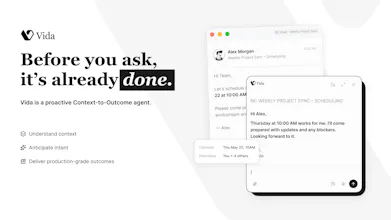
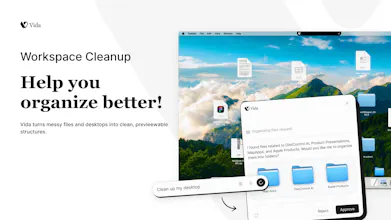
Vida is an AI that learns how you work, remembers what matters, and becomes more like you over time. The more you use Vida, the more it understands your habits, your projects, and your way of getting things done. Eventually, it works like a second version of you—quietly handling repetitive work in the background before you even ask. Today, we’re launching our first 5 SOTA use cases: Reply Rescue · Prompt Rescue · Resume Rescue · Workspace Cleanup · Daily Wrap 95 more to conquer in public.




Free Options
Launch Team / Built With


Dropbox SignSimple, secure eSignatures for the way your team works.
Promoted
@tehreem_fatima5 Thanks! That’s a tough one.
If we had to pick, it would probably be Reply Rescue. It captures what we think Vida should be—a system that understands enough context to take real work off your plate, instead of just generating text.
That said, Workspace Cleanup has also been a lot of fun because it’s such an everyday problem that almost everyone can relate to.
Hopefully we’ll have many more favorites as we work through the next 95 use cases! 🚀
The questions in this cases for me is always the same. How many tokens? How much control? Who is responsible for that?
With this being said, it seems an incredible app with huge potential.
@bruno_perez_borrell Great questions—really appreciate you bringing them up.
On tokens, we’ve intentionally avoided tying core capability to usage limits or feature locks. Instead, our pricing is designed to stay simple and low-cost, while letting users choose what fits their own needs.
We’ve also open-sourced parts of our stack, including OpenChronicle and BrowserBC, if you’re interested in how we think about memory and agent skills in more depth:
https://github.com/Einsia/OpenChronicle
https://github.com/Einsia/Browser-BC
For users who want more control, you can even explore or self-host parts of the system locally.
We’re trying to balance flexibility, transparency, and control depending on how people want to use Vida.
Very cool - how do you train my data?
@divyansh_lohia Thanks!
We actually don’t train our models on your data.
Your interaction history stays on your own device, not on our servers. Vida learns your preferences from your local context to provide better assistance, but your data is never used to train or improve our foundation models.
I can see this becoming really powerful if it integrates deeper with Slack/Notion workflows over time.
@vanvan_zhao1 Totally agree.
We see Slack and Notion as key surfaces where Vida can become much more useful over time—especially when it comes to understanding ongoing work context rather than isolated tasks.
We’re already moving in that direction step by step, but the focus is always the same: making sure integrations actually improve real workflows, not just add more connections.
The trust-curve answer above is the right design, and it makes one question matter more: once Vida graduates from suggest-and-preview and starts acting in the background, what does the morning-after look like? A did-this-while-you-were-away log with one-click undo is what would keep me comfortable staying at high autonomy. Preview protects me before it earns trust - the log is what protects me after. Congrats on the launch!
@syed_noor4 I love this perspective.
“Preview protects me before trust. The log protects me after.” That’s a really thoughtful way to frame it.
We completely agree that as Vida becomes more autonomous, transparency becomes even more important. An AI should evolve as your work evolves, but it should never become a black box.
A “did this while you were away” log is a fantastic idea, and we’ll seriously think about it. We want users to always understand what Vida has done, why it did it, and stay in control.
Really appreciate you sharing this.
@giddens Love that you're open to it. One tip if you build the log: make undo work per-action, not just per-session. Being able to reverse one thing without unwinding everything else Vida did that day is where the "stay
in control" promise actually gets tested. Rooting for the 100-use-case run.
Congrats on the launch. Curious which LLM you're using behind the scenes?
@ismaelyws Thanks a lot.
We use a model-routing approach behind the scenes—different tasks are matched with the most suitable models depending on the type of work, context length, and reliability requirements.
The goal is always the same: optimizing for consistent real-world outcomes rather than relying on a single model.