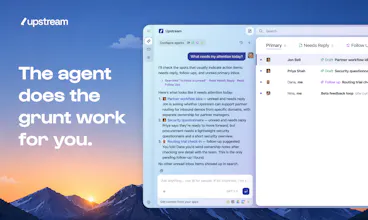
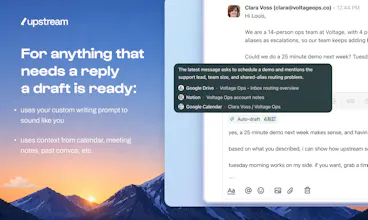
Finally, an inbox you'll look forward to. Agents sort your messages, draft your replies, and clear the grunt work behind the scenes, all in a client so well-crafted that email feels light, fast, fun.
No reviews yetBe the first to leave a review for Upstream
That does look great ! Is this something you are considering expending beyond emails ? (I know Slack is really the thing that's killing my productivity today...)
Your data is completely private and is only used to power your Upstream experience, like drafting in your voice, classifying your inbox, and answering your questions in chat. It is never used to train shared AI models.
Late to the thread but loving what I'm reading — especially Jonathan and Louis confirming nothing goes out without approval. That's the right instinct.
The follow-up I'd love your take on: how do you keep that approval step from becoming its own inbox grind? At high volume, approving every single draft can quietly recreate the exact load you're trying to remove. The teams I've watched do human-in-the-loop well tend to tier it — once the agent has earned trust, it auto-handles the truly low-stakes stuff ("got it, thanks") on its own, and reserves explicit approval for anything that actually commits you to something.
Curious whether Upstream leans that way, or keeps a hard approve-everything line on principle? Either way — congrats on #1. 👏
@syed_noor4 Thanks for your thoughtful comment Syed! In Upstream actions need an explicit approval or send.
I'm curious what type of low stakes messages you would be comfortable having an agent send on your behalf. And on the other hand are there specific messages that you would never want an agent to automate?
The stuff I'd let it send on its own all has one thing in common: it's relaying a fact, not making a decision. Order
status pulled straight from tracking, "got it, we're on it" acknowledgments, answers that map 1:1 to a policy you've already published (return window, hours, sizing chart). The agent isn't choosing anything there; it's just saving someone a click.
What I'd never automate is anything that commits you: refunds, discounts, replacements, "yes we can have that to you by Friday." And anything going to a customer who's clearly upset, because that's a tone and judgment call and getting it wrong there costs you the relationship. Same for anything the agent just isn't confident about. Low confidence should route to a human, not take a guess.
So, the line I'd actually draw isn't "low vs high stakes," it's "fact vs decision." Stakes feel fuzzy in the moment, but fact-vs-decision you can write a clean rule around. Curious whether that maps to how you're thinking about it on the Upstream side.
@syed_noor4 thanks for taking the time to write such a thoughtful response. I like the "fact vs decision" framing, definitely sounds like a cleaner distinction than low-stakes vs high-stakes.
Report
the "bet on the tool everyone uses" call is the right one. every "kill email" startup eventually shipped a thing 10 people use. the people drowning in 200 emails a day don't need a new protocol. they need the inbox they have to behave differently.
real question for the team: how do you handle the trust gap when an agent drafts a reply? specifically the moment a user has to choose between "send the draft" and "rewrite it because the agent missed nuance i never spelled out." that's where every AI email tool i've tried lost me. the cost of correcting the agent eventually exceeded the cost of writing from scratch.
if upstream's solved that ratio, that's the only thing that matters.






That does look great ! Is this something you are considering expending beyond emails ? (I know Slack is really the thing that's killing my productivity today...)
Upstream
@remy_z yes! Our vision is to help you get on top of everything that is important in your work life: Slack for sure, but also whatsapp, linkedin, etc.
Upstream
So cool ! if I sign up for this, is my data private? Do you use it to train AI models?
Upstream
@jean_philippe Thanks for giving us a try!
Your data is completely private and is only used to power your Upstream experience, like drafting in your voice, classifying your inbox, and answering your questions in chat. It is never used to train shared AI models.
Upstream
@jean_philippe Also a quick note: we're CASA Tier 2 certified
Upstream
@jontiret 🛡️
Late to the thread but loving what I'm reading — especially Jonathan and Louis confirming nothing goes out without approval. That's the right instinct.
The follow-up I'd love your take on: how do you keep that approval step from becoming its own inbox grind? At high volume, approving every single draft can quietly recreate the exact load you're trying to remove. The teams I've watched do human-in-the-loop well tend to tier it — once the agent has earned trust, it auto-handles the truly low-stakes stuff ("got it, thanks") on its own, and reserves explicit approval for anything that actually commits you to something.
Curious whether Upstream leans that way, or keeps a hard approve-everything line on principle? Either way — congrats on #1. 👏
Upstream
@syed_noor4 Thanks for your thoughtful comment Syed! In Upstream actions need an explicit approval or send.
I'm curious what type of low stakes messages you would be comfortable having an agent send on your behalf. And on the other hand are there specific messages that you would never want an agent to automate?
@louislecat
The stuff I'd let it send on its own all has one thing in common: it's relaying a fact, not making a decision. Order
status pulled straight from tracking, "got it, we're on it" acknowledgments, answers that map 1:1 to a policy you've already published (return window, hours, sizing chart). The agent isn't choosing anything there; it's just saving someone a click.
What I'd never automate is anything that commits you: refunds, discounts, replacements, "yes we can have that to you by Friday." And anything going to a customer who's clearly upset, because that's a tone and judgment call and getting it wrong there costs you the relationship. Same for anything the agent just isn't confident about. Low confidence should route to a human, not take a guess.
So, the line I'd actually draw isn't "low vs high stakes," it's "fact vs decision." Stakes feel fuzzy in the moment, but fact-vs-decision you can write a clean rule around. Curious whether that maps to how you're thinking about it on the Upstream side.
Upstream
Makes sense! Love the breakdown. Noting it all down for when we automate this even further :-)
Upstream
@syed_noor4 thanks for taking the time to write such a thoughtful response. I like the "fact vs decision" framing, definitely sounds like a cleaner distinction than low-stakes vs high-stakes.
the "bet on the tool everyone uses" call is the right one. every "kill email" startup eventually shipped a thing 10 people use. the people drowning in 200 emails a day don't need a new protocol. they need the inbox they have to behave differently.
real question for the team: how do you handle the trust gap when an agent drafts a reply? specifically the moment a user has to choose between "send the draft" and "rewrite it because the agent missed nuance i never spelled out." that's where every AI email tool i've tried lost me. the cost of correcting the agent eventually exceeded the cost of writing from scratch.
if upstream's solved that ratio, that's the only thing that matters.
Upstream
@sabir_hussain15 It all depends on your email volume, the types of inbound message you receive, and how often you typically reply to messages.
What are you most common email use cases?
Upstream
Upstream
@sabir_hussain15 @jontiret Jon "aka" the agent automation king. This guy would automate his breakfast if he could
Upstream
@sabir_hussain15 It depends on your inbox, but the main savings come from having drafts, triage, and follow-ups ready without prompting from scratch
ApplySeed
Upstream
@bengeekly We've got an iOS app, check it out 🙂
Upstream
@bengeekly @louislecat And it's gorgeous!
Upstream
Is Outlook on the roadmap?
Upstream
@nicole_harrison yes! Hoping to do it as soon as possible
Upstream
That's going to be interesting to implement Outlook :)
Upstream
@jontiret Oh boy we're in for a ride 🔥
Upstream
You can still try with your Gmail account if you have a personal one