
Your customers ask AI before they ask Google, and most brands have no idea whether they show up or lose to a competitor. Every other tool hands you a visibility score and stops there. Scribble does the whole loop: audit where you're invisible across every AI engine, create content that closes the gap, and amplify it through 50,000 creators who only get paid when AI cites them. A gap report won't win customers. Being the cited answer will.




Forum Threads


View all

Hey Product Hunt Fam!
I'm Kaavya, co-founder of Scribble Network. I've been a marketer and community builder for as long as I can remember, and have been deep in the GEO rabbit hole for a while now.
Two shifts got us here:
Creator and UGC budgets are eating into platform ad spend.
AI search loves to cite UGC when it builds an answer.
Which raised a question we couldn't drop:
Could money spent on creators actually move a brand's AI search visibility?
We tested it.
We were best suited to do this, because we started Scribble two years ago as a UGC platform with 50,000+ creators and over 100 campaigns run.
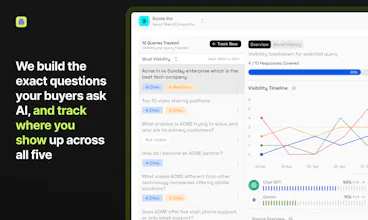
So we plugged that platform and creators into a homemade AI visibility intelligence tool and ran it on one client across 25 queries.
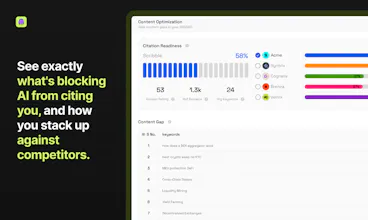
The tool generated content topics and gaps that the creators then made authentic content about on surfaces LLMs could read.
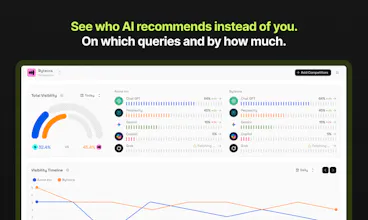
They were at around 2% aggregate visibility across the top 5 models. The market leader on the same queries was at 58%. Three months of steady UGC on the surfaces LLMs actually read, and that client now sits at roughly 25%.
That's when it clicked.
Every AI visibility tool out there could tell us we were invisible and where the answers came from. None could get us cited.
That's a distribution problem, but almost every AI Search product was treating it like a visibility problem
So we built the thing nobody else has: the first AI Search tool married to a creator platform.
We don't just measure your AI visibility, we fix it.
Our product attributes each brand mention back to the exact creator post that earned it.
And the platform now pays creators when they get cited. Creators love this.
This is our edge. We came at this from distribution and not measurement.
We never asked 'how do we track this?', we asked 'how do we actually get brands cited?'
The answer to this already lives in Scribble; try it on your own brand and tell me what you find.
Honest feedback wanted.
My co-founders and I are here all day answering everything.
@kaavya_prasad interesting approach with the creator bounties!
a question. how do you prevent attribution messiness if multiple creators write about the same query and both get cited?
@mohsinproduct There is no attribution messiness. Let's take this case. 2 creators are cited for one answer. It's never for the same section. Article one would have been used for one point and article 2 would be used to make another one. We have seen different sections in an answer get cited from the same piece also. The attribution is down to the last word with Scribble and we haven't experienced messiness yet.
Definitely looks like a useful resource for GEO, which is a market that lacks maturity compared to SEO and is crying out for orgs/products that help and give a boost to small startups. I find the pricing page slightly confusing because the headline pricing doesn't suggest any content generation for the insight plan but, scrolling down, it seems you get 10 pages of creator sourced LLM pages. This feels worth promoting in the headlines? Unless it's not as beneficial as it sounds. One other query. You say Claude is coming soon, but only for the Custom plan. Would it not be possible to select the four you want to be tracked? Perhaps swap Perplexity out for Claude etc. All in all, this is definitely a product I will consider using. Congratulations.
@martin_tanner You're absolutely right - our pricing page definitely needs work. The insight plan has content via creators, and it's damn useful. It ensures that the website gets cited at least, if not mentioned. With regard to swapping LLMs that are important to you - defnitely on the roadmap. This needs a bit of engineering on our end. Also, Claude has been tricky to serve on insight, but nothing our engineering overlords can't fix. Really thoughtful questions and we will report back to you soon with both these fixed!
The live-query approach is the right call, but the thing that bit us building retrieval-backed answers is run-to-run variance. Ask the same model the same prompt twice and the cited sources shift even with temperature pinned, because the retrieval layer re-ranks on freshness and whatever got indexed that hour. So 'this post held as a source on this date' has a real noise floor under it. Do you sample each tracked query a few times to separate a piece genuinely falling out from the model just rolling different sources that run?
@dipankar_sarkar Really good point, and no - we don't multi-sample within a single check, it's one call per prompt per day. So you're right that any single day's snapshot has that noise floor baked in.
What we lean on instead is the time dimension: we track each prompt daily, so a single day's citation shift doesn't mean much on its own, but a source holding across multiple consecutive days is a much stronger signal than any one-off result. We treat "cited once" very differently from "cited consistently across a week" — the former could easily be retrieval-layer noise, the latter is much harder to explain away as randomness.
But come to think of it, intra-day sampling would let us catch "genuinely fell out" vs. "just this run's re-rank" much faster than waiting on the daily trend. Worth us adding, especially for high-stakes prompts. Appreciate you pointing it out :)
Honestly this is part of why clients pick us to keep the creator UGC pipeline going instead of treating it as one-and-done. With this much noise in any single snapshot, staying visible isn't about one piece landing perfectly, it's about having a steady volume of fresh creator content in rotation so there's always something recent for the model to pick up.
Also, sounds like you've worked on this problem yourself. Would love to pick your brain sometime if you're up for it :D
The creators-only-get-paid-when-AI-cites-them model is the part I would want to understand operationally, since that is the whole trust loop. AI answers rarely link sources deterministically and the citation shifts by model and even by re-asking the same query, so how do you attribute a specific AI citation back to the creator whose content earned it, cleanly enough to trigger a payout? Is that matching automated, or is there a human review step before creators get paid?
@hazy0 Lots to unpack there.
1) AI answer shuffle sources for sure. But we’ve seen consistency with well-written UGC and industry reports.
2) Our frequency is once a day, and the citation unlock happens when a piece gets cited at least 2-3 times over a 7-10 day period. As campaign submissions happen on our platform, we’re able to cross-reference with answer sources (add the screenshot with the green bubbles)
3) This matching is currently done manually, and we’re automating it progressively. Over time, these proofs and payments will be publicly verifiable, and payouts will be instant via Stablecoins.
Thank you for thinking about this so deeply! :)
Appreciate the detail — the 2-3 citations over a 7-10 day window as the unlock threshold is what makes the payout defensible. Since matching is manual now but heading toward publicly verifiable proofs: what's the anchor you verify against — a stored snapshot of the AI answer captured at cite-time? The same query re-answered a week later can drop the citation entirely, so that snapshot seems like the thing a creator would need to dispute a missed payout.
@hazy0 We're going the smart contract route for this. We will write scribbler <> citation data on chain with the copy of the answer and the engine, with a timestamp on a public blockchain. This will trigger a USDC payment instantly as the conditions are met. All logs will be viewable on a block explorer - we'll obviously make it a bit more readable. And yes - this is useful for creators as it stands now. But over time this data graph builds, and we could potentially have an industry <> Creator citation probability that is verifiable. Brands might really like that. Thinking along these lines at the moment.
Writing the citation proof on-chain with a timestamp is the right call for making payouts disputable. One thing I'd nail down: do you put the full answer copy on-chain, or a hash/content-address with the actual answer text in off-chain storage like IPFS/Arweave? Full text on-chain gets expensive fast at daily volume, but if only the hash lives on-chain, a creator disputing a missed payout still needs the original captured answer preserved somewhere immutable to hash against, so where does that canonical copy live?
@mattchannelldev Thank you! And you've basically answered your own question with that last line, because that's exactly what we keep seeing: the content that gets cited IS the content made for humans.
We watch the opposite fail every day. People try writing "for the LLM" stuffed, hollow, optimised-sounding stuff, and it either never gets picked up or falls out on the next refresh. Engines recycle their sources constantly, and what survives is genuine opinion, real usage, specifics. The models are actively hunting for authentic human content, which is why they cite UGC over brand pages in the first place. So "optimising for citation patterns" and "writing genuinely useful content" turn out to be the same job.
I do agree with your push on incentives at scale. Our guardrail is structural rather than editorial, creators aren't paid for a citation, they're paid when a piece holds as a source atleast three times in a week. So a piece gamed for one lucky pickup earns nothing; only content the models keep independently choosing pays out, and that's consistently the human-first stuff. If the engines ever start rewarding junk, our alignment breaks, but so does AI search itself, so we're comfortable making that bet.
Also feel your pain on the traffic tank, that's the exact story we hear from most brands coming in. Curious what you tried on the GEO side so far?
@kaavya_prasad I like that; the structural guardrail is neat. Paying based on whether a piece holds, rather than on a single citation, basically forces quality by making gaming uneconomical. It produces a better answer than most editorial policies because it doesn't rely on anyone's judgement; the incentive just points the right way on its own.
On the GEO side, it's early days for us. We're midway through moving off WordPress onto a cleaner stack, partly because the old setup made structured data and content architecture harder than it needed to be. Beyond the technical hygiene, the main shift has been away from writing for keywords and towards writing genuinely useful, specific content that answers real questions properly. In short, on the SEO side, we got burnt by working with an SEO agency; they turned an upward traffic trend downwards with poorly written (AI-generated, by the looks), keyword-stuffed content.
What we haven't cracked yet, and will be looking to on the new site, is measurement. Knowing whether what we are doing is moving citation visibility is the missing piece, which is presumably the exact gap you are building into. How early does the signal show up to illustrate it's working? Three months felt like the number in your post, but I'm curious how noisy it is before that.
@mattchannelldev That agency story is unfortunately the most common origin story in our pipeline, sorry you lived it. The good news is the human-first shift you've already made is the hard part.
On timing, the first signal is fast. When content lands on surfaces the engines actually read, first citations can show up within days. So you know quickly if you're being picked up at all.
A trend you can trust takes longer. Early citations are noisy, engines recycle sources, so a piece appears, drops, comes back. That's why we measure whether a piece holds across refreshes, not single snapshots. The three-month arc in the post was 2% to ~9%to ~20%, and month one was the noisiest.
So, days to know you're being picked up, weeks to see direction, about a quarter for a trend worth making decisions on.
And yes, that measurement gap is exactly what we built.
One tip, run your domain through our tool on the new site, you'll have a clean baseline for the before/after. Happy to get on a call with you post.
@kaavya_prasad I will get on that and drop you a line after.
Paying creators only on sustained citations is a smart anti-gaming filter, the three-times-a-week threshold especially. From the consumer app side my experience matches your thesis, discovery moved to communities and AI answers faster than any dashboard showed it. Do the bounty economics work for consumer mobile apps too, or does the loop only close for B2B where a cited answer is worth real contract money?
@narek_keshishyan Short answer- hard for consumer apps as AI engines don’t refer traffic as much as traditional search.
Long answer - AI search volumes are at an all time high. But it doesn’t even begin to compare with traditional search for referral traffic volume. Now you could make a case that AI visibility is correlated to increase in direct traffic and volume on branded key words (side note we will be able to measure this with our upcoming GSC and GA integration), but until we’re able to do that level of last mile attribution, it only makes sense for
Products with > 100 USD ARPU
Services and products that need research before purchase
@kaavya_prasad That ARPU line is the honest cut, and it matches what I see from the consumer-mobile side, AI engines basically never send a referrer, so the whole loop is invisible to attribution. Where I'd push gently: for a consumer app the value of AI visibility shows up as being the thing the model names when someone asks it for a recommendation in a category, not as a referral click. That's real demand, it just never lands in GA or GSC because it's zero-click and usually happens a conversation before the install. Your branded-search correlation idea is probably the closest proxy anyone gets until attribution catches up, are you seeing branded lift actually track AI mentions in early data, or is it still too noisy to call?
@narek_keshishyan We don't have enough data yet tbh. But when the feature rolls out, we can start to see more - will keep you posted.
@kaavya_prasad That's the honest answer at this stage, fair enough. When it does roll out, the early signal I'd watch isn't total mentions — it's mentions on the questions a human would've answered "it depends," because that's exactly where an AI recommendation displaces a search instead of echoing one. That's the line where consumer GEO either earns its keep or doesn't.
That time-dimension framing makes sense, a source holding across consecutive days is a much stronger signal than any single snapshot. The thing I'd watch is whether your daily cadence outruns the engine's actual index-refresh cadence. When we sampled daily we sometimes saw a source hold for four or five days purely because the underlying index hadn't re-crawled yet, so the stability was the crawler being lazy, not the citation being durable. Did you find a refresh rhythm per engine, or does it look random?
@dipankar_sarkar Great catch! "Held for 5 days" could just be index staleness rather than a durable citation.
We do actually have the underlying data to check this, we just haven't analyzed it through this specific lens yet. Let me dig in and get back to you on whether there's a real refresh rhythm per engine or if it's more random. Appreciate you pushing on this, this thread's turning into a solid list of things to think about :)