
Powabase
Build AI apps with Postgres, RAG, and agents
938 followers
Build AI apps with Postgres, RAG, and agents
938 followers
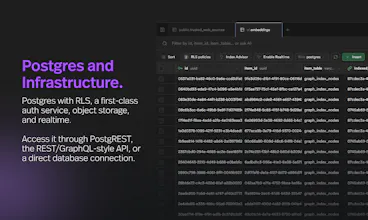
Powabase is a backend-as-a-service for AI-native applications, combining Postgres, RAG, agents, memory, workflows, and automation primitives in one platform. It helps agencies and in-house IT teams build new AI apps or add AI automation to existing products without stitching together fragmented infrastructure. Designed to work seamlessly with modern coding agents, Powabase helps teams ship faster while building more robust, token-efficient systems.





I like that you’re focusing on token efficiency as a platform concern, not just a model concern. Hidden orchestration costs are becoming a massive issue.
@daniel_henry4 Glad you noticed!
Two ways we impact token efficiency:
Building every project from first principles and debugging glue code+infra setup via Codex, Claude Code, or OpenCode can be VERY wasteful in terms of tokens. You can save significantly by leveraging well-crafted abstractions during development. This is where Powabase shines!
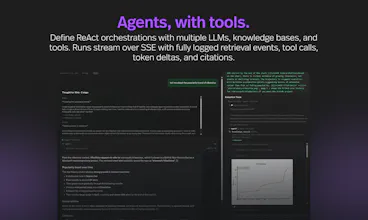
Traditional RAG or agent orchestrations done via Supabase + LangChain does not incorporate intelligent "agentic" retrieval. To get the right answer on the first try, you generally have to compensate with larger reserved context. This is wasteful in terms of tokens. Powabase's native multi-agent orchestration uses a similar architecture as Claude Code. When set up correctly, your agents can be much smarter about where to look for the most relevant pieces of context instead of stuffing everything in one go based on cosine similarity. You can also control reasoning levels directly if you want fewer "hidden reasoning tokens" at inference time.
@daniel_henry4 Adding to Hunter's point — the unglamorous lever here is observability. Most "hidden" orchestration cost is hidden because the existing stack doesn't show it. We surface token usage broken down by model, agent, and source (agent run / orchestration / workflow), plus per-run trace with reasoning steps, tool calls, and the RAG context that got retrieved for each step. Once you can see it, the optimization is usually obvious — you stop arguing about prompt length when the real waste was a poorly-targeted retrieval call.
Can one deploy isolated environments per customer/org?
@nuseir_yassin1 Yes, our enterprise plans offer dedicated hosting on client's chosen AWS region or their own data centers.
We also plan to offer a self-hosted open source version after early access period ends, likely around end of June / July 2026.
quick q, can teams export workflows + memory/state?
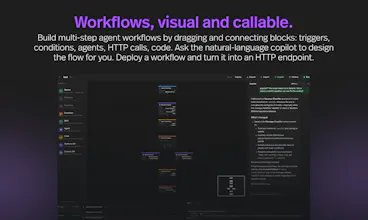
@krutiparekh16 Yes. Workflows are really just templated JSON objects. You can export them easily and re-import them into a different workflow for use as a module.
In terms of agent memory, everything is stored in the built-in Postgres db tables. You have full access and control over every part of your agent orchestration.
(I hope I understood your question correctly!)
How much time took to do it?
@mykola_s The idea came to us about a year ago. We started building by using Supabase's open source codebase as a baseline, then extended it with our own unique features and integrations.
Powabase is not a "static" solution. Given how quickly the AI landscape shifts, we need to be moving with it as well. So the work is never truly finished. Going from Supabase open source baseline to v1 of production-ready Powabase took about 6-7 months.
Shoutout to Claude Code. It's a great coding assistant that really helped us accelerate the development process.
This is very interesting. If this integrates deeply with Claude Code / Cursor workflows I can see dev agencies adopting it really fast. Congrats on shipping.
@roopreddy We are a dev agency ourselves so hopefully what we built could be useful for other dev agencies and teams looking to build their own AI-native SaaS.
We believe the future will be one with hyperpersonalized SaaS solutions enabled by coding agents and robust infra frameworks like Powabase.
@roopreddy currently we have comprehensive API docs and cookbook examples which can guide coding agents on how to build on Powabase and use our AI features. In the future we plan to add MCP and Agent Skills to make it even easier. For the standard Supabase features such as auth or storage, we have the same API, so it'll be familiar to coding agents. We also allow direct connection to the underlying Postgres DB. This is an area in which we'll be continuously improving - I myself been building client apps on Powabase with Claude Code
@1lastshot thanks for your support! Powabase essentially evolved out of GPT-trainer. We learned a lot of lessons when we tried using it as an AI agent platform for other apps we were building (e.g. AI-powered document processing) but ran into pain points with GPT-trianer's focus on chatbots. We're hoping that Powabase, "backend we wish we had", will help others build AI-native apps too, and we'd love to hear more about what apps you may be trying to build!
@1lastshot Following up from @michael_t_chang , Powabase was inspired by the fact that many users of GPT-trainer requested direct API access to the backend. Instead of stripping out the backend from an end-user SaaS, we thought it was best to properly address the root demand and build a dedicated AI-native BaaS instead.
Thank you for your positive feedback and encouragement!!
@1lastshot Thanks so much! Genuinely want to hear what you're building. Drop me a line about your use case and I'll help you set it up on Powabase.
@xin_chen17 Really appreciate that and I'd love your feedback on my idea. Is there a good way to contact you? The GPT Trainer support email, or Powabase discord, other...? Product Hunt doesn't have a DM option anymore.
@1lastshot We have a Discord at: https://discord.gg/k8W2A9KRtc. I am there most of the time so please feel free to drop in and ask any questions!
This launch caught my attention on the leaderboard for its positioning. May I ask how this compares architecturally to LangGraph Platform or Mastra?
@zerotox Good question. The key difference is scope. LangGraph Platform and Mastra are primarily orchestration frameworks, they give you great primitives for defining agent workflows, state, and control flow, but you still bring your own backend: vector store, database, auth, file storage, etc., and wire it all together yourself.
Powabase folds that whole stack into one backend. You get the orchestration layer (RAG, ReAct agents) plus the data and infra layer (vector storage, metadata, retrieval) integrated out of the box, so there's far less glue code between your agent logic and the services it depends on.