
PeakRoutine
Personalized health coaching powered by your biomarkers
526 followers
Personalized health coaching powered by your biomarkers
526 followers
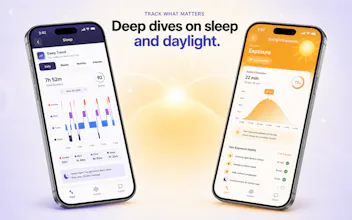
PeakRoutine connects your sleep, sunlight, exercise, calories, nutrition, mood, hydration, and more — correlates them against each other — then tells you exactly what it means for your body. No generic plans. Just a proactive AI coach that learns your biology and builds habits around it.






PeakRoutine
Hey Product Hunt 👋 — I'm Siddhant, co-founder of PeakRoutine.
Two years ago I was pre-diabetic at 32, staring at an Apple Watch full of data and still had no idea what was actually making me sick. Turns out it was my sleep. No app told me that. That's the thing nobody tells you: most health apps are expensive mirrors. They track everything and change nothing.
So we built one that would.
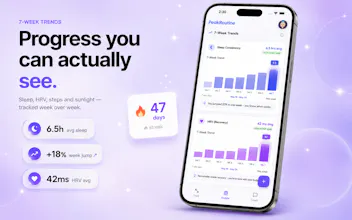
That gap became PeakRoutine. We pull in everything — sleep, sunlight, exercise, calories, nutrition, mood, hydration, HRV, stress — and instead of handing you another dashboard, our AI correlation engine finds the patterns that matter for your body specifically. Not a generic plan. Your biology, learned over time.
Here's what that looks like in practice:
You sync through Apple Health, so your Apple Watch, Oura, WHOOP, or whatever you use all flows in automatically.
We correlate your biomarkers against each other and surface the relationships you'd never catch manually — the ones that explain why you've been dragging this week.
Six AI health coaches answer anything about your sleep, recovery, stress, nutrition, or energy, grounded in your full biological picture.
A biology-aware habit engine builds your daily routine around what your body can actually handle right now — not what a template says you should do.
We recently became new parents — which has a way of making you ruthless about long-term health. You stop optimizing for today and start thinking in decades. It also showed us how differently health shows up depending on who you are and what season of life you're in. Women's health and parent-specific experiences are next on our roadmap — not as an afterthought, but because we've lived the gap firsthand.
So we built around your biology, not a dashboard.
If you've ever looked at your health app and thought "so what?" — this is built for you.
We're in early access on TestFlight right now — a small, intentional rollout before our full App Store launch. Install takes 2 minutes. Honest feedback from this community means everything at this stage — the good, the bad, and especially the brutal.
One question to kick things off: do you actually act on your wearable data, or mostly just look at it?
For the launch day we are offering 35% - come and try it out and I am sure you will love it.
AMA in the comments. Let's talk. 🙏
@siddhant_gupta12 Yeah, wearable data provided instant action impulse, get me to work on things for a day or two and when the fear subsides, back to what I do normally, ignoring the health related red flags. Does Peakroutine provides a plan, motivation and daily achievable goals to work on the red flags?
PeakRoutine
@satyaajeet You just described the exact frustration that led me to build PeakRoutine. That 2-day motivation spike is real — wearables are great at creating fear, terrible at sustaining action.
Yes — this is exactly what PeakRoutine is designed for. It takes your red flags (low HRV, poor sleep, elevated resting HR) and turns them into a personalized daily habit plan with small, achievable goals. Not a one-time alert, but a consistent loop — detect → analyze → adapt — so the plan evolves as your body does.
The idea is to make the healthy action so small and specific that it outlasts the fear 🙂 .
Would love for you to try it out and tell me if it sticks!
PicWish
@siddhant_gupta12 love the focus on actionable habits over just data mirrors. btw are you guys running 6 LLM agents with custom prompts for the coaches or is it one unified model?
PeakRoutine
@siddhant_gupta12 @mohsinproduct Appreciate that — actionable over data-mirror is the whole thesis 🙌
It's 6 custom models, one per coach — each with its own prompt, role and memory tuned to its specialty (Sleep, Recovery, Nutrition, etc.). But they all read the same shared biomarker context, so they stay consistent and hand off to each other instead of giving you six conflicting takes. Six specialists, one source of truth underneath.
@siddhant_gupta12 Many congratulations on the launch, Siddhant. :)
When Siddhant reached out to me about PeakRoutine, he didn’t just share a product pitch, he shared his personal story of recovering from pre-diabetes at 32. That raw honesty about his own health journey is exactly why I backed this hunt.
PeakRoutine offers personalized health coaching powered by your biomarkers. Instead of another dashboard, it connects your sleep, sunlight, exercise, calories, nutrition, mood, and hydration and correlates them against each other to reveal hidden patterns only your body shows.
Most health apps just track your health data, PeakRoutine is the opposite: a proactive AI coach that learns your biology over time and builds habits around it, not around generic templates.
The fact that it was born from Siddhant’s own frustration with wearable data that created fear but no action makes this mission deeply personal and trustworthy. Give it a spin! :)
PeakRoutine
@rohanrecommends This genuinely made my day — thank you so much for this 🙏
You captured the "why" behind PeakRoutine better than I sometimes can myself. That frustration of having data that creates anxiety but no clear path forward — that's exactly what kept me up at night (ironically making my HRV worse 😄).
The fact that you took the time to share not just what the product does but why it exists means everything at this stage of the journey. This community is something else.
For anyone reading - we're live on TestFlight and would love your honest feedback. The good, the bad, and the brutal. That's how we get better. 🚀
@siddhant_gupta12 Congratulations for the launch!!
I have always felt that Apple health lacks in giving the overall understanding of my health. I need to understand what high or low HRV means, etc. Does peak routine help with overall wellness? Do I get a daily score / tips to help Me achieve a top score (wellness wise)?
PeakRoutine
@aadesh_m_bagmar This is exactly the gap PeakRoutine was built to close! Apple Health is great at collecting data but terrible at explaining what it actually means for you.
Here's what you get in PeakRoutine:
Understanding your biomarkers — we don't just show you your HRV, we explain what it means in plain language, why it shifted, and what's likely driving it (poor sleep the night before? high stress day? recovery after exercise?)
Daily wellness score — yes! You get a unified score that pulls together your sleep, HRV, activity, stress, mood, hydration and more into one number, so you always know where you stand.
Personalized tips — not generic "sleep 8 hours" advice, but nudges grounded in your biology. If your HRV is low and your sleep efficiency dropped, your coach might suggest a lighter workout today and an earlier wind-down tonight.
Think of it as the layer between your wearable and actually knowing what to do — the interpreter your health data never had. 🙌
Would love to have you try it — we're on TestFlight right now!
In my experience every other app guilt-trips you over one bad night and kills the streak, so building around what your body can actually handle that day is a real wedge, congrats! I was wondering at n=1 with noisy wearable data, how do you stop it surfacing a coincidence as a pattern, i.e. telling me morning sunlight fixed my sleep when really I just skipped the late glass of wine? Is there a confidence threshold before a correlation becomes advice?
PeakRoutine
@artstavenka1 Thanks — and you nailed why the streak model is broken: punishing one bad night ignores that some days your body just can't
The sunlight-vs-wine case is the perfect question, and honestly: from passive n=1 data you can't fully separate two things that moved together. Nobody can. So one good night never becomes "sunlight worked."
What keeps coincidences out: the moment your wearable syncs we pull your last 90 days, so we're reading across dozens of nights — and a pattern has to repeat (including days the "wine" wasn't a factor) before it's advice. One-off signals stay low-confidence and never surface. So yes, there's a real threshold before a correlation becomes a recommendation.
The real fix though is the test loop: hold one variable for a few days and see if your sleep replicates. Holds without the wine → real for you. Doesn't → we drop it. About as close to causal as you get at n=1, and we'd rather admit that than dress a fluke up as proof.
PeakRoutine
@harini_mukesh Great question! Yes, absolutely. One of the most interesting things we've seen is that users often assume exercise or nutrition is the main driver of how they feel, but the data frequently points elsewhere. For example, some users discovered that just 20–30 minutes of morning sunlight was closely linked to better sleep quality and recovery, while others found that a few nights of poor sleep had a much bigger impact on mood and HRV than they expected. Helping people uncover these hidden connections is exactly why we built PeakRoutine.
Scarlett.
Congrats on the launch @siddhant_gupta12 !
Why would someone use this instead of Apple Health? Is the biggest differentiator the unified dashboard, the AI insights, or the habit-building system?
PeakRoutine
@byalexai Thanks so much 🙏
Great question - and the honest answer is we're not trying to replace Apple Health, we sit on top of it. Honestly, it's not any one of them. The dashboard, AI insights, and habits are all just pillars toward the real goal: actually improving your health, not just recording it.
Apple Health is a brilliant vault — it stores everything but tells you almost nothing. PeakRoutine actually makes sense of that data - surfacing correlations, trends, and patterns and tells you in plain language what it means for you, then helps you act on it through habits while taking into account recovery days, so one off day doesn't wreck your momentum.
None of the pillars does much alone. Together, they turn your data into a healthier you. That's the difference.
Congrats on the launch. Is this more of a preventive care app or it's meant for people with chronic conditions or both? How do you envision it?
PeakRoutine
@himani_sah1 Thanks so much, Himani! ✨
Honestly, it's neither in the clinical sense — at heart it's a wellness app. The whole point is helping you feel and function better day to day, and turning that into habits that compound into real long-term health.
So less "diagnose or manage a condition," more "understand your body, build the small habits that keep you well, and actually stick with them." Anyone can use it — it's about everyday wellness and playing the long game, not replacing medical care.
That's exactly how we envision it: your long-term health and habit-building companion. Curious what made you ask?
Health coaching based on your actual biomarkers is a great angle. Which biomarkers does PeakRoutine track, and how do you input them?
PeakRoutine
@doganakbulut Thanks! 😊
Core ones: sleep (duration + stages), HRV, resting heart rate, steps/activity/active energy, workouts, and daylight exposure — plus mood, journaling, and nutrition on the self-reported side.
Best part: you don't really input most of it. Connect Apple Health once and it pulls everything automatically — whatever your wearable writes to Apple Health flows in, nothing to type. The only manual bits are quick mood, journaling, and nutrition check-ins.
ChatWebby AI
Finally an app that turns my wearable data into something I can actually act on instead of just staring at. Does the habit engine adapt on low-recovery days, or hold me to the same plan?
PeakRoutine
@zain_sheikh This made our day 🙌 — "act on it instead of staring at it" is literally the whole reason we built it.
And yes, it adapts. Holding you to the same plan on a low-recovery day is exactly the streak-guilt trap we wanted to kill. When your recovery, sleep or HRV say you're running low, the engine dials the day back — swaps the hard session for a walk or mobility, protects your streak instead of breaking it, and nudges the harder stuff to a day your body can actually take it.
And it doesn't just hand you tasks — every step tells you what it affects and how it'll help (the "why it matters" + expected impact on your numbers), all laid out as a priority list so you know exactly what to do first instead of guessing.
The goal is consistency with your biology, not in spite of it — push when you've got capacity, recover when you don't, and always know which move matters most.