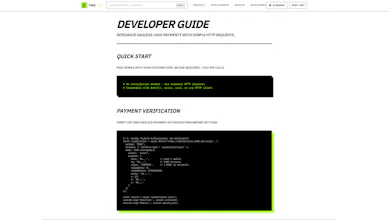
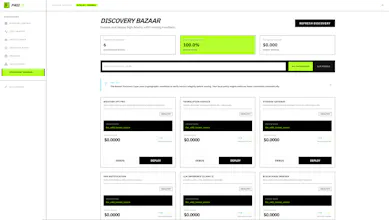
Most AI apps waste 70% of their budget. Wrong models. No caching. Payment fees that destroy micropayments. P402.shop: Compare 50+ AI APIs (GPT-5.2, Claude Opus 4.5, Gemini 3, more). Find the right model for your use case. See costs explode from 100 to 1M users. Free. P402.io: Accept micropayments without Stripe's $0.30 killing you. 1% flat fee. Built on x402—HTTP's payment standard, finally working. Vibe-coded apps break at scale. Optimized ones don't.
Hey Product Hunt! 👋
I'm Zeshan. I built P402 because I kept seeing the same pattern:
**AI apps work at 50 users. They break at 500.**
Not because AI is too expensive. Because of two things nobody talks about:
**1. Wrong model selection**
Most developers pick GPT-5.2 or Claude Opus and use it for everything. But for 80% of tasks—summarization, classification, simple queries—Haiku 4.5 at $5/M works just as well as models costing $14-25/M.
That's 70% waste hiding in plain sight.
**2. Payment fees on micropayments**
If you charge $0.05 per API call, Stripe takes $0.30. You lose money on every transaction. This is why nobody offers true pay-per-use pricing.
**So I built two tools:**
**P402.shop** = See exactly where you're overpaying
- Compare 50+ AI APIs (all the 2026 models: GPT-5.2, Opus 4.5, Gemini 3, etc.)
- Watch your costs explode from 100 to 1M users
- Spot the hidden waste
**P402.io** = Payment infrastructure that actually works for micropayments
- 1% flat fee (vs Stripe's $0.30 minimum)
- Built on x402—HTTP 402 "Payment Required" has been reserved since 1997, we finally made it work
- Users pay once, use for an hour (no popup per request)
The "aha moment" is when someone enters their use case into P402.shop and watches their costs explode at scale. That's when optimization stops being theoretical.
**What I'd love feedback on:**
- Is the value clear?
- What models/providers should we add?
- What would stop you from trying this?
P402.shop is free forever. P402.io has a generous free tier.
Let's fix the AI cost crisis. 🚀
Zeshan
For model cost optimization, how does P402.io's recommendations compare to just using OpenAI’s or Anthropic’s built‑in cost/perf guidance or tools like OpenRouter’s benchmarks?
OpenAI/Anthropic's built-in guidance: Inherently limited to their own ecosystem. Anthropic will never tell you "actually, DeepSeek R1 handles this task at 4% of the cost." Their guidance optimizes within their models, not across the market. Same with OpenAI, they'll recommend GPT-5.2 vs GPT-4o, but won't surface that Gemini 2.5 Flash might be 10x cheaper for your specific use case.
OpenRouter: Genuinely good. Their benchmarks are useful for capability comparison. But OpenRouter is a routing/aggregation layer their incentive is throughput, not helping you minimize spend. They show you prices, but don't model what happens to YOUR economics at 100K users vs 1M users. They also don't factor in the payment layer (which is where P402.io comes in).
Vendor-agnostic: We have no incentive to push you toward any provider
Scale modeling: Not just "price per token" but "your actual bill at your actual volume"
Task-matching: Recommendations based on use case, not just benchmarks (summarization ≠ reasoning ≠ code gen)
Full-stack view: Model costs are only part of the picture. If you're charging micropayments, Stripe's $0.30 might be bigger than your AI costs
Honestly, use all of them. OpenRouter for capability benchmarks, provider docs for specific features, P402.shop for the cross-provider economics and scale modeling.
We're not trying to replace benchmarks, we're solving the "I'm bleeding money and don't know where" problem.
@build_with_aj **Reply:**
Thanks! Yes, that's the direction. Payments are the foundation but the vision is a full routing layer. Your agent defines constraints (budget, latency, quality threshold) and P402 handles model selection, failover, and payment in one flow. Compare, route, pay, all through one integration.
Right now P402.shop handles the comparison piece, P402.io handles payments. Stitching them together into a proper orchestration layer is next. The goal is you shouldn't have to think about which provider to call or how to pay them, you just describe what you need and the router figures it out.
We're actively talking to early users to validate what to build next, so if you have specific MOR capabilities in mind, I'd love to hear what would be most useful for your setup.
@catt_marroll thank you for the shoutout on your slack and the heads up. I am pushing a fix for this now, always iterate, really appreciate the feedback!
This week marks the transition of P402 from an AI routing concept to a live financial protocol. We have successfully deployed the "Financial Rails" required to make Gemini-powered agents economically autonomous.
Technical Highlights:
1. Backend Overhaul (The Router) We completed a ground-up rewrite of p402.io to support high-frequency Agent-to-Agent (A2A) settlement.
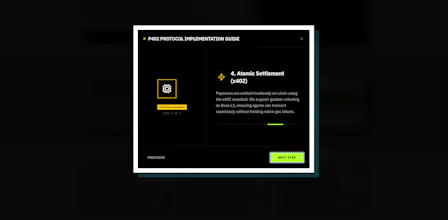
EIP-3009 Implementation: Built a complete exact payment scheme for gasless USDC transfers on Base L2.
Smart Contracts: Deployed P402Settlement.sol and integrated a new Blockchain Service layer (lib/blockchain/client.ts) to replace all simulation stubs with on-chain verification.
Testing: Added a comprehensive integration test suite covering route integrity, API exports, and settlement logic.
2. Architecture Scale: The Edge Network
To support global agent traffic, we secured Cloudflare credits to deploy the P402 Facilitator network.
Topology: 15 global edge regions running Cloudflare Workers.
Performance: Facilitators now handle EIP-3009 signature verification and rate limiting at the edge, ensuring <50ms latency for agent inference requests.
3. The Client: Farcaster Mini-App We updated mini.p402.io to serve as the user-facing control center.
Tech Stack: Next.js + Viem + Farcaster Auth.
Feature: Implemented a custom usePayment hook that handles EIP-712 typed data signing, allowing users to authorize USDC spend directly from their Farcaster identity.
Engineering Metrics:
Volume: 7 major commits across router and mini-app.
Security: Added Replay Protection, 3-of-5 Multisig Treasury, and Traffic Event logging for audit trails.
Current Status: The system is live on Base Mainnet (Chain ID: 8453). Agents can now query Gemini models via OpenRouter and settle usage in real USDC immediately.
2 weeks later: We shipped the top 3 requested features 🚀
Hey everyone! 👋
It’s been exactly two weeks since we launched P402.io here. The response was incredible (and honestly, a bit overwhelming). We saw developers finally settling paid API calls without the massive Stripe fees, which proved our thesis: micropayments for AI agents are broken, and x402 is the fix.
We spent the last 14 days glued to our Discord and GitHub issues. You asked, we shipped. Here is P402 v1.1:
1. WebSocket Support (Beta)
The #1 request. You can now stream payments and data for real-time agent interactions. Essential for voice agents and live-code generation tools.
2. Advanced Rate Limiting
We heard you on the "runaway agent" fears. We added granular rate limiting (per-user and per-IP). You can now cap an agent's spending at $5/hour so you don't wake up to a massive bill.
3. Usage Analytics Dashboard
"Flying blind" is over. We shipped a new dashboard that visualizes exactly which models (GPT-5.2, Opus 4.5) are eating your budget and where your revenue is coming from.
4. Performance Fixes
We squashed the caching bugs that some of you reported in the Pick & Place flows and optimized the payment verification latency by ~40%.
Thanks for building with us! keep the comments and feedback coming
Zeshan
Report
This is an A2A protocol? And what models can be connected?
P402.io
Product Hunt
For model cost optimization, how does P402.io's recommendations compare to just using OpenAI’s or Anthropic’s built‑in cost/perf guidance or tools like OpenRouter’s benchmarks?
P402.io
@curiouskitty Great question
OpenAI/Anthropic's built-in guidance: Inherently limited to their own ecosystem. Anthropic will never tell you "actually, DeepSeek R1 handles this task at 4% of the cost." Their guidance optimizes within their models, not across the market. Same with OpenAI, they'll recommend GPT-5.2 vs GPT-4o, but won't surface that Gemini 2.5 Flash might be 10x cheaper for your specific use case.
OpenRouter: Genuinely good. Their benchmarks are useful for capability comparison. But OpenRouter is a routing/aggregation layer their incentive is throughput, not helping you minimize spend. They show you prices, but don't model what happens to YOUR economics at 100K users vs 1M users. They also don't factor in the payment layer (which is where P402.io comes in).
Where P402.shop is different:
Vendor-agnostic: We have no incentive to push you toward any provider
Scale modeling: Not just "price per token" but "your actual bill at your actual volume"
Task-matching: Recommendations based on use case, not just benchmarks (summarization ≠ reasoning ≠ code gen)
Full-stack view: Model costs are only part of the picture. If you're charging micropayments, Stripe's $0.30 might be bigger than your AI costs
Honestly, use all of them. OpenRouter for capability benchmarks, provider docs for specific features, P402.shop for the cross-provider economics and scale modeling.
We're not trying to replace benchmarks, we're solving the "I'm bleeding money and don't know where" problem.
vibecoder.date
Loving the idea, are you planning to offer MOR capabilities? or stay focused on just payments.
P402.io
My Financé
your landing page is really nice! i actually posted internally in slack about how nice it is!
i did notice this unit which is a. very impressive but b. likely a bit off in terms of contrast!
congrats on launching!
P402.io
@catt_marroll thank you for the shoutout on your slack and the heads up. I am pushing a fix for this now, always iterate, really appreciate the feedback!
P402.io
This week marks the transition of P402 from an AI routing concept to a live financial protocol. We have successfully deployed the "Financial Rails" required to make Gemini-powered agents economically autonomous.
Technical Highlights:
1. Backend Overhaul (The Router) We completed a ground-up rewrite of p402.io to support high-frequency Agent-to-Agent (A2A) settlement.
EIP-3009 Implementation: Built a complete exact payment scheme for gasless USDC transfers on Base L2.
Smart Contracts: Deployed P402Settlement.sol and integrated a new Blockchain Service layer (lib/blockchain/client.ts) to replace all simulation stubs with on-chain verification.
Testing: Added a comprehensive integration test suite covering route integrity, API exports, and settlement logic.
2. Architecture Scale: The Edge Network
To support global agent traffic, we secured Cloudflare credits to deploy the P402 Facilitator network.
Topology: 15 global edge regions running Cloudflare Workers.
Performance: Facilitators now handle EIP-3009 signature verification and rate limiting at the edge, ensuring <50ms latency for agent inference requests.
3. The Client: Farcaster Mini-App We updated mini.p402.io to serve as the user-facing control center.
Tech Stack: Next.js + Viem + Farcaster Auth.
Feature: Implemented a custom usePayment hook that handles EIP-712 typed data signing, allowing users to authorize USDC spend directly from their Farcaster identity.
Engineering Metrics:
Volume: 7 major commits across router and mini-app.
Diff: +20,556 lines added / -5,269 removed (Net +15k).
Security: Added Replay Protection, 3-of-5 Multisig Treasury, and Traffic Event logging for audit trails.
Current Status: The system is live on Base Mainnet (Chain ID: 8453). Agents can now query Gemini models via OpenRouter and settle usage in real USDC immediately.
P402.io
This is an A2A protocol? And what models can be connected?