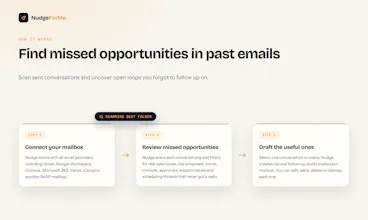
NudgeForMe scans your sent conversations, finds threads where someone never replied, and drafts natural follow-ups inside your own mailbox. It starts in draft mode, so you stay in control. You can review each opportunity, select the useful ones, and send from Gmail, Outlook, or IMAP/SMTP. Built by the Snoooz team after processing millions of emails, NudgeForMe is focused on one painful workflow: making sure leads, deals, partnerships, and customer conversations do not quietly go cold.
Hey Product Hunt 👋
Three years ago, we launched Snoooz here and were lucky to become #1 Product of the Day. Since then, we’ve processed millions of emails and kept seeing the same pattern:
People do not only need help replying faster. They also lose leads, deals, partnerships, and important customer conversations because they forget to follow up.
So we built NudgeForMe.
NudgeForMe scans your sent conversations, finds threads where you were expecting a reply, but they never replied, and drafts follow-ups inside your own mailbox. It starts in draft mode, so you stay in control. You can review each opportunity, choose the useful ones, and send from Gmail, Outlook, or IMAP/SMTP.
A few things that make it different:
• It looks at your actual sent conversations, not a separate CRM list
• It finds missed opportunities automatically
• It creates follow-up drafts in your mailbox
• It stops when someone replies
• It works in draft mode by default
• It is built by the Snoooz team, based on what we learned from millions of processed emails
We built this because follow-up is one of those small things that quietly costs people real opportunities.
Would love your feedback, especially on:
1. What would make you trust an AI follow-up agent?
2. Should this live as a focused product or become part of Snoooz long term?
3. What integrations should we prioritize next?
Thanks for checking it out.
Report
@victoria_dash Congrats on the launch. Losing a deal because nobody remembered to follow up is a real problem.
That said: in my experience bots do great with code or executing tasks, but they've always struggled with the relational side, sounding like a person instead of a system. How do you handle that?
Report
@victoria_dash@martin_herran When NudgeForMe drafts a follow-up, how much can it learn my voice over time like tone, phrasing, level of warmth/formality, and what controls do I have if a draft feels “too bot-like” for a particular relationship?
@martin_herran@swati_paliwal it is trained to understand your tone from the sent email, but also you can pass custom instructions in the prompt so the draft is more tailored to your needs.
@martin_herran Thank you, that’s a fair concern. Nudge uses the original conversation for context and can learn your tone and writing style, rather than generating a generic follow-up. You can also add custom instructions to refine how it writes... and because it starts in draft mode, you can review and adjust the message before anything is sent.
@ir3ne Thank you! Nudge looks at the full conversation to understand whether a reply was actually expected and filters out things like closing notes, FYIs, newsletters, completed conversations, and obvious no-reply threads.
It then shows the opportunities in the app first, so you can approve or dismiss them before any draft is created. Those decisions also help improve what Nudge surfaces over time.
Report
@victoria_dash That makes a lot of sense. I especially like that users can review or dismiss suggestions before a draft is created. Thanks for the detailed explanation, and good luck with the launch! 🚀
@victoria_dash The “missed opportunities because we forget to follow up” problem is very real. I especially like that NudgeForMe starts in draft mode rather than automatically sending messages. That control makes AI follow-ups much easier to trust. Curious to see how the reply detection performs in real-world conversations.
Report
Draft mode is the right default, and it also makes precision the entire product. If I open the folder and 4 of 15 drafts are worth sending, I stop opening the folder by week two and the 4 good ones die with the rest. I'd trade recall away hard for that, something like only flag threads where I asked a direct question and got silence for five days, because two right nudges a week beats fifteen maybes.
@asadmalik901 We agree that precision matters more than volume.
NudgeForMe first shows you the follow-up opportunities it finds in the app, so you can choose which ones should become drafts. We also filter out newsletters and conversations that clearly do not need a response.
As it learns more about your business and preferences, you can switch to autopilot but the default experience keeps you fully in control. Our goal is exactly what you described: a few genuinely useful nudges, not a folder full of maybes.
Report
@victoria_dash Showing the opportunities in the app first is the better ordering, that moves the filtering to a screen I'm choosing to open. The category I'd still watch isn't newsletters, it's my own sent messages that never wanted a reply, an FYI or a closing note, since those look exactly like unanswered threads. And if the app showed me my approve versus dismiss ratio over a few weeks, I could tell whether it's actually learning instead of taking your word for it.
@asadmalik901 I agree with you, and we already check whether a thread genuinely needs a follow-up or the conversation is closed, and from our tests it's working well so far. We do encourage users to share feedback so we can catch edge cases and improve the detection algorithm further.
Report
@asadmalik901 This is your 111 options argument again, in a different shape. Fifteen drafts is a first screen. The moment I have to be the filter, the good ones inherit the cost of the bad ones. Threshold tuning is the wrong knob for that. The knob is who pays for a wrong suggestion. Show 2, keep the other 13 searchable for when I go looking. Five days of silence after a direct question is a good rule. Does it survive the people who answer in a thread instead of a reply?
@asadmalik901@rabnoor_s That’s a fair framing. The best opportunities should be surfaced first, while lower-confidence ones stay available without creating noise. We take your feedback.
Report
@rabnoor_s@victoria_dash Surfaced first still puts them on the same screen, and that's where it goes wrong. Cap it instead, three a day, and let the rest live in search. The number worth watching after launch isn't drafts generated, it's what percent of drafts actually get sent. If that sits under 30% people quietly stop opening the folder and you never hear about it.
the detection quality questions in here are all good ones, but the thing I haven't seen asked yet is what happens to the actual email content once it's scanned. reading sent conversations well enough to tell "thanks, talk soon" apart from a real dropped thread means an LLM is seeing the full text of my client emails and partnership deals, not just headers or timestamps. is that content processed and then discarded, or retained/logged anywhere on your end? for a tool sitting on my entire sent folder that's the question I'd want answered in writing before connecting a real inbox, not just "draft mode by default."
@galdayan Good question, Nudge reads the conversation content to determine whether a follow-up is needed and to generate the draft. We do not use customer emails to train our models, and we do not retain a permanent copy of the entire sent folder, only the threads you want us to monitor.
@victoria_dash that's actually the answer I was hoping for, no training and no full-folder retention is the right shape. that privacy page is worth linking more prominently though, it answered the exact thing I was worried about and I only found it because you pasted it here rather than it being surfaced on the product page itself.
@galdayan You’re right — the privacy details should be much easier to find before someone connects a mailbox. We’ll surface that page more prominently on the product page and during onboarding.
@victoria_dash glad it's a real fix and not just a promise, moving that link out of a reply and onto the onboarding flow will save the next person from having to ask.
Report
Draft mode protects you at draft time. The risk lives at send time.
The draft exists because nobody replied. Then you open the folder tomorrow and some of those people have answered, just not in that thread. On the phone, on LinkedIn, in a new thread with a different subject. Sending just checking in to someone who already replied is the one follow-up that actually costs you the relationship, and it is worse than never following up at all.
So the check I would want sits at send rather than at generation. Re-verify the condition that created the draft, right before it goes out: nothing new in this thread, no newer message from that address anywhere in the mailbox, no meeting with them since. Cheap to run, and it is the whole difference between a stale draft and an embarrassing send.
Does it re-check anything at the moment you press send, or is the decision made when the draft is written?
@jernej_jan_kocica That’s a very good point. For automated follow-ups, Nudge re-checks the mailbox before sending and stops if it detects a reply, an out-of-office message, or a bounce. It can also adjust the next follow-up based on the latest response—for example, if someone asks you to follow up later or says when they will return from vacation.
Since this is our first release, we recommend starting in draft mode, where you choose which opportunities are worth following up on.
You’re also right that replies through LinkedIn, phone calls, meetings, or a separate email thread are harder to detect. We don’t claim to catch all of those today, but broader pre-send verification is a valuable safeguard and something we can add to our roadmap.
Report
Draft mode before any send is the right call. What I want to know: does it look for actual signals in the sent message, like a question or an explicit request, or is the detection purely time-based? A thread that ended with 'thanks, talk soon' should not queue a nudge. Those are easy to misread as cold.
@noctis06 Yes we look at the conversation and whether a reply was actually expected, including questions, requests, and signs that the thread is already closed. So a message like “thanks, talk soon” should not be flagged. We’ll keep refining this with real-world feedback and edge cases, so please share any feedback you have after trying our app :)
Report
The tone matching is the part everyone's asking about, but I'd worry more about false positives, threads that look unanswered but weren't actually waiting on anything, like a "sounds good, thanks" that just didn't need a reply back. How does it tell that kind of silence apart from someone actually going quiet on you?
@raffay_sajjad That’s exactly the kind of false positive we try to avoid. Nudge doesn’t rely on silence alone, it looks at the conversation context to determine whether a reply was actually expected or the thread had naturally ended.
Messages like “sounds good, thanks,” FYIs, and closing notes should be treated as completed conversations, while unanswered questions, requests, proposals, and pending decisions are more likely to be surfaced. Users can still review and dismiss opportunities, which helps improve detection over time.
Report
@victoria_dash Makes sense, treating it as context detection rather than a pure silence timer is the right shape. Curious whether the dismiss data actually improves the detection model over time across users, or if it's more of a per-account filter that resets whenever someone connects a new inbox.
Report
Does it look at the conversation context or mainly the time since the last reply?
@hamza_afzal_butt It looks at the conversation context, not just the time elapsed. Time is one signal, but Nudge also checks whether a response was expected and whether the conversation appears open or already complete.
Report
@victoria_dash interesting take. Congratulations for the launch!





NudgeForMe
@victoria_dash Congrats on the launch. Losing a deal because nobody remembered to follow up is a real problem.
That said: in my experience bots do great with code or executing tasks, but they've always struggled with the relational side, sounding like a person instead of a system. How do you handle that?
@victoria_dash @martin_herran When NudgeForMe drafts a follow-up, how much can it learn my voice over time like tone, phrasing, level of warmth/formality, and what controls do I have if a draft feels “too bot-like” for a particular relationship?
NudgeForMe
@martin_herran @swati_paliwal it is trained to understand your tone from the sent email, but also you can pass custom instructions in the prompt so the draft is more tailored to your needs.
NudgeForMe
@martin_herran Thank you, that’s a fair concern. Nudge uses the original conversation for context and can learn your tone and writing style, rather than generating a generic follow-up. You can also add custom instructions to refine how it writes... and because it starts in draft mode, you can review and adjust the message before anything is sent.
@victoria_dash Congrats on the launch! 🎉
I really like the "draft-first" approach. It feels much more trustworthy than automatically sending follow-ups.
Out of curiosity, how do you avoid suggesting follow-ups for conversations that intentionally went quiet or don't actually need another reply?
NudgeForMe
@ir3ne Thank you! Nudge looks at the full conversation to understand whether a reply was actually expected and filters out things like closing notes, FYIs, newsletters, completed conversations, and obvious no-reply threads.
It then shows the opportunities in the app first, so you can approve or dismiss them before any draft is created. Those decisions also help improve what Nudge surfaces over time.
@victoria_dash That makes a lot of sense. I especially like that users can review or dismiss suggestions before a draft is created. Thanks for the detailed explanation, and good luck with the launch! 🚀
NudgeForMe
@ir3ne thank you so much
@victoria_dash The “missed opportunities because we forget to follow up” problem is very real. I especially like that NudgeForMe starts in draft mode rather than automatically sending messages. That control makes AI follow-ups much easier to trust. Curious to see how the reply detection performs in real-world conversations.
Draft mode is the right default, and it also makes precision the entire product. If I open the folder and 4 of 15 drafts are worth sending, I stop opening the folder by week two and the 4 good ones die with the rest. I'd trade recall away hard for that, something like only flag threads where I asked a direct question and got silence for five days, because two right nudges a week beats fifteen maybes.
NudgeForMe
@asadmalik901 We agree that precision matters more than volume.
NudgeForMe first shows you the follow-up opportunities it finds in the app, so you can choose which ones should become drafts. We also filter out newsletters and conversations that clearly do not need a response.
As it learns more about your business and preferences, you can switch to autopilot but the default experience keeps you fully in control. Our goal is exactly what you described: a few genuinely useful nudges, not a folder full of maybes.
@victoria_dash Showing the opportunities in the app first is the better ordering, that moves the filtering to a screen I'm choosing to open. The category I'd still watch isn't newsletters, it's my own sent messages that never wanted a reply, an FYI or a closing note, since those look exactly like unanswered threads. And if the app showed me my approve versus dismiss ratio over a few weeks, I could tell whether it's actually learning instead of taking your word for it.
NudgeForMe
@asadmalik901 I agree with you, and we already check whether a thread genuinely needs a follow-up or the conversation is closed, and from our tests it's working well so far. We do encourage users to share feedback so we can catch edge cases and improve the detection algorithm further.
@asadmalik901 This is your 111 options argument again, in a different shape. Fifteen drafts is a first screen. The moment I have to be the filter, the good ones inherit the cost of the bad ones. Threshold tuning is the wrong knob for that. The knob is who pays for a wrong suggestion. Show 2, keep the other 13 searchable for when I go looking. Five days of silence after a direct question is a good rule. Does it survive the people who answer in a thread instead of a reply?
NudgeForMe
@asadmalik901 @rabnoor_s That’s a fair framing. The best opportunities should be surfaced first, while lower-confidence ones stay available without creating noise. We take your feedback.
@rabnoor_s @victoria_dash Surfaced first still puts them on the same screen, and that's where it goes wrong. Cap it instead, three a day, and let the rest live in search. The number worth watching after launch isn't drafts generated, it's what percent of drafts actually get sent. If that sits under 30% people quietly stop opening the folder and you never hear about it.
Dial
the detection quality questions in here are all good ones, but the thing I haven't seen asked yet is what happens to the actual email content once it's scanned. reading sent conversations well enough to tell "thanks, talk soon" apart from a real dropped thread means an LLM is seeing the full text of my client emails and partnership deals, not just headers or timestamps. is that content processed and then discarded, or retained/logged anywhere on your end? for a tool sitting on my entire sent folder that's the question I'd want answered in writing before connecting a real inbox, not just "draft mode by default."
NudgeForMe
@galdayan Good question, Nudge reads the conversation content to determine whether a follow-up is needed and to generate the draft. We do not use customer emails to train our models, and we do not retain a permanent copy of the entire sent folder, only the threads you want us to monitor.
You can check our privacy policy here:
https://nudgeforme.com/privacy.html
Dial
@victoria_dash that's actually the answer I was hoping for, no training and no full-folder retention is the right shape. that privacy page is worth linking more prominently though, it answered the exact thing I was worried about and I only found it because you pasted it here rather than it being surfaced on the product page itself.
NudgeForMe
@galdayan You’re right — the privacy details should be much easier to find before someone connects a mailbox. We’ll surface that page more prominently on the product page and during onboarding.
Dial
@victoria_dash glad it's a real fix and not just a promise, moving that link out of a reply and onto the onboarding flow will save the next person from having to ask.
Draft mode protects you at draft time. The risk lives at send time.
The draft exists because nobody replied. Then you open the folder tomorrow and some of those people have answered, just not in that thread. On the phone, on LinkedIn, in a new thread with a different subject. Sending just checking in to someone who already replied is the one follow-up that actually costs you the relationship, and it is worse than never following up at all.
So the check I would want sits at send rather than at generation. Re-verify the condition that created the draft, right before it goes out: nothing new in this thread, no newer message from that address anywhere in the mailbox, no meeting with them since. Cheap to run, and it is the whole difference between a stale draft and an embarrassing send.
Does it re-check anything at the moment you press send, or is the decision made when the draft is written?
NudgeForMe
@jernej_jan_kocica That’s a very good point. For automated follow-ups, Nudge re-checks the mailbox before sending and stops if it detects a reply, an out-of-office message, or a bounce. It can also adjust the next follow-up based on the latest response—for example, if someone asks you to follow up later or says when they will return from vacation.
Since this is our first release, we recommend starting in draft mode, where you choose which opportunities are worth following up on.
You’re also right that replies through LinkedIn, phone calls, meetings, or a separate email thread are harder to detect. We don’t claim to catch all of those today, but broader pre-send verification is a valuable safeguard and something we can add to our roadmap.
Draft mode before any send is the right call. What I want to know: does it look for actual signals in the sent message, like a question or an explicit request, or is the detection purely time-based? A thread that ended with 'thanks, talk soon' should not queue a nudge. Those are easy to misread as cold.
NudgeForMe
@noctis06 Yes we look at the conversation and whether a reply was actually expected, including questions, requests, and signs that the thread is already closed. So a message like “thanks, talk soon” should not be flagged. We’ll keep refining this with real-world feedback and edge cases, so please share any feedback you have after trying our app :)
The tone matching is the part everyone's asking about, but I'd worry more about false positives, threads that look unanswered but weren't actually waiting on anything, like a "sounds good, thanks" that just didn't need a reply back. How does it tell that kind of silence apart from someone actually going quiet on you?
NudgeForMe
@raffay_sajjad That’s exactly the kind of false positive we try to avoid. Nudge doesn’t rely on silence alone, it looks at the conversation context to determine whether a reply was actually expected or the thread had naturally ended.
Messages like “sounds good, thanks,” FYIs, and closing notes should be treated as completed conversations, while unanswered questions, requests, proposals, and pending decisions are more likely to be surfaced. Users can still review and dismiss opportunities, which helps improve detection over time.
@victoria_dash Makes sense, treating it as context detection rather than a pure silence timer is the right shape. Curious whether the dismiss data actually improves the detection model over time across users, or if it's more of a per-account filter that resets whenever someone connects a new inbox.
NudgeForMe
@hamza_afzal_butt It looks at the conversation context, not just the time elapsed. Time is one signal, but Nudge also checks whether a response was expected and whether the conversation appears open or already complete.
NudgeForMe
@hamza_afzal_butt thank you for your support Hamza!