
Nautis
The AI-native Operating System for founders.
764 followers
The AI-native Operating System for founders.
764 followers
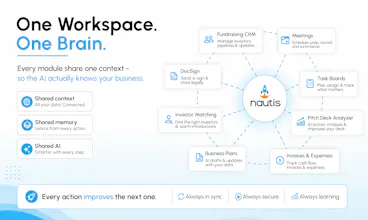
Nautis is the AI-native Operating System for founders. Manage fundraising, planning, finance, documents, meetings, CRM, hiring, and daily operations from one connected workspace. Unlike disconnected SaaS tools, every module shares one AI brain, giving you context-aware automation, smarter insights, and a Chief of Staff that understands your business—not just one app. Spend less time managing tools and more time building.




Hey PH 👋 Baltej here, Founder of Nautis.
Over the last few years, I've been immersed in the startup ecosystem—building products, working alongside founders, collaborating with investors, and seeing firsthand what it really takes to build a company from zero.
No matter the stage, I kept seeing the same problem.
Founders don't spend most of their time building.
They spend it switching between CRMs, docs, spreadsheets, meetings, investor updates, invoices, emails... and now a growing list of AI tools that still don't understand each other.
Every tool has part of the picture.
Every AI knows one thing.
Nothing knows your business.
That frustration became the inspiration behind Nautis.
Instead of building another AI assistant, we asked a different question:
What if your entire startup lived in one workspace, with one AI that actually understands everything?
That's what we've spent months building.
🚀 A Fundraising CRM that knows your investor conversations.
📄 AI that turns your pitch deck into a business plan.
📂 Data rooms connected to your fundraising pipeline.
🤖 An AI Copilot that can draft emails, update your CRM, prepare meetings, and help across every module.
☀️ And my favorite feature: the Chief of Staff Briefing. Every morning, Nautis reviews your workspace overnight and tells you exactly what deserves your attention before your day even begins.
We're incredibly excited (and honestly a little nervous 😅) to finally share Nautis with the Product Hunt community.
I'd genuinely love to hear your thoughts.
If you could have an AI take one thing completely off your plate as a founder, what would it be?
We'll be here all day answering questions, collecting feedback, and shipping improvements.
And because every launch deserves a little fun... we even made a Nautis rap 😂🎤
🎵
Hope it gives you a laugh.
Thank you so much for checking out Nautis and supporting our launch. It truly means the world to us. ❤️
Find me on:
Linkedin: https://www.linkedin.com/in/baltej-singh-46b78112
Twitter: https://x.com/baltejsingh88
----
One more thing! 🎉
To thank the Product Hunt community for being our earliest supporters, we're offering 3 months of Nautis Premium for the price of just 1 month.
Simply sign up, then head to Organization Settings → Offers and apply the code PHEARLYBIRD to unlock the offer. 🚀
----
We can't wait to hear what you build with it. 🚀
— Baltej & the Nautis Team
@baltejsingh88 The "one AI brain" concept is really interesting. How do you maintain shared context across modules while still respecting role-based permissions? That seems like one of the hardest product challenges to solve at scale.
@vipul_bhatia_trugenai Thanks, Vipul! That is definitely one of the harder parts. We maintain a shared business context at the company level, but every request is still filtered through the user's role, module permissions, and record-level access.
So the AI Chief of Staff can connect information across modules, but it only reasons over data that the current user is authorized to access. The AI is not treated as a separate all-access identity. It follows the same permission boundaries as the team member using it.
@baltejsingh88 Many congratulations Baltej! :)
How I met the maker
Baltej and I were introduced through @consultsourabh a few weeks ago.
What the tool does
Nautis is an AI-native operating system for founders that brings fundraising, planning, finance, documents, meetings, CRM, hiring, and daily operations into one connected workspace.
Every module shares a single “AI brain,” so the system has context-aware automation, smarter insights, and a Chief of Staff that understands your whole business instead of just one app.
Why I endorse it
Since we met, we’ve brainstormed positioning and messaging angles together, and I’m really happy with how the product evolved to be truly AI-native and founder-first.
Baltej has been extremely meticulous with the product, and I’m glad he’s finally launching it publicly.
Give it a spin! :)
@consultsourabh @rohanrecommends Thank you so much for the thoughtful write-up and for all the conversations we've had over the past few weeks. Your feedback on the positioning and messaging genuinely helped us refine how we communicate Nautis, and I really appreciate the time you invested.
I'm glad you can see the direction we're building towards. This is just the beginning, and we'll keep shipping based on feedback from founders like you. Thanks again for the support, it means a lot! 🚀
@baltejsingh88 Congrats on the launch, Baltej.Nautis sounds like it is tackling a very real founder problem, the business context is scattered everywhere, so even good tools only see fragments.
I have one question, how does Nautis keep the AI Copilot grounded across all modules without creating stale or conflicting context?
The Chief of Staff Briefing sounds especially useful. A daily summary that understands fundraising, data rooms, investor conversations and follow-ups could save founders a lot of mental switching.
@vahid_davoudi Thank you so much! Really appreciate the thoughtful question.
That's exactly why we built Nautis around a single shared business context rather than separate AI assistants for each module. Instead of copying information between modules, the AI references the latest data from the underlying systems at the time of each request, while respecting permissions. That helps avoid stale or conflicting context and keeps everyone working from the same source of truth.
And yes, that's the vision for the Chief of Staff Briefing. Rather than summarizing everything, it surfaces the updates, risks, follow ups, and decisions that actually need the founder's attention that day.
@baltejsingh88 That makes sense. Pulling from the source systems at request time sounds much cleaner than maintaining copied context per module. The what needs attention today framing for the briefing is exactly the useful version of this
@vahid_davoudi Thank you! I'm glad that resonates.
That was one of our biggest design principles. Founders don't need another activity feed telling them everything that changed. They need a Chief of Staff that can filter the noise and answer one simple question: "What actually needs my attention today?"
That's the experience we're working towards, and we'll keep refining it based on how founders use it in the real world. Really appreciate the thoughtful feedback!
I already run something close by pointing Claude Code at separate repos per function (fundraising notes, finance model, CRM export), and the reasoning quality is fine. The wall I hit isn't the model, it's shared state: getting one agent to actually see the deck, the cap table, and the CRM at the same time without me re-feeding context every session.
Just interested - where do you think your value sits? The connectors and persistent memory layer or approvals/ audit trail for actions within Nautis?
@aidan_codefox That's exactly the problem we kept running into as well. The models are already very capable. The real challenge is maintaining business context over time.
I'd say our biggest value is the persistent business context. Every module shares the same data layer, so the AI Chief of Staff understands your business without you having to re-explain it in every conversation. On top of that, approvals, audit logs, permissions, and workflows make it practical for teams, not just individual founders. We see connectors as the plumbing. The real differentiation is the business memory and context that keeps getting richer as your company grows.
Congrats on the launch, Baltej. Founder tooling usually fails by trying to replace judgment instead of protecting time, so I am curious which side Nautis lands on. What does it take over on day one: inbox triage, metrics reviews, investor updates? I run a healthcare AI company and my scarcest resource is uninterrupted thinking time. If the OS framing translates into fewer tabs and fewer status meetings, count me in. Which integrations ship at launch?
@clemente_lopez1 Thank you! I completely agree. We don't believe AI should replace founder judgment. It should protect a founder's time and surface the information needed to make better decisions.
From day one, our AI Chief of Staff helps with things like inbox triage, meeting summaries, investor follow ups, daily briefings, metrics, tasks, approvals, and preparing investor updates. The idea is to reduce context switching so founders can spend more time thinking and less time collecting information.
At launch, we integrate with tools like Google Workspace, Microsoft 365, Gmail, Google Calendar, meeting transcription platforms, Stripe, and several other external tools. The goal isn't to replace everything overnight, but to bring business context together so the AI can work across your existing stack instead of becoming another isolated tool.
@baltejsingh88 That covers exactly what I check every morning: Stripe, calendar and inbox in one brief would replace my first hour of the day. The approvals flow is the piece I would test first, since delegation only sticks when I can see what the assistant did and why. Good luck with the launch, Baltej, keeping an eye on this one.
@clemente_lopez1 Thank you so much! That's exactly the workflow we want to simplify.
I completely agree about approvals. AI shouldn't make important business decisions on its own. It should gather the context, explain why it's recommending something, and let the founder approve or reject it with full visibility. That balance between automation and control is something we're putting a lot of focus on.
Really appreciate your support, and I'd love to hear your feedback once you've had a chance to try it! 🚀
I'm impressed by how much thought went into solving a workflow problem instead of simply adding AI everywhere. The feature that converts a pitch deck into a business plan especially caught my attention because founders often repeat the same information in different formats. I'd love to know how much customization users have over those generated outputs before sharing them externally.
@thomas_jack4 Thanks, really appreciate that! That was exactly our thinking. Founders shouldn't have to rewrite the same information again and again. The generated business plan is fully editable, so you can change sections, add your own insights, adjust the tone, and refine everything before sharing it. We see AI as a starting point, not the final output.
"Shared data layer across all modules" is the interesting architectural bet here — most startup-OS tools bolt features together with separate databases and call it "integrated." Curious how you're handling permission/access boundaries across modules when everything shares one layer — does finance data get the same access rules as, say, hiring pipeline data, or is there per-module scoping on top of the shared layer?
@abhineetarora Great question, Abhineet. The data layer is shared, but access is not. We have role-based and module-level permissions on top of it, so someone working in hiring does not automatically get access to finance or fundraising data. We are also adding more granular controls for sensitive records and AI responses, so the AI only uses information the user is actually allowed to access.
@baltejsingh88 That's the right layer to enforce it at — scoping the AI's output to the same permissions rather than treating "the AI" as a separate all-access identity is easy to get wrong and you clearly haven't. Curious about one edge case: when the AI synthesizes an insight that draws on multiple modules (e.g., a hiring recommendation informed by budget headroom from finance), how do you handle it if the user only has access to one of the underlying sources? Does the insight get withheld entirely, or regenerated using only what they're permitted to see?
@abhineetarora That's a great edge case, and it's something we've spent a lot of time thinking about.
Our approach is to regenerate the response using only the data the user is authorized to access. The AI never reasons over or exposes restricted information to produce an answer. If an insight depends on data the user can't access, it either omits that part or indicates that additional information exists but isn't available under the current permissions. We think it's important that the AI behaves exactly like a trusted team member, respecting the same access boundaries as everyone else.
Nautis caught my attention from today's leaderboard. How does Nautis decide what deserves attention in the morning briefing versus what can safely wait?
@himani_sah1 Thanks! Our AI Chief of Staff looks at what actually needs a founder's attention, not just what's new. It prioritizes things like missed deadlines, low runway, pending approvals, investor follow ups, important meetings, and blockers that could slow the team down. The goal is simple: help founders start the day with clarity instead of spending the first hour figuring out what needs attention.
Congrats on the launch!
Bringing fundraising, finance, meetings, documents etc. into one founder workspace sounds very practical.
I’m curious, is Nautis mainly designed to replace tools founders already use, or does it also integrate with tools like Notion, HubSpot, and Google Drive while keeping the shared AI context?
@ceren_kaya_akgun Thank you! Our goal isn't to ask founders to replace everything overnight. Nautis integrates with many of the tools founders already use, so you can keep your existing stack while benefiting from shared AI context. As more of your startup's data and workflows connect through Nautis, the AI becomes increasingly useful because it understands your business, not just individual tasks.