LLMagnet gives WordPress sites an AI visibility layer. Track visits from ChatGPT, Claude, Gemini and other AI crawlers, measure your AI Visibility Score, generate llms.txt and structured data, and make your site readable and actionable for AI agents.
I’ve spent years designing and building websites for businesses. We spend hours getting a headline right, making the offer clear, making sure visitors understand why they should care. As a builder, I want that work to be accessible to AI too.
My focus with LLMagnet has been making this practical for the person running the site. Which AI crawlers are visiting? What pages are they accessing? What can you improve? You should be able to start answering those questions from your WordPress dashboard.
There’s still a lot to figure out in this space, and we’re building with that in mind.
If you give it a try today, tell us what’s useful, what’s confusing, and what you wish it did. I’m here with the team and would love to talk through your site and use case.
Thanks for being part of our launch!
Report
These days I ask an assistant about a product before I'd think to open a search tab. Getting a look at which of those bots come sniffing around a site feels handy. Bookmarked.
@amine_aziz_alaoui Thank you Amine! Interesting to hear that’s already your first stop when researching a product. From the site owners side, seeing which bots visit and which pages they reach helps make that shift a little less invisible. Appreciate the bookmark! :)
@amine_aziz_alaoui Appreciate that Amine, “which bots are already sniffing” is exactly the first signal we wanted site owners to see. If you try it on a WP site, curious which crawler shows up first for you.
@nadav_berger1 Yes! Shopify is supported too 🙌 You can track how your store appears across AI platforms and see where there’s room to improve.
Report
Not gonna lie I’m still not sold that “AI visibility” is even a real category.
Most sites I touch either block the bots or ignore them. And if ChatGPT answers from training data half the time anyway… does watching crawler hits on my WP install actually change anything, or is it just another dashboard?
@achi_raanan Fair pushback - “AI visibility” is still messy as a label.
Watching crawler hits won’t make ChatGPT recommend you, and better content still matters more than another dashboard. What we’re trying to make visible is the ops layer most WP sites miss: which bots already reach you, and whether they hit money pages vs junk. Separate from “did we get cited.”
If you try it on one site you already block/ignore bots on, curious what actually shows up.
@achi_raanan That’s fair, Achi. Tracking bot visits alone isn’t enough. The value is in spotting what needs attention on your pages and helping you fix it. A crawler visit doesn’t mean you’ll appear in an AI answer, and we shouldn’t blur that line. We want LLMagnet to help you make useful changes, not just give you another dashboard to check.
Report
If I rewrite a product page to make it clearer for AI, how would I know the changes helped? A crawler coming back is a start, but what would you look for next? Curious how people here are measuring this on their own sites.
@yotam_abu Great question. A crawler coming back is only step one. Next I’d watch: (1) whether that specific URL gets hit again and how often (2) whether crawl coverage shifts toward the pages you care about, and (3) whether the readiness checks behind Visibility Score move on that page (structure/clarity/content quality) after you recalculate.
We can’t promise a ChatGPT citation from one rewrite - we can show whether the foundations you control actually improved. If you try a rewrite on one product page, tell me what moved first on your side.
@yotam_abu Adding to Ido’s point, I’d save a snapshot of the page’s score and crawl activity before editing, and note exactly what changed and when. That gives you a baseline to compare against after the rewrite. It won’t prove the rewrite caused every change, but it makes the results easier to interpret.
Been poking at bot logs on a couple WP installs and honestly the GPTBot / ClaudeBot / OAI-SearchBot split is messier than most SEO tools make it look. Half the time the URLs that matter aren’t even the ones getting hit. How are you surfacing that without drowning in raw access logs? Is Visibility Score more of a readiness checklist, or closer to “these bots actually reached X”?
@ron_fybish1 Hey Ron, the score is closer to a readiness checklist. It helps you spot what needs work on your site, while crawler tracking shows the visits we’ve recorded in WordPress, without having to dig through raw logs.
That distinction matters: a page can score well and still get little crawler activity. And a recorded visit doesn’t mean the page was indexed or cited in an AI answer. Appreciate you bringing this up, it’s something we should make clearer on the launch page.
@ron_fybish1 You’re describing exactly the mess we built for.
LLMagnet doesn’t dump raw access logs. It identifies AI crawlers (GPTBot, ClaudeBot, OAI-SearchBot, and others), then shows which bots hit you and which URLs they actually reached - so you can see whether the money pages are getting crawled or just thin archives.
Visibility Score is the readiness side, not crawl reach. It’s a checklist of whether your content is set up for AI access and understanding. Crawler activity is tracked separately, so a high score doesn’t mean “bots reached X,” and a crawler hit doesn’t mean ChatGPT recommended you.
If you’ve got those WP installs handy, install the free plugin and tell me what shows up first - bots you expected, or pages you didn’t want hit.
Report
Congrats on shipping this. Feels like one of those “why didn’t this exist earlier?” tools for WordPress people.
Quick question for the room: if you could only show a client ONE screenshot about AI discovery on their site, what would it be?
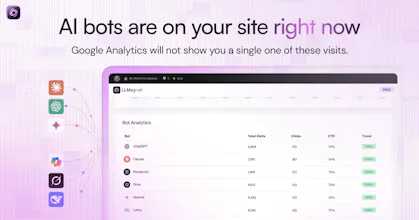
@daniel_wishnia Thanks Daniel! My pick would be the Bot Analytics view attached here. It answers a concrete first question for a client, which crawlers are reaching my site, how often, and how is that changing over time?
The next step would be checking which pages they access, particularly whether they’re reaching the product and service pages that matter to the business.
I’d also explain what this screenshot doesn’t tell us..a crawler visit isn’t proof of a mention or recommendation in an AI answer. It’s evidence of crawl activity, and a useful starting point for deciding what to investigate next.




LLMagnet
Hey everyone, I’m Ben, co-founder of LLMagnet.
I’ve spent years designing and building websites for businesses. We spend hours getting a headline right, making the offer clear, making sure visitors understand why they should care. As a builder, I want that work to be accessible to AI too.
My focus with LLMagnet has been making this practical for the person running the site. Which AI crawlers are visiting? What pages are they accessing? What can you improve? You should be able to start answering those questions from your WordPress dashboard.
There’s still a lot to figure out in this space, and we’re building with that in mind.
If you give it a try today, tell us what’s useful, what’s confusing, and what you wish it did. I’m here with the team and would love to talk through your site and use case.
Thanks for being part of our launch!
These days I ask an assistant about a product before I'd think to open a search tab. Getting a look at which of those bots come sniffing around a site feels handy. Bookmarked.
LLMagnet
@amine_aziz_alaoui Thank you Amine! Interesting to hear that’s already your first stop when researching a product. From the site owners side, seeing which bots visit and which pages they reach helps make that shift a little less invisible. Appreciate the bookmark! :)
LLMagnet
@amine_aziz_alaoui Appreciate that Amine, “which bots are already sniffing” is exactly the first signal we wanted site owners to see. If you try it on a WP site, curious which crawler shows up first for you.
wow! does it work with shopify?
LLMagnet
@nadav_berger1 Yes! Shopify is supported too 🙌 You can track how your store appears across AI platforms and see where there’s room to improve.
Not gonna lie I’m still not sold that “AI visibility” is even a real category.
Most sites I touch either block the bots or ignore them. And if ChatGPT answers from training data half the time anyway… does watching crawler hits on my WP install actually change anything, or is it just another dashboard?
LLMagnet
@achi_raanan Fair pushback - “AI visibility” is still messy as a label.
Watching crawler hits won’t make ChatGPT recommend you, and better content still matters more than another dashboard. What we’re trying to make visible is the ops layer most WP sites miss: which bots already reach you, and whether they hit money pages vs junk. Separate from “did we get cited.”
If you try it on one site you already block/ignore bots on, curious what actually shows up.
LLMagnet
@achi_raanan That’s fair, Achi. Tracking bot visits alone isn’t enough. The value is in spotting what needs attention on your pages and helping you fix it. A crawler visit doesn’t mean you’ll appear in an AI answer, and we shouldn’t blur that line. We want LLMagnet to help you make useful changes, not just give you another dashboard to check.
If I rewrite a product page to make it clearer for AI, how would I know the changes helped? A crawler coming back is a start, but what would you look for next? Curious how people here are measuring this on their own sites.
LLMagnet
@yotam_abu Great question. A crawler coming back is only step one.
Next I’d watch:
(1) whether that specific URL gets hit again and how often
(2) whether crawl coverage shifts toward the pages you care about,
and (3) whether the readiness checks behind Visibility Score move on that page (structure/clarity/content quality) after you recalculate.
We can’t promise a ChatGPT citation from one rewrite - we can show whether the foundations you control actually improved. If you try a rewrite on one product page, tell me what moved first on your side.
LLMagnet
@yotam_abu Adding to Ido’s point, I’d save a snapshot of the page’s score and crawl activity before editing, and note exactly what changed and when. That gives you a baseline to compare against after the rewrite. It won’t prove the rewrite caused every change, but it makes the results easier to interpret.
Just Sign
Been poking at bot logs on a couple WP installs and honestly the GPTBot / ClaudeBot / OAI-SearchBot split is messier than most SEO tools make it look. Half the time the URLs that matter aren’t even the ones getting hit. How are you surfacing that without drowning in raw access logs? Is Visibility Score more of a readiness checklist, or closer to “these bots actually reached X”?
LLMagnet
@ron_fybish1 Hey Ron, the score is closer to a readiness checklist. It helps you spot what needs work on your site, while crawler tracking shows the visits we’ve recorded in WordPress, without having to dig through raw logs.
That distinction matters: a page can score well and still get little crawler activity. And a recorded visit doesn’t mean the page was indexed or cited in an AI answer. Appreciate you bringing this up, it’s something we should make clearer on the launch page.
LLMagnet
@ron_fybish1 You’re describing exactly the mess we built for.
LLMagnet doesn’t dump raw access logs. It identifies AI crawlers (GPTBot, ClaudeBot, OAI-SearchBot, and others), then shows which bots hit you and which URLs they actually reached - so you can see whether the money pages are getting crawled or just thin archives.
Visibility Score is the readiness side, not crawl reach. It’s a checklist of whether your content is set up for AI access and understanding. Crawler activity is tracked separately, so a high score doesn’t mean “bots reached X,” and a crawler hit doesn’t mean ChatGPT recommended you.
If you’ve got those WP installs handy, install the free plugin and tell me what shows up first - bots you expected, or pages you didn’t want hit.
Congrats on shipping this. Feels like one of those “why didn’t this exist earlier?” tools for WordPress people.
Quick question for the room: if you could only show a client ONE screenshot about AI discovery on their site, what would it be?
LLMagnet
@daniel_wishnia Thanks Daniel! My pick would be the Bot Analytics view attached here. It answers a concrete first question for a client, which crawlers are reaching my site, how often, and how is that changing over time?
The next step would be checking which pages they access, particularly whether they’re reaching the product and service pages that matter to the business.
I’d also explain what this screenshot doesn’t tell us..a crawler visit isn’t proof of a mention or recommendation in an AI answer. It’s evidence of crawl activity, and a useful starting point for deciding what to investigate next.