
Lensmor
Turn exhibitor data into pre-booked sales meetings
623 followers
Turn exhibitor data into pre-booked sales meetings
623 followers
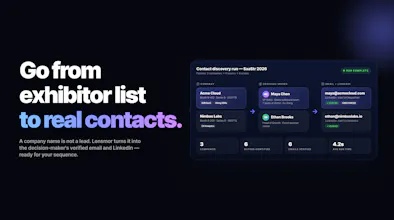
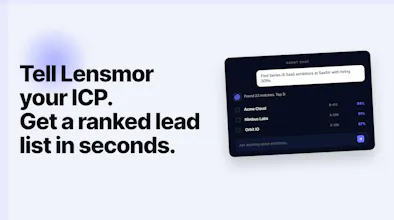
Unlike generic contact databases, Lensmor starts with exhibitor data, helping teams discover relevant events, find exhibiting companies, identify decision-makers, reveal verified emails, and book meetings before the show begins. Standout features include 160,000+ global events, exhibitor search, reverse company-to-event lookup, CSV export, and an AI agent for lead discovery and outreach planning.




Congrats, Claire! Proving ROI after the show is notoriously hard. Does Lensmor currently track which exported contacts actually turned into meetings or pipeline, or is that still a manual CRM step?
Lensmor
@barnaby_lloyd Great question, Barnaby — and I agree, post-show ROI is one of the hardest parts of trade show marketing.
Today, Lensmor focuses on the pre-show intelligence layer: helping teams identify the right exhibitors, contacts, and outreach angles before the event starts. Once contacts are exported or pushed into a CRM like HubSpot, teams can track meetings and pipeline there using Lensmor/event as the source or campaign.
We’re not trying to pretend full attribution is solved magically inside Lensmor yet. Deeper tracking would require access to CRM, calendar, email, and revenue data, which many teams are understandably careful about.
Our current priority is to make the pre-show signal much stronger first — so teams start with better accounts, better contacts, and better context. Then we can build more attribution workflows on top of that foundation.
Congrats on the launch! Does the AI Agent generate intelligence briefs that include recent news, job changes, or funding rounds? Or is it more static company/exhibitor data?
Lensmor
@andrew_paul11 Great question, Andrew — yes, we believe recent news, job changes, funding rounds, product launches, and other company-level signals are very important. They’re on our roadmap, and we’ll be shipping updates around this soon.
One thing we’ve learned is that exhibitor data itself is not static either. Trade shows have a short time window, and exhibitor lists, booth info, sponsors, and company context can change quickly before the event.
So we don’t think of this as a static CSV export. Our goal is to build a continuously refreshed event intelligence layer — combining exhibitor data with timely company signals, so sales teams can act on fresh context before the show starts.
Curious how the intent signal scoring works in practice; is it based on the exhibitor's booth activity at past shows, or are you pulling from outside signals like hiring and funding too? asking because the ICP filter looks solid but intent is usually where these tools get fuzzy
Lensmor
@alexzayago Great question — and I completely agree, “intent” is where many tools become fuzzy.
For us, we try to separate ICP fit from event intent. ICP fit answers: “Is this the right type of company?” Intent answers: “Why is this company worth engaging now, in this specific market window?”
Today, our scoring starts with event-native signals: exhibitor category, event relevance, sponsor/booth presence, repeat attendance across shows when available, market/category alignment, and how well the company/contact maps to your ICP.
We’re also adding more outside company signals like hiring, funding, product launches, and recent news. But we don’t want intent to become a black-box score. The goal is to show the underlying signals clearly, so teams understand why an account is being prioritized.
Congrats, Claire! How do you handle duplicate or parent-subsidiary company listings across multiple shows? One team might attend 5+ events per quarter and needs deduplication.
Lensmor
@antonio_manuel1 We work on deduplication across company names, domains, websites, LinkedIn pages, and event metadata, so the same company showing up across multiple shows doesn’t become five separate messy records.
That sounds really cool, but where do you get the participant lists from? Usually access to participants is only available in the app or personal account after purchasing tickets, and the participants are different every year, so it’s impossible to train the AI in advance. How did you solve this?
Lensmor
@mykyta_semenov_ We don’t rely on private attendee lists or assume that AI can be “trained” on a fixed participant list in advance. As you said, attendee data is often gated, changes every year, and may only be available inside an event app or personal account.
Lensmor is focused first on public and permitted event signals: exhibitor directories, sponsor pages, company websites, event categories, booth/company information, and other open company-level signals. We then enrich and map that data against your ICP to identify which events, exhibitors, and decision-makers are most relevant before the show.
So the product is less about scraping a hidden attendee list, and more about building a live event intelligence layer from data that can be refreshed as the event changes. Trade show data is not a static CSV — it has a short time window, and freshness matters a lot.
Congrats on the launch, and as one who loves going to expos for leads, I really like the idea! I was wondering whether the database could include side events related to each expo. Based on my experience, most real networking happens outside the exhibition space at those events, so I believe it would be helpful to include those information for reference as well.
Lensmor
@jinhao_bai2 Great point — and I completely agree. Our current focus is the core exhibitor and event intelligence layer, but we definitely see side events as an important part of the broader event graph. They can reveal where high-value conversations are more likely to happen, not just who is officially exhibiting.
One challenge is that side-event data is often fragmented and less structured, but that’s exactly why it could become very valuable once mapped properly. We’ll be exploring this direction more as we expand Lensmor beyond exhibitor lists into a richer pre-show intelligence workflow.
Good one for sales people. How does it help with bulk outreach, like someone want to set outreach sequence automatically?
Lensmor
@imrulkaayes Exactly — and I think this is an important distinction.
Trade shows are already a form of scaled customer acquisition. The real question is not just “how do I send more emails?” but “which event has the highest concentration of ICP-fit companies, and who should I meet there?”
For B2B, trust still matters a lot. Offline conversations and face-to-face meetings can create a level of credibility that purely automated outreach often can’t.
So our view is not to use AI for “spray and pray” bulk outreach. It’s to use AI to make the offline GTM motion much more precise: choose the right events, identify the right companies, find the right people, and create a relevant reason to connect before the show starts.