Launched this week

Humalike
Give your AI agents the social intelligence they're missing
725 followers
Give your AI agents the social intelligence they're missing
725 followers
Today's models are capable enough. Smart enough. Fast enough. But we still feel they don’t fit in the room. Humalike is building the behavioral infrastructure for humanlike AI agents. The social skills & proactiveness your agents have been missing. APIs, models, benchmarks.




Congratulations on the launch!
How does Turn Taking decide the best moment for an agent to join a conversation? does it adapt differently for fast moving group chats? really curious about the underlying approach.
@avery_thompson2 Thanks for support and question! Turn-taking uses other components like Social Signals to make better judgment. Social signals keeps track of typing speeds and realizes when chat is dynamic vs quiet. Turn taking also handles interruptions when agent already started processing and another message appears in group chat, that way agent is never spammy :))
Humalike
@avery_thompson2 tysm!!
One quick question: i feel that knowing when not to speak is what always gives bots away in group chats rather than the opposite. Does it work out of the box, or do you have to tune it per community?
jared.so
@david_vilalta Spot on, and that's exactly one of our biggest advantages: you don't have to tune it. It works out of the box, no per-community setup.
Thank you for the comment! :))
Humalike
@david_vilalta So far, solutions were either bad or didn't work at all. This is our first solution to this problem, give it a try! We'll keep making it better :))
The social memory piece is what stands out to me - most agent frameworks treat every conversation as stateless, so an agent forgets it already annoyed someone yesterday. Curious how you handle memory decay though, do old signals about a person just fade over time or does everything stay weighted the same forever? Congrats on the launch.
jared.so
@galdayan You absolutely nailed it Gal and that's one of the reasons why we came up with that idea.
Regarding the handle memory decay - we don't actually handle it right now, but weighting the memories based on their age is a good idea and we will probably implement it in some way int he future!
Happy to chat more about it :))
Humalike
@galdayan Good insight Gal, thanks! tysm for the supp
Social intelligence is exactly the layer that separates a demo from something a business will actually put on the phone. In production the failures are almost never 'wrong answer' - they're tone, over-promising, or not knowing when to shut up and hand off to a human. How are you measuring 'social' correctness? That's the part that's brutal to eval. Congrats on the launch.
Humalike
@david_marko Thanks for the supp David!
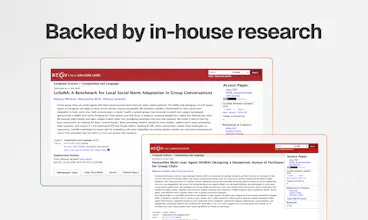
@david_marko Yes it's hard to measure and evaluate, especially in automated way since it usually takes human to judge what is appropiate in social setting. We have in-house research team working on evals and we open-sourced one of them, that is targeted on how well LLM adjusts to the group it is speaking to.
Paper link: https://arxiv.org/pdf/2606.14600
By the way I see you are maker of Worvi that could benefit from Humalike APIs. If you have more feedback / ideas please let us know!
How are you measuring "humanlike" in your benchmarks, and do the APIs let you tune how proactive an agent gets so it doesn't end up nudging users nonstop?
@serdardvi1 Hi, the bar for making AI more social is low enough that you can see the difference with naked eye. On top of that we have benchmarks related to specific capabilities, like adapting to local social norms: https://arxiv.org/pdf/2606.14600
Social Learning component helps agent understand and adapt to specific group. If it's not enough you can always tune it on your end, turn-taking component accepts prompt on how it should behave.
Humalike
@serdardvi1 Norms / Turn-taking / Theory of Mind are the pillars that enable Humalike to not have the "nudging users nonstop" problem.
For Humalike, when you say AI agents are missing “social intelligence,” is the core use case more about agents communicating with end users, collaborating with other agents, or handling public/community channels? The topic mix includes Developer Tools, Marketing & Sales, Design & Creative, and Social & Community, so I’m wondering who you see as the first user with the sharpest pain.
@mia_qiao Agent interacting with multiple humans is use case that we care about the most. We can argue that if you master this scenario, then 1:1 also gets better, and maybe agent-to-agent collaboration also improves, but we are not focusing on agent to agent at all.
Humalike
@mia_qiao Hey Mia! Agents communicating with end users. Agent-to-agent collaboration is not our core use case right now (more niche / less useful use cases). Core 2 ICP are (today.): 1. Any company that has agents communicating in any way with Humans (user experience is bad generally). 2. Devs with/want companions/personal agents
The benchmark piece is interesting here. For agents, “social intelligence” can get fuzzy fast. I’d want to see failure cases like interrupting too often or being too passive, not just success scores. Are you measuring those negative behaviors too?
@xiaosong001 Hey! Social Observability components evaluates these failure modes. We are obviously focusing on failure modes even more than on success stories.