Launching today
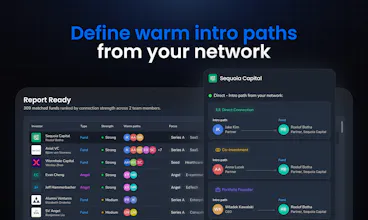
Fundraisly: ultimate AI agent for fundraising. It analyzes 300K+ investors and millions of deals, identifies the relevant ones actively investing in your space, maps warm paths to them from your own network, then covers the rest with targeted cold outreach. The result: 20-40 qualified investor meetings. Built by founders who raised over $1B.


Payment Required
Launch Team / Built With


Fundraisly
Hey Product Hunt! 👋 I'm Anna, founder of Fundraisly.
I spent 2.5 years as an investment analyst at $600M+ AUM VC Fund, portfolio includes 10 unicorns. I reviewed thousands of pitch decks — and saw firsthand how broken fundraising is. Brilliant founders wasting months cold-emailing the wrong investors. Meanwhile, the right ones were just sitting in databases nobody knew how to use.
So I built what I wished founders had when they came to us: an AI agent that analyzes 300K+ investors and millions of deals to find exactly who's active, relevant, and likely to respond — in minutes, not months.
The results blew my own expectations:
🎯 60–70% open rates. We only reach investors who are actively investing in your space, not generic cold lists
📞 On average, founders conduct 20-40 qualified investor meetings within the first 90 days with funds actively investing in their space
💼 3k+ VC calls conducted in last 6 months with funds like a16z, Sequoia, Index Ventures
💰 $100M+ raised for founders through the platform
Fundraisly isn't a CRM or a database. It's an AI agent that does the entire investor research, outreach, and follow-up for you — so you can focus on building your company.
I'd love your feedback — especially from founders who've been through the fundraising grind. What was the most painful part for you? Happy to answer any questions! 🚀
Scade.pro
Fundraisly
@nastassia_k Thanks a lot 🚀
Fundraisly
@nastassia_k Thanks so much!
@annmast The most painful part was realizing I was pitching product features instead of the underlying insight. Investors don’t fund what you built — they fund why the problem is structurally unavoidable. Took me longer than I’d like to admit to learn that distinction. Congrats on the launch, Anna!
Fundraisly
@dani_mashael Features are just the answer - investors want to see you've diagnosed the disease, not just the symptoms. That structural inevitability is exactly what Fundraisly is built on: the way fundraising is broken isn't a product gap, it's a systems problem. That conviction is what got us here. Love the perspective, thanks for the kind words on the launch! 🙌
@annmast @dani_mashael So true, and it's a hard lesson because building something real makes you want to talk about what it does. The shift from 'here's the product' to 'here's why this problem exists' is a mental model switch, not just a messaging fix. Appreciate you sharing that - I see it so often with my Client, too. Once you unlock it, that's when the magic happens ;)
Fundraisly
@dani_mashael Appreciate the support!
Welltory
@annmast Good luck :)
Fundraisly
@veranika_zdanovich Thank you 💙
Fundraisly
@veranika_zdanovich Thanks, means a lot!
@annmast good luck! 🤞
Fundraisly
@vadym_pavlenko Thank you 🙌
Fundraisly
@vadym_pavlenko Appreciate the support!
@annmast Very cool! Would be great to know how your data is sourced, would pitchbook, dealroom, crunchbase etc have similar data?
Fundraisly
@faizanlaghari Great question! And yes, we pull from multiple sources including the ones you mentioned. But they're inputs, not the product.
The difference is what happens after the data is collected. Those platforms give you a database to search manually. We run it through an AI layer that scores and ranks investors against your specific company profile, filters for active deployment signals, and maps warm paths through your personal network on top of that.
So a founder using PitchBook still has to figure out who's relevant, who's currently writing checks, and how to get in front of them. Fundraisly answers all three and then executes the outreach. It's less "better database" and more "the work that used to take weeks, done in minutes." 🚀
Fundraisly
@faizanlaghari Appreciate the support!
what happens to a founder's reputation with investors if the outreach volume is high and the targeting is off. investor networks are small and word travels. a founder who sends 200 poorly targeted cold emails through an AI agent can do real damage to their chances before they ever get on a call. how are you thinking about the downside risk of scale outreach in a community where relationships and signal matter more than volume
Fundraisly
@ansari_adin Fair point, and worth saying out loud because founders genuinely lose sleep over this.
VCs are processing hundreds of emails a week. A well-crafted cold email that doesn't land isn't a reputation event, it's just noise that passes through. They won't remember it, and they certainly won't hold it against you when you reach out again with a warm intro six months later.
What actually ruins a founder's reputation in the VC community is dishonesty, inflated metrics, misleading decks, P&L that doesn't hold up to scrutiny. That travels fast and sticks. A cold email that didn't convert? Nobody's talking about that at a partner meeting.
The other side of this: we're not sending several emails a day to the same investor. The sequencing is measured, spaced out, and stops the moment there's a reply. And the target list is built for accuracy, if an investor isn't a genuine fit, they don't make the list in the first place.
Outreach done right is genuinely the safest part of the process 🙌
@annmast Cool idea! Seems very useful assuming the methodology used to assign potential investors to your relevant vertical is sound (i.e. the categorization your own vertical needs to first be correct and then the categorization of the investor's vertical needs to also be correct). How exactly are you doing that? Are there automated analyzes done on an investor's completed deals that properly categorize those companies relative to the profile of your own? The largest waste of time in my opinion is not necessarily obtaining contact info or sending the email but ensuring the person I am emailing is actually an appropriate person to contact.
Fundraisly
@millwiller For investors, we run automated analysis on their completed deals, not their stated thesis, which is often outdated or deliberately vague. What sectors did they actually back? What stage, check size, business model, and geography patterns emerge from their real portfolio? A fund that says "we invest in enterprise software" but has 60% consumer deals in their last 20 investments tells you something their website never would.
And you're right about the contact layer too, matching to the right fund is only half of it. We go to partner level, mapping which specific partner has the relevant thesis 🚀
Emma Intelligence
Happy launch day. How fast does the first investor call usually show up?
Fundraisly
@userio_neimio It depends on the plan, but with our full-service plan, infrastructure setup takes 2 weeks. After that, meetings start flowing in. In one campaign, a founder had 16 calls locked in during the first three days, including a conversation with the Andreessen Horowitz team within 25 minutes of outreach going live.
Fundraisly
@userio_neimio For full-service campaigns, setup usually takes a couple of weeks before meetings start appearing. The exact timing depends on targeting, deliverability, and how ready the materials are.
Fundraisly
@userio_neimio Appreciate the support!
Fundraisly
@userio_neimio Thanks man! Fast and furious, as they say 🙂
I like that Fundraisly focuses on active and relevant investors, not just “more contacts.” That feels much more useful for founders (or at least for me).
Curious how you decide which investors are actually a good fit for a startup. Is it mostly based on past deals, current activity, stage, geography, or all of these together?
Fundraisly
@andrasczeizel All of the above, but the magic is in how they're weighted together, not treated as separate filters.
We start with the hard constraints: stage, geography, check size, and sector. That cuts the 300K+ universe down to a realistic pool. Then the second layer: recent deal velocity in your specific sub-vertical, partner-level thesis (different partners at the same fund can have completely different conviction areas), and timing signals like fund age and deployment pace.
Then there's a third layer that most tools miss entirely: warm path proximity. A perfectly matched investor you can reach through two degrees of your network is worth 10x a cold contact with identical criteria on paper.
Fundraisly
@andrasczeizel Appreciate the support!
mailX by mailwarm
What data do you connect to build that graph, if it's Gmail or LinkedIn, and how do you handle privacy there?
Fundraisly
@karimbenkeroum Great question! Transparency here matters a lot to us.
We connect Gmail, Outlook, and LinkedIn to build the relationship graph. For Gmail and Outlook, we analyze metadata and communication patterns (frequency, recency, responsiveness). We're CASA certified for our Google integration, which means our security practices have been independently audited and verified.
For LinkedIn, we work with a GDPR-certified third-party service to handle that connection, so data handling there meets the highest European privacy standards.
Really interesting - curious how you handle the warm path mapping when someone's network is mostly in a different industry. I'm coming from institutional finance/tax consulting, so my warm connections are mostly family offices and healthcare executives, not traditional tech VCs. Does the system weight domain-relevant investors even when they're not traditional tech VCs? Congrats on the launch
Fundraisly
@joe_rucker Really relevant question and actually a more common situation than most founders admit.
A few things work in your favor here. Family offices are a significant part of our investor database and many are actively deploying into tech, especially at early stage where ticket sizes align. So your existing warm connections to family offices aren't a liability, they may be direct paths to capital that's less competitive than traditional VC.
Healthcare executives as angels or check-writers is also a pattern we see a lot in healthtech, medtech, and enterprise SaaS with healthcare verticals.
The system doesn't penalize domain mismatch, it maps your warm paths as they are, then supplements with targeted cold outreach to traditional tech VCs where your network has gaps. So in practice you'd be running two tracks in parallel: leveraging your existing institutional finance connections where they're relevant, and building new warm paths into tech VC through the LinkedIn expansion layer.
Fundraisly
@joe_rucker Appreciate the support!