Launching today
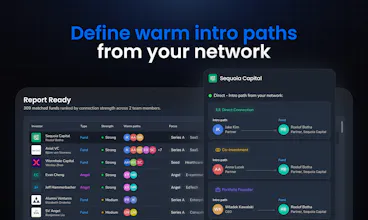
Fundraisly: ultimate AI agent for fundraising. It analyzes 300K+ investors and millions of deals, identifies the relevant ones actively investing in your space, maps warm paths to them from your own network, then covers the rest with targeted cold outreach. The result: 20-40 qualified investor meetings. Built by founders who raised over $1B.


Payment Required
Launch Team / Built With


Fundraisly
Hey Product Hunt! 👋 I'm Anna, founder of Fundraisly.
I spent 2.5 years as an investment analyst at $600M+ AUM VC Fund, portfolio includes 10 unicorns. I reviewed thousands of pitch decks — and saw firsthand how broken fundraising is. Brilliant founders wasting months cold-emailing the wrong investors. Meanwhile, the right ones were just sitting in databases nobody knew how to use.
So I built what I wished founders had when they came to us: an AI agent that analyzes 300K+ investors and millions of deals to find exactly who's active, relevant, and likely to respond — in minutes, not months.
The results blew my own expectations:
🎯 60–70% open rates. We only reach investors who are actively investing in your space, not generic cold lists
📞 On average, founders conduct 20-40 qualified investor meetings within the first 90 days with funds actively investing in their space
💼 3k+ VC calls conducted in last 6 months with funds like a16z, Sequoia, Index Ventures
💰 $100M+ raised for founders through the platform
Fundraisly isn't a CRM or a database. It's an AI agent that does the entire investor research, outreach, and follow-up for you — so you can focus on building your company.
I'd love your feedback — especially from founders who've been through the fundraising grind. What was the most painful part for you? Happy to answer any questions! 🚀
Scade.pro
Fundraisly
@nastassia_k Thanks a lot 🚀
@annmast The most painful part was realizing I was pitching product features instead of the underlying insight. Investors don’t fund what you built — they fund why the problem is structurally unavoidable. Took me longer than I’d like to admit to learn that distinction. Congrats on the launch, Anna!
Fundraisly
@dani_mashael Features are just the answer - investors want to see you've diagnosed the disease, not just the symptoms. That structural inevitability is exactly what Fundraisly is built on: the way fundraising is broken isn't a product gap, it's a systems problem. That conviction is what got us here. Love the perspective, thanks for the kind words on the launch! 🙌
Welltory
@annmast Good luck :)
Fundraisly
@veranika_zdanovich Thank you 💙
@annmast good luck! 🤞
Fundraisly
@vadym_pavlenko Thank you 🙌
@annmast Very cool! Would be great to know how your data is sourced, would pitchbook, dealroom, crunchbase etc have similar data?
Fundraisly
@faizanlaghari Great question! And yes, we pull from multiple sources including the ones you mentioned. But they're inputs, not the product.
The difference is what happens after the data is collected. Those platforms give you a database to search manually. We run it through an AI layer that scores and ranks investors against your specific company profile, filters for active deployment signals, and maps warm paths through your personal network on top of that.
So a founder using PitchBook still has to figure out who's relevant, who's currently writing checks, and how to get in front of them. Fundraisly answers all three and then executes the outreach. It's less "better database" and more "the work that used to take weeks, done in minutes." 🚀
mailX by mailwarm
What data do you connect to build that graph, if it's Gmail or LinkedIn, and how do you handle privacy there?
Fundraisly
@karimbenkeroum Great question! Transparency here matters a lot to us.
We connect Gmail, Outlook, and LinkedIn to build the relationship graph. For Gmail and Outlook, we analyze metadata and communication patterns (frequency, recency, responsiveness). We're CASA certified for our Google integration, which means our security practices have been independently audited and verified.
For LinkedIn, we work with a GDPR-certified third-party service to handle that connection, so data handling there meets the highest European privacy standards.
Emma Intelligence
Happy launch day. How fast does the first investor call usually show up?
Fundraisly
@userio_neimio It depends on the plan, but with our full-service plan, infrastructure setup takes 2 weeks. After that, meetings start flowing in. In one campaign, a founder had 16 calls locked in during the first three days, including a conversation with the Andreessen Horowitz team within 25 minutes of outreach going live.
Fundraisly
@userio_neimio For full-service campaigns, setup usually takes a couple of weeks before meetings start appearing. The exact timing depends on targeting, deliverability, and how ready the materials are.
I like that Fundraisly focuses on active and relevant investors, not just “more contacts.” That feels much more useful for founders (or at least for me).
Curious how you decide which investors are actually a good fit for a startup. Is it mostly based on past deals, current activity, stage, geography, or all of these together?
Fundraisly
@andrasczeizel All of the above, but the magic is in how they're weighted together, not treated as separate filters.
We start with the hard constraints: stage, geography, check size, and sector. That cuts the 300K+ universe down to a realistic pool. Then the second layer: recent deal velocity in your specific sub-vertical, partner-level thesis (different partners at the same fund can have completely different conviction areas), and timing signals like fund age and deployment pace.
Then there's a third layer that most tools miss entirely: warm path proximity. A perfectly matched investor you can reach through two degrees of your network is worth 10x a cold contact with identical criteria on paper.
Hey there
Are you in any way incentivized in a successful fundraising by your customers?
I mean, is your business model is “pay for our service” or rather “pay for your result”?
Fundraisly
@shishkinii Great question - and yes, we're deeply incentivized in every raise we work on.
Every campaign directly impacts our reputation, which means we only take on founders we genuinely believe in and go all-in when we do.
On the commercial side: right now our model is service-based (you pay for the platform and campaign execution). We're actively working toward a success fee structure, which is the natural evolution, but that requires us to obtain a brokerage license first. We're in that process.
Spiritme
Do follow-ups go out automatically? That's where a lot of outreach starts feeling robotic.
Fundraisly
@nikita_bogdanov1 Yes, follow-ups are automated, but that's exactly where we put the most work in to make sure they don't feel that way.
The sequences are written per campaign, not pulled from a generic template. Timing, tone, and content are calibrated based on the investor's profile, thesis, and recent activity, so each touchpoint feels like a considered follow-up, not a drip sequence.
We also monitor replies in real time. The moment an investor responds, they're pulled out of the sequence and handed off for a human conversation. No one gets a follow-up after they've already replied.
The goal is that an investor reads it and thinks "this founder did their homework", not "this is a mass campaign."
Threedio
Skeptical about quality, ngl. Used a similar service last year, won't name names. They booked 12 meetings, but 8 were with associates at funds that did not invest at the stage or check size we needed. By the third call I was burning founder time just to hear "too early for us." How are you screening for stage fit beyond what a fund says on its website?
Fundraisly
@anna_titova That's exactly the stage-fit problem we try to avoid. We don't rely only on what a fund says on its website; we look at recent investments, check-size patterns, partner activity, and whether similar companies actually got funded. The outreach also includes your deck and context, so investors know why they're being asked to take the call.