
Databox is an AI-powered business intelligence and analytics platform for teams that need clear, trusted answers fast. It offers the best of BI, without the complicated setup, steep price, or long learning curve. It provides a blend of powerful, but easy-to-use, features, from preparing datasets and creating the custom metrics your company needs to track, to building beautiful dashboards, customizing your reporting, and receiving AI-powered insights.
This is the 7th launch from Databox. View more

Skills Marketplace by Databox
Launched this week
A library of ready-made skills for paid ads, website performance, ecommerce, revenue, and more. Each skill pulls from your live performance data and returns a finished, shareable report in under a minute. Run them in Claude when you want answers in chat, or schedule them in n8n to land in Slack or email automatically. Free to download.


Free Options
Launch Team / Built With


This seems really interesting because I feel like most people don't struggle with getting an answer from AI they struggle with asking the right prompt. I'm curious what was the first report that almost every customer kept asking for. I always find those patterns interesting because they usually tell you what people actually care about, not just what they say they want.
Databox
@reda_roqai_chaoui Good question, and you're right that it's a useful signal. The GA4 Website Traffic & Performance Report was the one we kept seeing requested first, almost every team wants the "what happened to my traffic and why" answer before anything else, regardless of industry. It's basically the front door report, so that's why it's the featured skill in the marketplace. After that it splits by function pretty quickly - paid ads people want spend efficiency, SEO people want visibility.
The marketplace is probably the most interesting part of this. My first thought was maintenance. If a skill gets updated less often than the tools or metrics it depends on, how does a team know? Is there some way to flag outdated skills before they quietly start producing misleading reports? Congrats on the launch!
Databox
@jared_salois Maintenance is the right thing to worry about, and it's a fair gap to call out. Today there's no staleness flag or "last verified" indicator on a skill page, it's closer to the rename-with-different-semantics issue someone raised above, where the failure is quiet rather than loud. The metric map and troubleshooting flow help if something breaks outright, but drift in what's considered best practice for a metric isn't surfaced automatically yet. Good prompt for what a healthy signal on each listing should look like."
@zigapotocnik That makes sense. Drift is the harder problem because nothing breaks, it just slowly becomes less true. Curious if you think that can ever be detected structurally, or if it will always rely on user feedback.
Databox
@jared_salois I think there's a structural piece available, even if it can't catch everything. Things like usage patterns across teams running the same skill, or comparing a skill's metric assumptions against what's currently in the live Databox connection, could surface a "this hasn't been touched in a while and the source has changed" signal without anyone reporting it. But the harder layer, whether the analytical framing itself is still the right one for how a channel or platform works today, probably does need a human in the loop. Likely ends up being a mix, structural checks to flag candidates, feedback to confirm them.
I'm still learning data analytics, so this looks interesting. Would you recommend these AI skills for beginners who are trying to understand their data, or are they better suited for experienced teams?
Databox
@vaishnavi_makode Both, honestly. The skills don't require you to know how to build reports or write prompts - you download the file, connect your data source, and trigger it with a phrase. The expert framing is already inside the skill, so you get a structured analysis without needing to know what to ask for. If anything, that makes them more useful for beginners than a blank AI tool, since you're not starting from scratch. The setup guide walks you through every step too.
@zigapotocnik That actually makes a lot more sense. I like that the expert guidance is already built in, because figuring out what to ask is usually the hardest part when you're just starting out. Thanks for explaining!
ConnectMachine
Love it! How do you control the quality of the skills in the marketplace so that it doesn't become flooded with low-quality skills over time?
Databox
@syed_shayanur_rahman Every submission goes through a review before it goes live - we check that it's a specific, repeatable analytical workflow built on real Databox MCP data, usable by a non-analyst, and that the output actually holds up against live data. Generic or vague submissions don't clear that bar. We also package and write every listing ourselves, so there's a natural bottleneck that keeps volume in check while the quality bar is being established. The goal is a small library worth running, not a long tail of things that almost work.
ModuleX
The "knowledge as an executable skill file instead of a blog post" framing really stuck with me, so I'm curious what stops the marketplace from filling up with thirty near identical GA4 skills once partners pile in, is there any curation layer or do the best ones just float up by usage?
Databox
@sezerufukyavuz There is a curation layer, it's not just first-come-first-served. Every submission goes through a review against criteria like being genuinely useful and not just a generic prompt, built on real Databox MCP data, and usable by a non-analyst, so near-duplicate "me too" GA4 skills wouldn't clear that bar as-is. That said, we'd rather have a few genuinely different takes on a popular category than artificially cap it, the bar is about whether it adds a distinct angle, not whether the data source has already been covered.
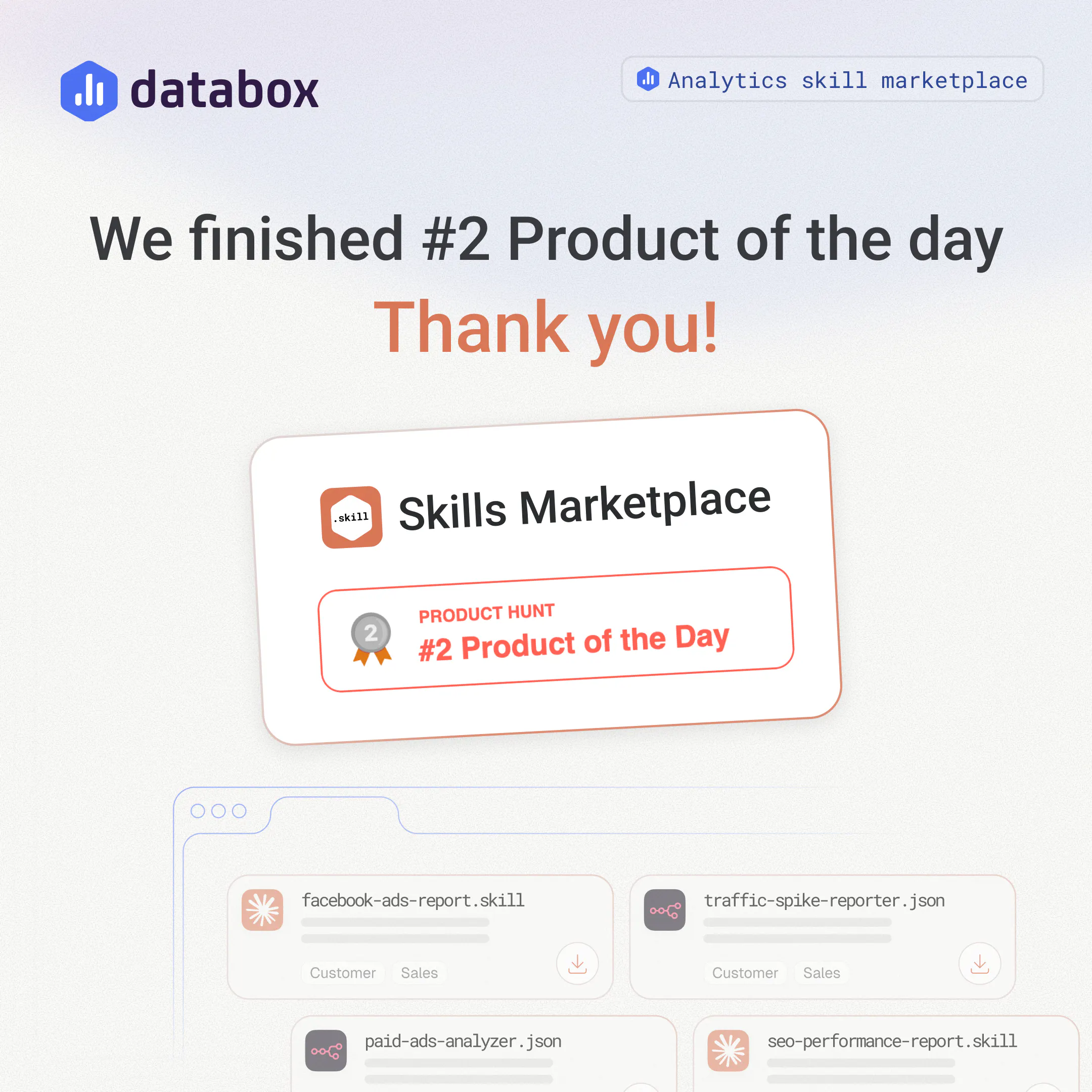
Congrats on being #2 Product of the Day. It would be awesome if the marketplace eventually supported community ratings and reviews for each skill or does it support already?
Databox
@ankur_jeswani Thanks Ankur! Not live yet but actually in progress right now - community ratings and reviews per skill are coming soon. Glad it's on your wishlist, it's on ours too.
I spend more time deciding which report to build than actually reviewing it, so this approach caught my attention. Having analysis already structured around real metrics sounds like it could save a lot of back and forth.
Databox
@new_user___090202674ab6e030a7a9c52 That's the exact friction we built this for - the planning overhead of "what should this report even cover" eats more time than people expect. Each skill starts from a specialist's framing of what to measure and compare, so you skip that blank-page step and go straight to reviewing real output. Let us know how it goes if you give one a try.