
Claude by Anthropic
A family of foundational AI models
5.0•886 reviews•65K followers
A family of foundational AI models
5.0•886 reviews•65K followers
We're an AI research company that builds reliable, interpretable, and steerable AI systems. Our first product is Claude, an AI assistant for tasks at any scale.
This is the 42nd launch from Claude by Anthropic. View more
Claude Sonnet 5
Launched this week
Our most agentic Sonnet yet, with top-tier intelligence for coding and everyday professional work.



Free Options
Launch Team


 ChatGPT by OpenAI
 Gemini
How does the pricing scale for heavier workloads, and are there any caps on context length or API rate limits I should watch out for at the higher tiers?
Curious how Claude handles really long documents compared to the usual token limits I'm used to. Can you drop in a 200 page PDF and have it pull out specific info accurately?
ModuleX
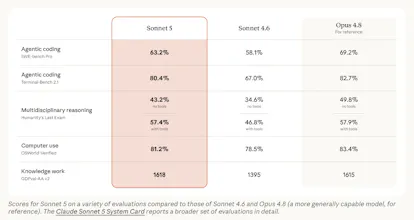
the line that got me is Sonnet basically creeping up on Opus 4.8 territory while costing way less, that's a wild place for the mid tier to sit. when it's driving a browser or terminal on its own, what's it actually doing to keep a long autonomous run from quietly drifting off the original task?
How does Claude handle really long documents compared to other models, and is there a hard cap on context length or input size?
DiffSense
Loving "baby Fabel" so far. Started to use it lasst night. Feels a s good as Opus 4.6 TBH. 🙏
Honestly impressed by how Claude handles longer context without losing the thread. Used it to summarize a messy research doc and it actually flagged ambiguities instead of guessing.
Honestly the tone feels way more natural than other assistants I've poked at, and it actually pushed back politely when my prompt was vague instead of just guessing. Made me trust the answer more.