
Clark
An AI coworker with its own cloud computer
783 followers
An AI coworker with its own cloud computer
783 followers
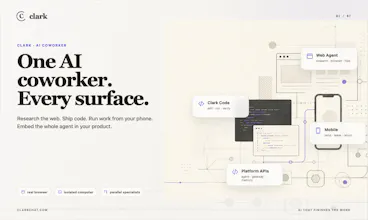
Clark is an AI coworker with its own cloud computer - browser, terminal, files, and code. Hand it a real task, close the tab, and come back to finished work: wide, sourced research; websites; spreadsheets; decks; audits; or tested code. It can fan work out to parallel specialists, run on a schedule, and return artifacts with the evidence behind them. Use Clark on web or mobile, work in real repositories with Clark Code, or embed the agent through an OpenAI-compatible API.



Free Options
Launch Team / Built With


This looks cool! Was wondering what the difference is between this and /loop on claude code? Can't cc agents run autonomously already?
Clark
@loup_wang clark cloud agent is closer to Manus with a bit more flexibility and power
and clark code is replacement for codex / cc
We stress-tested Clark on original mathematics research — specifically, an open gap in our Riemann Hypothesis program at MathLab (mathlab.quantiterate.com), a proof verification platform with an adversarial War Room.
We gave Clark a five-step forward path and told him to implement it. He produced two compilable LaTeX files: an unconditional lemma with correct proofs and a conditional strip theorem with five named hypotheses. When we critiqued structural defects in v1.0, he absorbed every point and produced a tighter v1.1 with a changelog. Rating: 7–8/10.
Your three questions:
1. First task: we went straight to the hardest thing we could think of. Most honest test.
2. "Own cloud computer" comes through — getting back compilable LaTeX with correct theorem numbering and cross-references is qualitatively different from chat.
3. Where we'd hesitate: autonomous long-horizon work. Clark is an excellent decomposer — he factors hard problems into clean sub-problems. But when the difficulty is a tension that doesn't decompose further, he'll keep refining the scaffold without resolving it. The human critique loop is what made him improve. Infrastructure, not engine. We'll use him again.
Clark
@quantiterate Thank you for the feedback Matthew!
There is ongoing work to balance your last point #3!
"Its own cloud computer" is a meaningfully different architecture than most AI-coworker tools that just call APIs — giving it a persistent environment changes what it can actually do end-to-end. Curious how you're handling security/sandboxing for that computer, especially once it's doing real multi-step tasks unsupervised. That's usually the part that keeps teams from trusting autonomous agents with anything consequential.
Congrats on the launch. The own-cloud-computer model is compelling, especially the inspectable files, screenshots, sources, and logs. Before trusting it with repository changes or form submissions, can users define approval gates for sensitive actions and scope them to a specific operation, account, repository, and time window? Also, after a partial failure, do the logs show what completed and whether a retry is safe?
I've tried plenty of AI tools, but the ability to return completed research with evidence feels much more practical. I'm curious how well it adapts to different workflows over time.
I've been looking for something that can manage research without constant supervision, and this sounds promising. The idea of parallel specialists is especially interesting. I'd love to know how the system decides which specialist handles each part of a project.
I'm intrigued by the combination of research, coding, spreadsheets, and presentations in one workflow. I've used separate tools for each of those tasks, so bringing everything together sounds efficient. My biggest question is how well it maintains context across longer projects where priorities and requirements change over several days.