
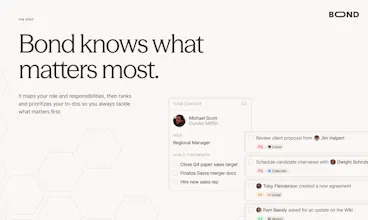
Bond is an AI Chief of Staff for executives. It connects to your tools, learns how your company works, and turns scattered tasks into a self-managing to-do list that always knows what you need to do next. You can ask Bond to prepare you for your next meeting, draft a follow-up, send an email, create action items, identify blockers, surface risks, or delegate tasks to team members.




Forum Threads


How Bond Won Product of the Week: The Full Playbook
Bond secured #1 Product of the Week on Product Hunt earlier this summer and we ve decided to leak our exact playbook.
Join us on August 13th for a workshop where the Bond team will reveal exactly how we earned more than 800 upvotes in 24 hours without ever dropping below the top spot.
You ll leave with:
- A step-by-step launch timeline, even if you re on a time crunch
- The exact assets to prepare
- A launch-day checklist and distribution plan
- Access to a private community of founders preparing for and sharing advice on Product Hunt launches
We ll also give direct feedback on your upcoming launches and end with an open Q&A.
Sign up HERE
PS. Want research-backed productivity lessons from the world s highest performers, behind-the-scenes Bond updates, and first access to playbooks like this one? Join our newsletter and learn how to win back 10 hours every week.
What's on the roadmap? Curious where you're taking the "chief of staff" concept. Are you going deeper on specific workflows or broader across more of the exec stack?
Bond
@annemarie_leys Love this question.
The blunt version: we won't stop until every executive is unemployed from their own to-do list.
The thing we're building toward is you waking up to a single message from Bond that says: "you picked up 10 new todos since you left yesterday. I already handled 6 of them myself and delegated the other 4 to your team. You're all good." That's the whole dream. Not a dashboard you check, but a chief of staff that just runs the back office of your life while you sleep.
And we're honestly very, very close to that. More than people expect.
So to your actual question: it's both, but the order matters. We go deeper on the core workflows first (discovery, prioritization, delegation, follow-through) because that's where trust is won or lost, and then broader across the whole stack once the foundation is rock solid. Depth earns the right to go wide :)
Naise AI
Really cool idea. How does the AI handle task prioritization under the hood? Can I feed it my quarterly marketing OKRs so it knows which tasks actually move the needle versus what's just urgent?
Bond
@andika_fadhilah Under the hood Bond scores everything on things like importance, urgency, and effort, then ranks from there. Urgency also decays and climbs over time, so something genuinely time-sensitive rises while a loud-but-pointless ping doesn't hijack your day.
It also classifies your todos across multiple frameworks (Eisenhower, GTD, and more), because everyone manages their work differently. Some people think in quadrants, some in next-actions, so Bond meets you in whatever system you already live in instead of forcing its own.
And yes, exactly what you're describing: you can feed Bond your priorities and goals (quarterly OKRs included), and it weighs tasks against what actually moves the needle for you, not just what's screaming loudest. That's the difference between a to-do list and a chief of staff. One sorts by deadline, the other sorts by impact.
How does Bond distinguish between tasks the executive should personally handle versus tasks that should be delegated and does that threshold adapt over time based on observed behavior?
Bond
@daniel_juan2 Personally one of my favorite features, let me explain: Bond builds up a profile of you and the people you work with, learning what your responsibilities are, and what your colleagues own too. Based on that, it can suggest the right person to delegate a task to, rather than leaving everything on your plate.
And that profile sharpens over time: the more Bond observes who handles what, through your emails, messages, and what you complete or pass along, the better it gets at telling what's truly yours to do versus what's better delegated to someone else. Hope this sparks some excitement 🚀
Most executive workflows involve a lot of verbal context from calls and meetings does Bond integrate with transcription tools like Fireflies or Otter to capture and act on spoken decisions?
Bond
@new_user___10520260379921a76fc2d64 Notetakers are a gold mine for Bond. So many 'action items' from meetings get lost. But Bond captures them all.
Currently we're supporting: Granola, Clickup notetaker, Fireflies, Fellow, Fathom, Circleback. But we're adding them on the go as users ask for them :)
As an executive company scales the complexity of their operating environment grows exponentially how does Bond's architecture handle that scale without becoming a bottleneck or a noise machine itself?
Bond
@diego_joaquin1 Love this engineering question, it's the thing we obsess over.
We're basically filtering smartly through all the noise, and as a company grows, Bond does more filtering, not more pinging. There are only so many important todos you can do in a day, so our goal is to surface the ones that have the biggest impact and those that best align with your personal and company goals.
Most executive tools are built around individual productivity but Bond seems to sit at the intersection of personal workflow and team coordination. How do you prevent it from becoming a surveillance layer that makes direct reports feel micromanaged?
Bond
@dominic_cruz Great question, Dominic, this is a line we think about a lot.
Bond is designed around the executive's existing workflow, not employee surveillance. It works from the context the executive already has access to and turns that into better follow-through. The goal isn't "watch what everyone is doing"; it's "help me remember what I owe people, who or what is blocked, and where a follow-up would be useful."
A big part of that is how Bond presents information: evidence-backed, task-focused, and action-oriented. It should surface "this customer launch is waiting on a decision" rather than "Alex hasn't replied in 36 hours."
Used well, it reduces micromanagement because follow-ups become clearer, more contextual, and less reactive.
The standard we hold ourselves to is: Bond should make teams feel better supported, not more watched.
Hope this helps 🙏
Executives frequently make decisions based on gut feel and informal conversations that never get documented how does Bond capture those unstructured signals and factor them into what it surfaces next?
Bond
@elijah_smith6 Really sharp question, there's two parts:
First, a lot of what feels "undocumented" actually is captured somewhere, just scattered. The gut-feel call you made in a Slack DM, the aside in an email, the "let's just go with X" moment in a meeting transcript. That informal layer is exactly where Bond lives, so it picks up signals that never made it into a doc or a ticket. The decision didn't get written down formally, but it left a trace, and Bond connects that trace to what comes next.
Second, for the stuff that's truly only in your head, you can just tell Bond. A quick "I've decided we're pausing the X launch" and it factors that into what it surfaces from then on, no formal process required. It remembers across conversations, so you say it once.
What it won't do is pretend to read your mind. It can't infer a decision you've made zero signal about anywhere. But the bet is that far more of executive "gut feel" is observable than people assume, it's just buried in the noise.