Everything you do at work needs "managing": projects, tasks, priorities, customers, meetings, teams, strategy. You can't remember it all. Ari, your second brain that manages it all for you: it tracks things, stays current without constant updates, and tells you what matters. Less admin. More building. Free to start.
The greatest companies like Amazon and Uber have long used “bar raisers” to grow their talent—and now you can too. Ari helps you and your team maintain and grow a higher standard of execution by handling the work about work, tracking commitments, reporting progress, aligning communications and priorities, driving follow-through, and showing what’s working so you can double down. You and everyone gains more time and mental space for meaningful work, to tackle your most ambitious projects.
The bar raiser framing is smart because it names the thing nobody wants to be, the person who nags. Question on "reporting progress": when Ari reports up, what does the artifact look like, a doc, a chat summary, or something a manager can drop straight into the Monday deck? I build a deck agent (AskDeck) so the "tracker to three exec slides" step is the part I think about, curious where you landed.
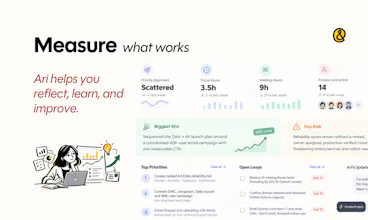
@thicreator Ari provides lots of different options for "reporting progress": chat message via Web /Slack/Teams chat to surfaces a brief during daily greeting or meeting notes summary. You can follow up by asking Ari to generate/update a deck/slides/doc with more details, in the latest dashboard widgets feature, Ari could generate customized dynamic widgets on the dashboard by just chatting with her, she will give you detailed information in your preferred representation. It's more powerful than a static text/table/list since you can interact with those widgets and ask Ari about it.
@thicreator there are status updates shared with the team (you opt-in). And signals/metrics aggregated across teams and the org. The aggregated signals are anonymized, like trends and patterns across meetings. How much time did we spend across different types of discussions as a team. What are the blindspots that slow us down, etc. etc.
@thicreator It is a combination of reflections ari has done about the users work compounded into a status update doc generated every day for every user. It factors in your meetings, the chats in slack you've had and the actual real work from any integrations you've connected. As an engineer using primarily github and asana, it knows everything I've done in those tools and adds them to my work status reports for me automatically.
We've completely eliminated the "what did you do yesterday part of standup"
Report
I like the focus on reducing the work about work. A lot of time gets lost just figuring out what needs attention next.






AskDeck
The bar raiser framing is smart because it names the thing nobody wants to be, the person who nags. Question on "reporting progress": when Ari reports up, what does the artifact look like, a doc, a chat summary, or something a manager can drop straight into the Monday deck? I build a deck agent (AskDeck) so the "tracker to three exec slides" step is the part I think about, curious where you landed.
Ariso
@thicreator Ari provides lots of different options for "reporting progress": chat message via Web /Slack/Teams chat to surfaces a brief during daily greeting or meeting notes summary. You can follow up by asking Ari to generate/update a deck/slides/doc with more details, in the latest dashboard widgets feature, Ari could generate customized dynamic widgets on the dashboard by just chatting with her, she will give you detailed information in your preferred representation. It's more powerful than a static text/table/list since you can interact with those widgets and ask Ari about it.
Ariso
@thicreator there are status updates shared with the team (you opt-in). And signals/metrics aggregated across teams and the org. The aggregated signals are anonymized, like trends and patterns across meetings. How much time did we spend across different types of discussions as a team. What are the blindspots that slow us down, etc. etc.
Ariso
@thicreator It is a combination of reflections ari has done about the users work compounded into a status update doc generated every day for every user. It factors in your meetings, the chats in slack you've had and the actual real work from any integrations you've connected. As an engineer using primarily github and asana, it knows everything I've done in those tools and adds them to my work status reports for me automatically.
We've completely eliminated the "what did you do yesterday part of standup"
I like the focus on reducing the work about work. A lot of time gets lost just figuring out what needs attention next.
Ariso
@jharkhandi_chora1 Ariso is exactly for solving that issue! It knows you, your work and what your organizations goals are so you can very easily align
Ariso
@jharkhandi_chora1 one thing we say to Ari all the time is "Do this for me", so that we can focus on the real work.
The second brain approach is interesting, especially for teams juggling projects, meetings and customer work at the same time.
Ariso
@johnnie_kuvalis It's starting to frighten me how much I've started delegating to Ari, but it does make me much more efficient!
Nowadays with coding agents running rampent I can ship so much stuff I absolutely need something like ariso to keep me on track.
A quiet support system that remembers the details sounds genuinely useful. Congrats @erkang
Ariso
@james_carter35 I like how you framed it - a support system is something we all need but most of us don't have at work.