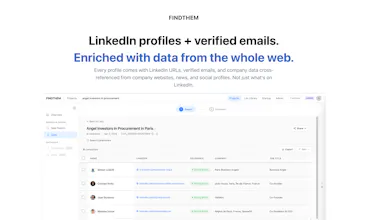
FindThem is an AI-powered search engine across 1B+ LinkedIn profiles enriched with Web Data. Find angel investors, sales prospects, hiring managers, and decision-makers with verified emails. Try free, credits per profile found & enrichment [No subscription].
No reviews yetBe the first to leave a review for FindThem
Maker
📌
Hey Product Hunt! 👋
I'm Kuda, the maker of FindThem.
The problem: Every founder raising capital, every sales rep building a pipeline, and every recruiter sourcing candidates does the same thing, they spend hours scrolling through LinkedIn, guessing at search filters, and copy-pasting profiles into spreadsheets. LinkedIn Sales Navigator costs $100+/mo and still makes you do the manual work.
To solve it I built: FindThem lets you describe who you're looking for in plain English like "angel investors in healthtech, based in EU, invested pre-seed in last 12 months" and our AI searches across 1B+ LinkedIn profiles, cross-referenced with data from the entire web. You get back verified emails, LinkedIn URLs, enriched company data, and a relevance score explaining why each person matches.
How it works:
Search → describe your ideal person in natural language
Enrich → every result comes with verified contact data
Export → CSV, plug into your CRM
What makes us different:
No LinkedIn Premium or Sales Navigator needed
Pay per profile found — no subscriptions, no per-seat pricing
AI relevance scoring explains why each match fits your criteria
We're a small team and built this because we were tired of spending 10+ hours building a single prospect list manually. Now it takes minutes.
Coming soon: AI-drafted personalized outreach for every person on your list.
Would love to hear - what's your biggest frustration when trying to find the right people to reach out to? 💬
Try it free at findthem.pro -> no credit card needed.
Report
@kuda Congratulations on this. I'm going to try it out. But I must say the pay-per-profile model is smart, it removes the commitment barrier that makes founders hesitate to try new tools. The real question is what happens after the export. A CSV of verified leads is only as useful as the system receiving it. Most founders plug it into whatever CRM they already have, which often isn't set up to handle enriched data properly. I'm talking about wrong pipeline stages, no follow-up sequences, contact records that just sit there. The prospecting problem gets solved and the conversion problem quietly gets worse.
Report
Quite useful! But if lead discovery becomes trivial with tools like this, do you think the real bottleneck shifts to outreach quality?
Report
Maker
@lak7 outreach quality was always the most important - this tool gives you more options
Report
This is going to be really helpful for HR's at our company, just a quick question how do we make a bulk search and bulk export?
Report
Maker
@nayan_surya98 hi you just search for how many profiles you need up to 1000 and then export as csv
does natural language search actually handle descriptions like 'fintech operator who's exited once and is now investing in b2b saas' differently from keyword search, or is the 'describe your ideal lead' interface just a more polished way to run the same structured filters?
from what i can read, the differentiation is in the enrichment layer. 1b+ profiles with web data layered on top of linkedin means the matching isn't limited to what's in someone's headline or job titles. if the enrichment actually captures context that structured fields miss, like conference speaking history, writing, or other signals, then natural language queries start to mean something qualitatively different. for use cases where the right person is hard to find by title alone, that's where this earns its pitch.
Report
Maker
@gabrielpineda The natural language search here is not polished filters , it is semantic search + verifiable requirements that get evaluated against 1B+ profiles enriched with web data, so "fintech operator who's exited once" can match someone whose LinkedIn says "GP at [fund]" but whose writing and talks reveal the operating background.
But yeah the enrichment layer is what makes natural language queries mean something qualitatively different.
Congrats on the launch, Kuda! As someone building in the data intelligence space, I know firsthand how fast profile data decays. Quick question on your infrastructure: are you maintaining your own proprietary dataset for these 1B+ profiles, or relying on third-party vendors? Curious how you handle data velocity—what's the typical refresh rate to ensure the job and contact data isn't stale?
Report
"1B+ LinkedIn profiles enriched with web data" — what does the enrichment layer actually add beyond what's on the profile itself? Like if I'm searching for angel investors who've backed B2B SaaS in the last 18 months, is that investment history coming from LinkedIn or are you pulling from Crunchbase/news sources too? The quality of that web enrichment determines whether this is a prospecting tool or just a fancy LinkedIn filter.
@kuda Congratulations on this. I'm going to try it out. But I must say the pay-per-profile model is smart, it removes the commitment barrier that makes founders hesitate to try new tools. The real question is what happens after the export. A CSV of verified leads is only as useful as the system receiving it. Most founders plug it into whatever CRM they already have, which often isn't set up to handle enriched data properly. I'm talking about wrong pipeline stages, no follow-up sequences, contact records that just sit there. The prospecting problem gets solved and the conversion problem quietly gets worse.
Quite useful! But if lead discovery becomes trivial with tools like this, do you think the real bottleneck shifts to outreach quality?
@lak7 outreach quality was always the most important - this tool gives you more options
This is going to be really helpful for HR's at our company, just a quick question how do we make a bulk search and bulk export?
@nayan_surya98 hi you just search for how many profiles you need up to 1000 and then export as csv
Features.Vote
does natural language search actually handle descriptions like 'fintech operator who's exited once and is now investing in b2b saas' differently from keyword search, or is the 'describe your ideal lead' interface just a more polished way to run the same structured filters?
from what i can read, the differentiation is in the enrichment layer. 1b+ profiles with web data layered on top of linkedin means the matching isn't limited to what's in someone's headline or job titles. if the enrichment actually captures context that structured fields miss, like conference speaking history, writing, or other signals, then natural language queries start to mean something qualitatively different. for use cases where the right person is hard to find by title alone, that's where this earns its pitch.
@gabrielpineda The natural language search here is not polished filters , it is semantic search + verifiable requirements that get evaluated against 1B+ profiles enriched with web data, so "fintech operator who's exited once" can match someone whose LinkedIn says "GP at [fund]" but whose writing and talks reveal the operating background.
But yeah the enrichment layer is what makes natural language queries mean something qualitatively different.
Lensmor
Congrats on the launch, Kuda! As someone building in the data intelligence space, I know firsthand how fast profile data decays. Quick question on your infrastructure: are you maintaining your own proprietary dataset for these 1B+ profiles, or relying on third-party vendors? Curious how you handle data velocity—what's the typical refresh rate to ensure the job and contact data isn't stale?
"1B+ LinkedIn profiles enriched with web data" — what does the enrichment layer actually add beyond what's on the profile itself? Like if I'm searching for angel investors who've backed B2B SaaS in the last 18 months, is that investment history coming from LinkedIn or are you pulling from Crunchbase/news sources too? The quality of that web enrichment determines whether this is a prospecting tool or just a fancy LinkedIn filter.