Hey folks
If you're wiring up an API integration Stripe, Descope, Twilio, Resend, anything drop it below with what you're building.
I'll reply with the specific ways it breaks after the happy path works: the webhook that fires twice, the event that lands late, the token that's never actually verified, the state that goes stale. The stuff that passes every test and still pages you at 2am.
That's what we've spent years (and a lot of production incidents) learning and what FetchSandbox encodes so your coding agent catches it before prod.
the failure-library angle is interesting but the thing I'd want proven before trusting it: who keeps the simulated failure behavior itself honest against the real API over time? stripe changes retry semantics or adds a new webhook edge case, and if fetchsandbox's simulation of that api lags the real one, you get a false sense of security - green in the sandbox, still breaks in prod, just a different flavor of the same problem you're trying to solve. is that drift something you actively monitor per-API, or does it rely on someone reporting a mismatch?
FetchSandbox
@galdayan this is the sharpest question in the thread, and honestly the one that keeps me up....you're right that a sandbox drifting from the real api is just the same problem moved somewhere else, green here and still breaks in prod. any tool in this space has to answer it or its not worth trusting.
where i can be straight: two things ground it today. one, the failure library isnt guessed from docs, its built from real integration failures, so the patterns actually happened, not ones i imagined. two, nothing counts as verified unless it actually reproduces in a run, so its behavior-grounded not just written down.
what i wont pretend: a fully automated per-api drift monitor that continuously diffs our simulation against the live api isnt there yet. today when stripe changes retry semantics its closer to catch-and-correct than an automated watchdog. thats the honest gap.
and thats exactly the thing that has to exist for this to be trustable at scale. per-api drift detection is on the roadmap and high on it. you're pointing at the real moat and the real risk at the same time.
@rnagulapalle that's a fair line to draw honestly - catch-and-correct today, automated drift detection on the roadmap. most tools in this space wouldn't admit the gap exists at all. good luck with it, will be watching how the drift detection work lands.
FetchSandbox
@galdayan thanks man... the honesty its not a strategy, i just cant sell you trust on something i know is still a gap, that kind of defeats the whole point of the product.
FetchSandbox
@galdayan ll come back to this thread when the drift detection actually lands so you can hold me to it. and if you ever have thoughts on how youd want it to work, im all ears, you clearly think about this deeper than most...
The "verify what happens after the 200 OK" framing is the actual gap for me — most of my integration bugs live in retries and webhook ordering, not the happy path. Two things I'd want to pin down before wiring it into a Claude Code loop: when I connect over MCP, does the failure library and my recorded scenarios live locally per-project or in your cloud, and can I pin a specific failure (say a Stripe webhook-out-of-order case) so a CI run replays it deterministically instead of re-deriving it each run? Determinism is what decides whether I'd gate a merge on it.
FetchSandbox
@hi_i_am_mimo good questions, and using determinism as your merge gate is the right call, so i'll be precise.
where the library lives: it's server-side, not per-project. when you connect over mcp you're talking to our backend. you're not recording your own scenario library locally, you're pulling from the curated one we ship per API. runs are keyed to a sandbox id you control, but the failure definitions themselves live on our end.
determinism: named workflow + named scenario is repeatable, same inputs replay the same way, and you get a receipt url as the artifact to attach. duplicate/retry (same event id redelivered) is fully deterministic today, you can gate CI on that one right now.
honest caveat on your exact example: out-of-order isn't a first-class pinned fixture yet. ordering currently falls out of variable timing rather than a strict "deliver B before A" replay. duplicates, retries, stale state, deterministic. precise out-of-order as a pinned sequence, not yet, that's the next one i'm adding.
so if your gate is retries and duplicate delivery, it's ready. if the specific gate is deterministic out-of-order replay, i'm not going to tell you it's there when it isn't.
Server-side is fine as long as a pinned failure stays deterministic - that's the whole merge-gate question for me. When I pin something like a Stripe webhook-out-of-order case, is that scenario version-locked on your side so a CI replay months later reproduces byte-identical behavior, or can a library update silently shift a pinned case out from under a green build? Frozen-per-pin is what would let me actually block a merge on it.
FetchSandbox
@hi_i_am_mimo no... its not frozen-per-pin today.
right now scenarios are curated on our side, so if we push an update it can change how a pinned case behaves. that means a replay months later isnt guaranteed identical, and youre right, without that you cant really gate a merge on it.
what you want is lockfile behavior. pin scenario@version, it stays frozen, anything we change ships as a new version you opt into, nothing moves unless you bump it. thats the model that makes it gateable and its what i need to build. not there yet.
so for now id gate on duplicate and retry for current correctness, but i wouldnt lean on a months-later identical replay til the versioned pin exists. rather tell you that than sell you a gate that can move under you.
if youre up for it id want your take on what that pin/version contract should look like, youre basically describing the spec i need to hit.
When you lock a pinned scenario to a certain version, how does that affect the upstream API itself changing its own structure? What will happen if Stripe, for instance, changes their webhook payload format? Will the pinned fixture remain fixed on the old format forever (thus allowing you to test your retry/de-duplicate logic separately), or will it simply be automatically migrated to the new format the next time someone runs it?
Frozen-forever is exactly the behavior I'd want for a pinned regression case - the point is my retry/dedup logic keeps getting tested against the exact byte layout that once broke it, even after Stripe moves on. What I'd want alongside it is a signal rather than a silent migration: flag the pin as upstream-drifted so I can consciously add a second scenario for the new format instead of quietly losing coverage on the old one. Does FetchSandbox surface that drift, or does a pinned fixture just sit there with no indication the live API has diverged?
FetchSandbox
@saksham_salvi youve basically found the real tension, and the honest answer is those are two different problems that should never be solved by the same mechanism.
a pinned scenario should stay frozen on the format it was pinned at, it should not auto-migrate. the whole point of the pin is to test your retry and dedupe logic against a stable input, so your first option is the correct behavior. silent auto-migration is exactly the thing that shifts a case out from under a green build, which is the failure we dont want....
but the fact that stripe changed its payload is real and you still need to know. thats a separate job. drift detection surfaces it, tells you the live format no longer matches your pinned fixture and offers a new version, and you opt into that explicitly like bumping a dependency, with a diff you actually review. frozen for determinism, plus deliberate opt-in migration when reality moves. two mechanisms, never conflated, never silent.
now the honest part, neither of those fully ships today. versioned pins and drift detection are both things im building, and your question is basically the spec for how they have to interlock. right now if we updated a fixture it would change under you, which is exactly why the versioned pin has to come first, so a format change becomes a new version you choose, not a silent swap. youre asking the right question before it exists, which is more than fair.
FetchSandbox
Hi everyone! I'm Raj, maker of FetchSandbox.
I spent years at PayPal and other SaaS companies wiring up API integrations. Building them was never the hard part — knowing what breaks, when, and how to catch it before production was. In the agentic world that's only sharper: your AI writes the integration in minutes, but nobody checks how it behaves when a webhook fires twice or an event lands late.
FetchSandbox gives your coding agent runnable sandboxes for 60+ real APIs (Stripe, Descope, Twilio, Resend, and more) — right in your IDE. It runs the real integration — requests, state changes, webhook deliveries — so you catch the lifecycle bugs mocks never show.
A few things we're proud of:
Real API behavior, not 200-OK mocks — webhook retries, duplicate events, stale state, rate limits
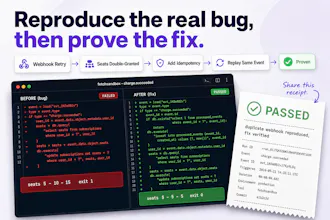
Reproduce → prove — it reproduces the actual failure, applies a fix, and reruns until it passes
Persistent memory for API integrations — it learns failure patterns, so every run gets safer
MCP-native — works in Cursor, Claude Code, and Codex; no keys, no accounts
I'd love to hear in the comments:
How do you test an API integration today — before it hits production?
Would a sandbox that reproduces the actual failure (duplicate webhook, late event), not just a 200 mock, be useful to you?
What's the worst post-integration bug that ever slipped to prod on you?
FetchSandbox
BTW — you can try it headless in Claude Code, Cursor, or Codex via MCP. One-line install, no keys or accounts, and the API is fully documented.
Here's a starter prompt to try:
./fetchsandbox "test my Stripe checkout — customers are getting charged twice. reproduce it and prove the fix."
PicWish
@rnagulapalle congrats! btw is the failure library stored completely locally inside the mcp server or hitting your cloud database ?
FetchSandbox
@mohsinproduct thanks Mohsin! it's server-side .. a smart router / classifier on our end handles it, so the failure library stays shared and always current for everyone 🙌
Congrats on the launch, Raj. The "passes every test and still pages you at 2am" framing hits home — I shipped a Stripe integration this week where everything was green in test mode, then the first real card hit a setup-mode checkout and it 400'd on a missing currency param test mode never complained about. Exactly the class of thing a simulated lifecycle would have caught before prod.
Curious about the failure library: is it seeded from documented API behavior, or does it learn from failures observed across real integrations? The compounding-memory angle is the most interesting part of this to me.
Free tier plus MCP made it an easy try — pulling it into my agent setup this week.
FetchSandbox
@ryan_davis23 thanks ryan, and yeah that setup-mode currency 400 is exactly it. test mode passes clean, the mode/param interaction only bites on a real card, and you don't find out until prod. that class of thing is what the stripe library carries.
on seeded vs learned: today it's curated from real integration failures and documented behavior, but nothing enters until it's reproduced. a buggy handler and a fixed one have to actually diverge in a sandbox run, not just "the docs say this can happen." so it's behavior-grounded and proof-gated, not just a wiki.
the auto-learning piece, failures from live integrations flowing back in on their own, that's early. that's the compounding thing you're pointing at and it's where this goes. curation is still more hands-on than i'd like right now, being straight about it.
glad you're wiring it in this week. if anything's rough, reply or DM, i want the sharp edges. fast first win: point it at a stripe flow and have it prove the webhook-retry/idempotency path before you merge.
@rnagulapalle Proof-gated is the right call — "the docs say this can happen" libraries rot into wikis fast; a failure that has to actually diverge in a run before it counts is the only version I'd trust. Honestly, hands-on curation at this stage sounds like a feature, not a confession.
Taking you up on the first win: I've got a webhook handler that grants usage credits on invoice.paid, and "does a duplicate delivery double-grant" is exactly the path I've been meaning to prove rather than assume. If the Stripe library can show my handler diverging on the duplicate-webhook run, that's the precise 2am I want deleted. Will report back, sharp edges included.
FetchSandbox
@ryan_davis23 appreciate that, and honestly the feature not a confession line made my morning. thats the exact bar i want too, if it didnt actually break in a run i dont trust it either.
the double-grant on invoice.paid is a perfect one to start with. thats the kind of bug that looks totally fine until the retry hits and someone quietly gets credited twice. if it shows your handler splitting on the duplicate run then yeah, thats a 2am you dont have to live again.
please report back, the rough edges especially. and if anything feels off while youre in there just ping me, i'd rather hear it than not.
@rnagulapalle ok this earned its keep on day one. pointed it at my invoice.paid handler and the duplicate-webhook pattern called my exact sin — dedup was a check-then-add inside a transaction, not an atomic primitive. sequential retries were fine, and I hammered it with ~160 parallel duplicate deliveries locally and never actually caught the race (window's sub-ms against a local db) — but the checklist was still right, the primitive was wrong. prod latency is a different animal. shipped the fix you'd predict: unique constraint on the dedup key, insert first, catch the dupe error as a no-op.
One sharp edge since you asked: the pattern matching was great but I ended up hand-rolling the duplicate-delivery firing against my own local handler. a first-class "aim scenario X at MY webhook url" would've saved me the whole rig. that's the feature I'd pay for.
Good tool man.
This is much closer to how API testing should actually work. a 200 OK can give a lot of false confidence when the real bugs are duplicate webhooks, delayed events, retries, stale state, and partial failures that only appear after the initial request.
The reproduce, fix, rerun loop feels especially useful for coding agents, because writing the integration is becoming the easy part while proving it survives real behavior is still hard. Curious how the persistent memory works across projects. does FetchSandbox learn failure patterns globally for an API like Stripe, or keep everything scoped to the specific codebase and workflow?
FetchSandbox
@andrasczeizel thanks man.. 100% agree..and on global vs scoped, it's both. the global layer is per-API: when you test stripe you inherit the known ways stripe breaks, webhook dedup on the wrong header, a PaymentIntent stuck at requires_capture, duplicate delivery on retry. you don't rediscover those. that library compounds the more integrations run against it.
the scoped layer is your code: the reproduce, fix, rerun happens against your handler and your routes. global tells the agent what to look for, the sandbox proves whether your specific code survives it.
honest state: the global per-API library is real and shipped. the cross-project learning piece, where a failure one team surfaces flows back into the shared graph automatically, that's the direction we're heading, not a solved thing yet
The "verify what happens next" framing is exactly the gap — 200 OK tells you nothing about the retry/webhook/state mess that actually breaks in prod.
Two things I'd want to know as someone wiring these into agents:
When an agent drives this over MCP, does it get to discover the failure library as callable scenarios — enumerate and pick which failure to inject — or is scenario selection still human-curated and the agent just runs what you set up?
And "remembers what breaks" — is that memory per-project, and does it auto-replay the known-break scenarios as a regression gate on the next change, so a fix that regresses gets caught without me re-describing the bug? @rnagulapalle
FetchSandbox
@akbar_b good questions, both hit the same edge.
first one, it's more guided than a raw menu today. the agent doesn't freely enumerate the whole failure library and pick, but it's not just running whatever i configured either. you describe the symptom or bug you're worried about, the router matches that to the right workflow plus scenario, and you can also pass a scenario by name directly. what's not there yet is a clean "list all injectable failures for this API" call the agent can just browse. reasonable thing to expose, on the list.
second, the library is per-API not per-project right now. you inherit the known breaks for stripe/clerk/etc the first time you touch them. the per-project piece, what broke in your specific app, is early.
and the auto-replay-as-regression-gate, honestly not automatic yet. today a known break is a re-runnable workflow plus scenario you can drop into CI, so a regressing fix does get caught, but you're wiring that gate yourself. it's not auto-replaying on every change on its own. that loop, catch the regress without you re-describing the bug each time, is exactly where this goes. being straight: not there today.
The "remembers what breaks" line is the whole reason I clicked. The APIs I integrate never fail cleanly. They pass in dev, pass in review, then throw a 500 once a week in production for reasons I can never reproduce on demand. Does FetchSandbox help with that kind of intermittent break, or is it aimed more at catching hard contract changes when a provider ships a new version? And does it cover webhook and callback flows, or just the requests I make outbound? Those inbound calls are where I get burned most and they're the hardest to test.
FetchSandbox
@chielephant this is basically what i built it for so i'll answer straight.
the intermittent break is the core use case. those are impossible to reproduce because they're timing and state dependent, a retry hitting stale state, a duplicate event, a slow response tripping a race. in the sandbox you turn those conditions on deterministically, so the once-a-week 500 becomes something you can trigger and watch fail on demand instead of waiting for prod to show you. that's the "remembers what breaks" part, it's a curated set of failure modes per API.
webhooks and callbacks, yes, fully covered, that's honestly where most of the value is. duplicate deliveries, retries, out of order, dropped events, you replay them and see if your handler double-processes or corrupts state.
the provider-version-drift one is the honest gap. we catch a shape mismatch within a run if our model of the API is current, but auto-detecting that the live provider moved on its own is still on the roadmap.