
Second Brain for AI
Persistent memory for Claude, ChatGPT & Cursor. Free.
571 followers
Persistent memory for Claude, ChatGPT & Cursor. Free.
571 followers
Every AI conversation starts from zero. Your projects, decisions, and preferences disappear as soon as you close the chat. Second Brain fixes that. It is a self-hosted memory layer that works with Claude, ChatGPT, Cursor, and any MCP client. You can store context once and recall it by meaning instead of keywords. It includes duplicate detection, semantic search, and a web UI. Built on Cloudflare, it offers a free tier and your data remains yours. MIT licensed.
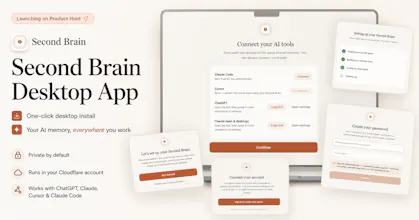
This is the 2nd launch from Second Brain for AI. View more
Second Brain for AI v2
Launching today
Second Brain remembers your projects, people, decisions, and preferences across Claude, ChatGPT, Cursor, Codex, and any MCP client. V2 automatically links related memories, follows those connections during recall, and distinguishes settled decisions from drafts and stale context. Open source and self-hosted in your Cloudflare account.


Free
Launch Team / Built With


Second Brain for AI
the "newer information is not always more correct" insight is the entire challenge of persistent AI memory in one sentence. most memory systems assume monotonic updates and break the first time claude and cursor disagree.
real q: when claude asserts one project decision and cursor asserts a different one hours later, does second brain surface both with source + timestamp, or resolve automatically? asking because the resolution logic IS the product — everything else is storage.
Second Brain for AI
@thenameisarian Both surface, but not equally. Canonical memories are protected, so the contradictory Cursor write comes in as a draft for review rather than a silent overwrite. You confirm it supersedes the original or deprecate it. Deprecated memories drop from recall but stay in the audit trail. No tool wins by being last.
This is a strong direction. The interesting part isn’t just “memory,” it’s whether the system can tell what is still true vs what was only temporary context.
I like the idea of separating settled decisions from drafts and stale context. That feels essential if AI memory is going to be useful across tools instead of slowly becoming a pile of old assumptions.
Curious how you handle corrections when the memory graph connects something wrong.
Second Brain for AI
@vahid_davoudi Corrections work on two layers. When the graph forms a bad link, you can remove it directly from the Related list (one tap in the web UI) or via the unlink MCP tool. Weak links also get pruned automatically as evidence thins. For the truth vs temporary context question, canonical entries mark what's settled and are protected from silent overwrites. Drafts hold contested context until confirmed.
Second Brain for AI
Hi Product Hunt,
Six weeks ago Second Brain launched here and finished #3 Product of the Day. The comments shaped everything in v2.
The biggest ask was smarter recall. v1 found memories by similarity. v2 builds a real knowledge graph. Every time you store a memory, the system extracts the people, projects, and decisions mentioned and links them to related entries automatically. Recall follows those links with distance decay, so direct matches surface first and connected context fills in behind them. You ask about a January decision and get the context behind it, the person involved, and the newer decision that changed it. Nothing tagged by hand.
Notion sync is the other big one. Your context is already written down somewhere. v2 connects directly to your Notion workspace and pulls it into the graph, so you are not starting from scratch. It picks up only what changed on each sync and you can exclude pages you do not want in recall.
Beyond those two: conflict detection marks older memories as superseded when you update a decision, so stale context does not surface as fact. The whole thing runs on your own Cloudflare account. We never touch your data. Open source, free tier, ten-minute setup.
I built this because I kept losing context between tools. Second Brain is one memory layer across all of them, and it stays yours.
What context do you find yourself re-entering most across sessions?
Finally something that solves the most frustrating part of using AI. Plugged it into Claude and Cursor and the recall by meaning actually works, way better than digging through old chats. Love that it's self-hosted too.
Second Brain for AI
@phardinghy4670 The recall-by-meaning piece was the hardest to get right. Glad it's landing as actually useful rather than just technically interesting.