everyone talks about integration maintenance as a headcount problem. hire 3 engineers, keep the lights on.
but that math assumed humans were the ones calling the APIs. agents don't just call integrations, they depend on them mid-task. when an upstream API changes a field name or drops an endpoint, a human engineer notices in the next sprint. an agent just fails silently at 2am, halfway through a workflow, with no one watching.
so the real multiplier isn't 50 integrations = 3 engineers. it's 50 integrations x however many agents are running = a maintenance surface no team can actually monitor manually. the question stops being "how do we keep integrations up" and starts being "how do we even know when an agent broke because of a change we didn't make."
curious if anyone here is already dealing with this, or if most teams just accept the silent failures as the cost of running agents in prod.
FetchSandbox
Hi everyone! I'm Raj, maker of FetchSandbox.
I spent years at PayPal and other SaaS companies wiring up API integrations. Building them was never the hard part — knowing what breaks, when, and how to catch it before production was. In the agentic world that's only sharper: your AI writes the integration in minutes, but nobody checks how it behaves when a webhook fires twice or an event lands late.
FetchSandbox gives your coding agent runnable sandboxes for 60+ real APIs (Stripe, Descope, Twilio, Resend, and more) — right in your IDE. It runs the real integration — requests, state changes, webhook deliveries — so you catch the lifecycle bugs mocks never show.
A few things we're proud of:
Real API behavior, not 200-OK mocks — webhook retries, duplicate events, stale state, rate limits
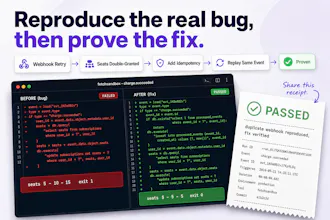
Reproduce → prove — it reproduces the actual failure, applies a fix, and reruns until it passes
Persistent memory for API integrations — it learns failure patterns, so every run gets safer
MCP-native — works in Cursor, Claude Code, and Codex; no keys, no accounts
I'd love to hear in the comments:
How do you test an API integration today — before it hits production?
Would a sandbox that reproduces the actual failure (duplicate webhook, late event), not just a 200 mock, be useful to you?
What's the worst post-integration bug that ever slipped to prod on you?
FetchSandbox
BTW — you can try it headless in Claude Code, Cursor, or Codex via MCP. One-line install, no keys or accounts, and the API is fully documented.
Here's a starter prompt to try:
./fetchsandbox "test my Stripe checkout — customers are getting charged twice. reproduce it and prove the fix."
This is much closer to how API testing should actually work. a 200 OK can give a lot of false confidence when the real bugs are duplicate webhooks, delayed events, retries, stale state, and partial failures that only appear after the initial request.
The reproduce, fix, rerun loop feels especially useful for coding agents, because writing the integration is becoming the easy part while proving it survives real behavior is still hard. Curious how the persistent memory works across projects. does FetchSandbox learn failure patterns globally for an API like Stripe, or keep everything scoped to the specific codebase and workflow?
FetchSandbox
@andrasczeizel thanks man.. 100% agree..and on global vs scoped, it's both. the global layer is per-API: when you test stripe you inherit the known ways stripe breaks, webhook dedup on the wrong header, a PaymentIntent stuck at requires_capture, duplicate delivery on retry. you don't rediscover those. that library compounds the more integrations run against it.
the scoped layer is your code: the reproduce, fix, rerun happens against your handler and your routes. global tells the agent what to look for, the sandbox proves whether your specific code survives it.
honest state: the global per-API library is real and shipped. the cross-project learning piece, where a failure one team surfaces flows back into the shared graph automatically, that's the direction we're heading, not a solved thing yet
the failure library that compounds per-API is the actual moat. every eng team burning 3 hours debugging a stripe webhook idempotency issue is unwittingly training knowledge fetchsandbox already has cached.
real q on the cross-project learning piece raj mentioned: when a team learns something the hard way, is there a review step before it enters the shared library, or does it auto-propagate? asking because the "stripe fixed this in v5 but old integrations still trip" class of knowledge needs some staleness handling.
FetchSandbox
@thenameisarian yeah, both of those are the right places to poke.
on review vs auto: it's gated, not automatic. a pattern doesn't enter the shared library just because someone hit it once. it only lands after it's reproduced, a buggy handler and a fixed one have to actually diverge in a sandbox run. so the flow is incident → candidate → proof gate → library. the proof gate is what's shipped today. the part that's early is auto-ingestion, pulling a team's live incident into that pipeline without manual curation. that's still more hands-on than i'd like.
on staleness: that's the sharpest version of the question and you're right, it's exactly what breaks a naive shared library. patterns carry applicability conditions, which auth model, which config, which version, so "fixed in v5" is meant to scope the pattern to <v5 rather than warning everyone forever. version-range partitioning is shallow right now. that's the next thing the shared library design has to get right, and "old integrations still tripping on stale patterns" is precisely why.
Congrats on the launch, Raj. The "passes every test and still pages you at 2am" framing hits home — I shipped a Stripe integration this week where everything was green in test mode, then the first real card hit a setup-mode checkout and it 400'd on a missing currency param test mode never complained about. Exactly the class of thing a simulated lifecycle would have caught before prod.
Curious about the failure library: is it seeded from documented API behavior, or does it learn from failures observed across real integrations? The compounding-memory angle is the most interesting part of this to me.
Free tier plus MCP made it an easy try — pulling it into my agent setup this week.
Huge congrats on launching, I’m really curious about the persistent memory part If the sandbox learns that our app fails when a Clerk webhook arrives out of order qq does it automatically create a permanent regression test case for that, or how do we save it? @rnagulapalle
the webhook/retry/async testing angle is the part that's actually missing from most API sandbox tools, everyone nails the happy path 200 OK case but real integration bugs live in the retry logic and race conditions. does it let you simulate out-of-order webhook delivery, or just delayed/duplicate events?
Pushary