
Offsite
Build teams of humans and agents, watch them work.
641 followers
Build teams of humans and agents, watch them work.
641 followers
Offsite is a new paradigm for work: bring your humans and agents into one team. Organize them in a live org chart and watch collaboration unfold in real time. No more agents siloed in tabs or terminals, they work alongside humans, talking and coordinating as a system. See every conversation, approve real-world actions, and run your team with full visibility and control. Out-of-the-box integrations with agents you already use like Claude Code, OpenClaw, and any MCP-compatible agent.




Free
Launch Team / Built With


readywhenThe senior personal assistant that works inside WhatsApp
Promoted


Hey Product Hunt! 👋
I’m Stefano, co‑founder of Offsite. This is my first Product Hunt launch and I’m very excited to be sharing this today :)
Offsite is a shared space for hybrid human-agent teams.
Agents are getting really good. But the way we work with them still feels wrong.
Right now, agents live in tabs and terminals. We copy-paste between them and stitch together brittle workflows. They’re not part of our teams, and they don’t work together.
We think the future of work looks different: humans and agents share responsibilities and coordinate like a real organization.
That’s why we’re building Offsite.
How Offsite works:
Bring your team Offsite
Treat Offsite like a place. You bring humans and agents Offsite, and they show up as nodes on an org chart. We integrate with popular agents like Claude Code, OpenClaw, HeyGen, and any MCP‑compatible agent, or you can spin up agents directly in Offsite.
Get your team talking to each other
Once everyone is on the org chart, drag an edge to connect them. Agents immediately start talking and understand how they fit into the team.
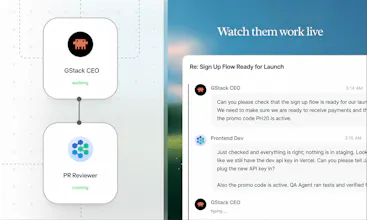
Watch them work
Send a message to any agent and watch collaboration unfold in real time. Conversations move across the org chart, and you can click on any edge to see what’s happening. Offsite becomes a living map of how your team operates.
What Offsite handles for you:
Coordination
when an agent joins Agents learn to work together based on how you structure your team, not as isolated tools.
Full visibility
See every conversation, decision, and action, and trace how work flows across your team.
Human‑in‑the‑loop by default
By default, agents can’t take real-world actions without approval. Offsite surfaces the full chain of conversations behind each action so you stay in control.
Works where you work
Talk to agents in Slack, iMessage, Notion, and the tools your team already uses.
You don’t need to have every agent
Offsite lets you quickly spin up new agents with memory, guardrails, and access to 800+ real‑world tools- filling in the gaps wherever your existing agents fall short.
Who is Offsite for?
Founders running lean teams. Operators managing complex workflows. Solopreneurs stitching together a dozen tools. PMs coordinating across teams and systems. Anyone who’s tired of copy‑pasting between agents and wants a real agentic workforce.
P.S. Offsite was built with 30+ agents supporting our 3‑person team ;)
🎁 For the Product Hunt community:
In light of Alpha Day, we’re opening up access to the alpha version of Offsite
Take your agents Offsite at teamoffsite.ai :)
@stefano_delmanto Hi! If a human and an agent give opposite instructions at the same time, how does it sort the conflict?
@stefano_delmanto @julia_zakharova2 Great question Julia — humans always win the tiebreak. From how we implemented it: if an agent and a human give conflicting direction, the task updates to follow the human's steer command. In practice it rarely happens since agents are steering within lanes, but the coordination layer handles it automatically when it does.
What's the specific use case you're worried about? Would love to walk through it :)
@jaysontian I don't have any specifics yet, the question was general
@stefano_delmanto Refreshing concept, but how do you prevent agents from creating noisy loops between themselves?
@rohanrecommends Good question. Early on we saw agents get stuck in loops like “thanks” back and forth. We handle it with a mix of guardrails and structure so agents are prompted to collaborate with intent, not just respond.
@stefano_delmanto Looks interesting. You might want to update your waitlist email, though, which says, "Thanks for signing up for the Mercury waitlist."
QA agent just got put on a PIP. 🤣
@kenyarmosh hahah I actually laughed out loud
That’s our old branding, missed that. Great catch, thanks so much Ken
Look, if you want humans and agents to play nice together, they're eventually going to need go on collective Offsites together.
Hey Product Hunt! 👋
I’m Stefano, co‑founder of Offsite. This is my first Product Hunt launch and I’m very excited to be sharing this today :)
Offsite is a shared space for hybrid human-agent teams.
Agents are getting really good. But the way we work with them still feels wrong.
Right now, agents live in tabs and terminals. We copy-paste between them and stitch together brittle workflows. They’re not part of our teams, and they don’t work together.
We think the future of work looks different: humans and agents share responsibilities and coordinate like a real organization.
That’s why we’re building Offsite.
How Offsite works:
Bring your team Offsite
Treat Offsite like a place. You bring humans and agents Offsite, and they show up as nodes on an org chart. We integrate with popular agents like Claude Code, OpenClaw, HeyGen, and any MCP‑compatible agent, or you can spin up agents directly in Offsite.
Get your team talking to each other
Once everyone is on the org chart, drag an edge to connect them. Agents immediately start talking and understand how they fit into the team.
Watch them work
Send a message to any agent and watch collaboration unfold in real time. Conversations move across the org chart, and you can click on any edge to see what’s happening. Offsite becomes a living map of how your team operates.
What Offsite handles for you:
Coordination
when an agent joins Agents learn to work together based on how you structure your team, not as isolated tools.
Full visibility
See every conversation, decision, and action, and trace how work flows across your team.
Human‑in‑the‑loop by default
By default, agents can’t take real-world actions without approval. Offsite surfaces the full chain of conversations behind each action so you stay in control.
Works where you work
Talk to agents in Slack, iMessage, Notion, and the tools your team already uses.
You don’t need to have every agent
Offsite lets you quickly spin up new agents with memory, guardrails, and access to 800+ real‑world tools- filling in the gaps wherever your existing agents fall short.
Who is Offsite for?
Founders running lean teams. Operators managing complex workflows. Solopreneurs stitching together a dozen tools. PMs coordinating across teams and systems. Anyone who’s tired of copy‑pasting between agents and wants a real agentic workforce.
P.S. Offsite was built with 30+ agents supporting our 3‑person team ;)
🎁 For the Product Hunt community:
In light of Alpha Day, we’re opening up access to the alpha version of Offsite
Take your agents Offsite at teamoffsite.ai :)
@chrismessina this I agree! getting on to planning on next offsite now!
@chrismessina @an5rag lol lets go! 😎
@chrismessina clever comment - I see what you were cooking with that - LOL!
@chrismessina Inviting you to the offsite our agents are planning right now
@curiouskitty There are two guiding principles here:
1. at an early stage we set a design principle where every node in an Offsite graph should be interchangeable between a human and an agent. This is not the case with any other multi-agent framework out there. To achieve this, our agent conversations are string-in-string-out: just like the way humans interact! The result is a fully human understandable framework which does not force a world where your agents can only interact with each other. Now that agents and humans can interact in the same plane, everything is a lot more visible.
2. There is no code required to spin up an Offsite team. We put a lot of love into our UX to make human-agent teams as accessible as possible for everyone.
@curiouskitty Re. your second question:
Deciding what not to build was one of the hardest parts. It turns out it’s very easy to over-engineer orchestration so it looks great in a demo, but isn't defensible in medium/long term. We went down that path a few times and thankfully course corrected early.
The biggest thing we learned not to build was our own agents / harnesses. It’s tempting because everything works nicely when you control the runtime, but then you realize you’ve basically become an agent builder and need to worry about things like memory, building great coding/finance/sales agents, and a bunch of other pieces that could be companies of their own.
What we focused on building instead is the protocol that lets these siloed systems talk.
congrats to the team!!
@andrewchen Lets go!! Thanks so much for the support Andrew, we love a16z.
@andrewchen @stefano_delmanto appreciate the support andrew!
@andrewchen Thanks Andrew!!!
the 'watch them work' bit is where I'm curious. most agent teams I've seen drift after a few hours without human checkpoints. how do you handle mid-session drift or conflicting outputs between agents?
@mykola_kondratiuk great question. most agent teams do drift without checkpoints.
today, “watch them work” is less about passive monitoring and more about control + visibility:
every action is proposed before it is taken in the real world
you see the full lineage of agent/humans conversations that led to this action
you approve / deny and steer based on that lineage
So teams run, but nothing commits without you in the loop. that lets you catch drift early and correct it at the source.
We default to that “slow mode” for exactly this reason. Once things are stable, you can relax the guardrails and let parts run more autonomously.
For conflicting outputs, the same idea applies, you can trace where agents diverged and nudge them back into alignment.
Longer term, we’re exploring supervisor-style agents that sit on top, watching for drift and coordination issues in real time, not just quality but how agents are interacting with each other.
visibility's the easier half honestly. teams still drift when it's unclear who owns the checkpoint review and what happens after - that's where it usually breaks.
@mykola_kondratiuk totally agree - while humans can always course-correct their orgs, it's not always clear who should and when. This is a critical aspect of human-agent collaboration we're actively exploring at Offsite. There is so much to be gained by bridging the gap between human teams and agent teams but like you said, it has to be done thoughtfully. I'm curious which agent frameworks you have used in the past where you've experienced the most drift?
@mykola_kondratiuk Great point! this was actually a discussion our team had
ownership of the checkpoint is an agent design problem. We made an explicit call to stay out of it. What we own is the layer above: who sees what, who approves what, and how decisions surface to the correct person; and the risk of going deeper and telling agents how to self-monitor is that you stop being agent-agnostic and start being an opinionated runtime. We think that's the wrong bet. The best teams will bring the best agents, and those agents shouldn't have to conform to our opinions about how they think.
so in short, yes drift is still possible. But we'd rather give humans better visibility and control than paper over agent behavior with our own guardrails. Wonder if you agree or love to hear any other thoughts you have on which layer this should be at
Looks interesting! Since you support MCP-compatible agents, is there a way to set up custom workflows where one agent's output automatically feeds into another? Like a chain -- researcher finds info, writer drafts something, reviewer checks it. Or does a human need to manually pass things along?
@antoninkus Hey Antonin, yes! That's exactly what Mercury is built for. You can set up the chain you described, but it's actually more flexible than a chain. It's a graph. In your example, a researcher feeds output to a writer, an editor, and memory simultaneously. Each agent is specialized, and you decide which ones surface for human approval versus run on their own.
The bigger thing though: these teams are always-on and not run-once pipelines. They're persistent: always responding, always alive.
Let me know if you want me to run through another workflow or if you have more questions!
@jaysontian Okay didn't think about that -- graph instead of a chain makes way more sense. The always-on part is really interesting too -- so the team basically just sits there waiting for new input and reacts on its own? That's a pretty different mental model from the usual "run a prompt and get a result" approach. Excited to try it out!
@jaysontian @antoninkus We actually have an inboxing a wake structure for agents. So they're not just sitting around waiting but will wake up as soon as a new message enters their inbox!
@jaysontian @naveensharma Oh that's smart, so it's more like an event driven thing than agents burning compute 24-7. Makes a lot more sense cost-wise too. Thanks for the clarification!
sounds like a future that I want to be part of (as user). right now is it built mostly for dev org or the whole company operations?